
Pulp Fiction, 1865 · page 141 of 400
The Argosy — page 141: what you’re looking at
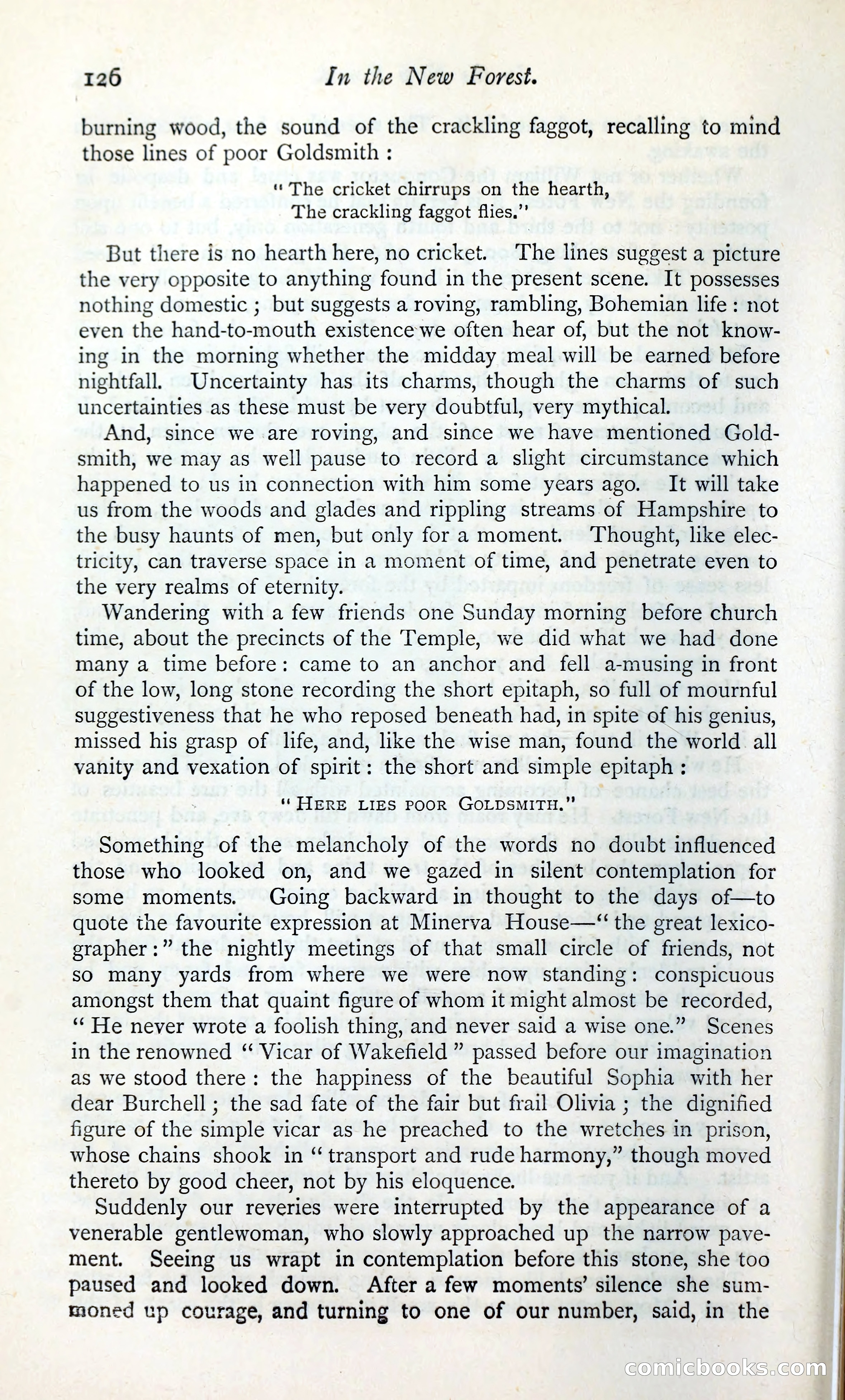
A restored page from Pulp Fiction, 1865. Page through the whole issue in the reader above.
📄 Transcribed text from this page (OCR, searchable)
Machine-transcribed from the original scan — historical spelling and the odd misread are preserved.
126 In the New Forest. burning wood, the sound of the crackling faggot, recalling to mind those lines of poor Goldsmith : ‘The cricket chirrups on the hearth, The crackling faggot flies.”’ But there is no hearth here, no cricket. The lines suggest a picture the very opposite to anything found in the present scene. It possesses nothing domestic ; but suggests a roving, rambling, Bohemian life: not even the hand-to-mouth existence we often hear of, but the not know- ing in the morning whether the midday meal will be earned before nightfall. Uncertainty has its charms, though the charms of such uncertainties as these must be very doubtful, very mythical. And, since we are roving, and since we have mentioned Gold- smith, we may as well pause to record a slight circumstance which happened to us in connection with him some years ago. It will take us from the woods and glades and rippling streams of Hampshire to the busy haunts of men, but only fora moment. Thought, like elec- tricity, can traverse space in a moment of time, and penetrate even to the very realms of eternity. Wandering with a few friends one Sunday morning before church time, about the precincts of the Temple, we did what we had done many a time before: came to an anchor and fell a-musing in front of the low, long stone recording the short epitaph, so full of mournful suggestiveness that he who reposed beneath had, in spite of his genius, missed his grasp of life, and, like the wise man, found the world all vanity and vexation of spirit: the short and simple epitaph : ‘‘ HERE LIES POOR GOLDSMITH.” Something of the melancholy of the words no doubt influenced those who looked on, and we gazed in silent contemplation for some moments. Going backward in thought to the days of—to quote the favourite expression at Minerva House—‘“ the great lexico- grapher:” the nightly meetings of that small circle of friends, not so many yards from where we were now standing: conspicuous amongst them that quaint figure of whom it might almost be recorded, ‘He never wrote a foolish thing, and never said a wise one.” Scenes in the renowned ‘ Vicar of Wakefield ” passed before our imagination as we stood there: the happiness of the beautiful Sophia with her dear Burchell; the sad fate of the fair but frail Olivia ; the dignified figure of the simple vicar as he preached to the wretches in prison, whose chains shook in “ transport and rude harmony,” though moved thereto by good cheer, not by his eloquence. Suddenly our reveries were interrupted by the appearance of a venerable gentlewoman, who slowly approached up the narrow pave- ment. Seeing us wrapt in contemplation before this stone, she too paused and looked down. After a few moments’ silence she sum- moned up courage, and turning to one of our number, said, in the CONNIE OOOKS (CO)