
Pulp Fiction, 1917 · page 192 of 196
Adventure Magazine, Mid-September 1917 — page 192: what you’re looking at
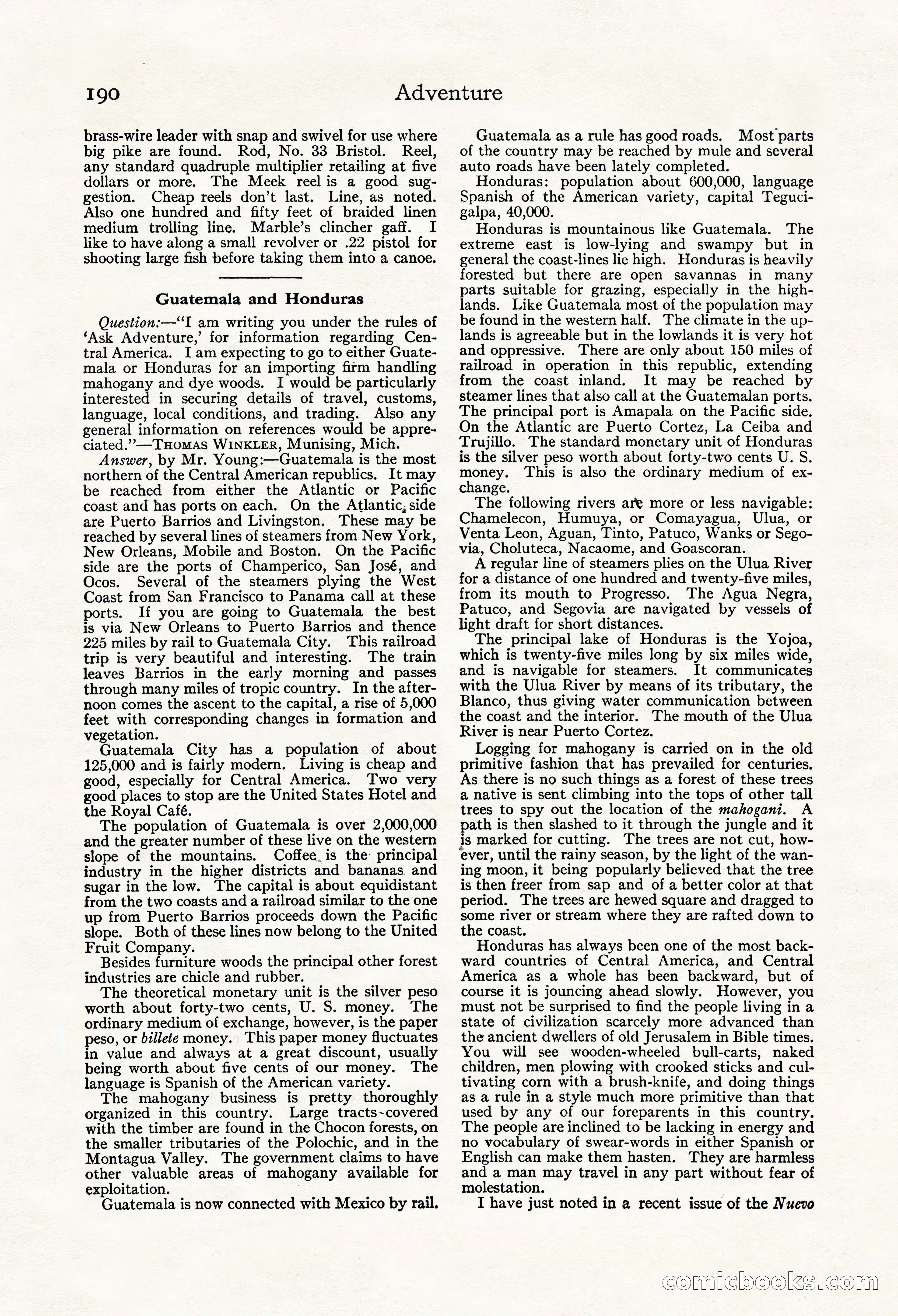
A restored page from Pulp Fiction, 1917. Page through the whole issue in the reader above.
📄 Transcribed text from this page (OCR, searchable)
Machine-transcribed from the original scan — historical spelling and the odd misread are preserved.
190 brass-wire leader with snap and swivel for use where big pike are found. Rod, No. 33 Bristol. Reel, any standard quadruple multiplier retailing at five dollars or more. The Meek reel is a good sug- gestion. Cheap reels don’t last. Line, as noted. Also one hundred and fifty feet of braided linen medium trolling line. Marble’s clincher gaff. I like to have along a small revolver or .22 pistol for shooting large fish before taking them into a canoe. Guatemala and Honduras Question: —“I am writing you under the rules of ‘Ask Adventure,’ for information regarding Cen- tral America. I am expecting to go to either Guate- mala or Honduras for an importing firm handling mahogany and dye woods. I would be particularly interested in securing details of travel, customs, language, local conditions, and trading. Also any general information on references would be appre- ciated.”,—THOMAS WINKLER, Munising, Mich. Answer, by Mr. Young:—Guatemala is the most northern of the Central American republics. It may be reached from either the Atlantic or Pacific coast and has ports on each. On the Atlantic; side are Puerto Barrios and Livingston. These may be reached by several lines of steamers from New York, New Orleans, Mobile and Boston. On the Pacific side are the ports of Champerico, San José, and Ocos. Several of the steamers plying the West Coast from San Francisco to Panama call at these ports. If you are going to Guatemala the best is via New Orleans to Puerto Barrios and thence 225 miles by rail to Guatemala City. This railroad trip is very beautiful and interesting. The train leaves Barrios in the early morning and passes through many miles of tropic country. In the after- noon comes the ascent to the capital, a rise of 5,000 feet with corresponding changes in formation and vegetation. Guatemala City has a population of about 125,000 and is fairly modern. Living is cheap and good, especially for Central America. ‘Two very good places to stop are the United States Hotel and the Royal Café. The population of Guatemala is over 2,000,000 and the greater number of these live on the western slope of the mountains. Coffee.is the principal industry in the higher districts and bananas and sugar in the low. The capital is about equidistant from the two coasts and a railroad similar to the one up from Puerto Barrios proceeds down the Pacific slope. Both of these lines now belong to the United Fruit Company. Besides furniture woods the principal other forest industries are chicle and rubber. The theoretical monetary unit is the silver peso worth about forty-two cents, U. S. money. The ordinary medium of exchange, however, is the paper peso, or billete money. This paper money fluctuates in value and always at a great discount, usually being worth about five cents of our money. The language is Spanish of the American variety. : The mahogany business is pretty thoroughly organized in this country. Large tracts~covered with the timber are found in the Chocon forests, on the smaller tributaries of the Polochic, and in the Montagua Valley. The government claims to have other valuable areas of mahogany available for exploitation. Guatemala is now connected with Mexico by rail. Adventure Guatemala as a rule has good roads. Most parts of the country may be reached by mule and several auto roads have been lately completed. Honduras: population about 600,000, language Spanish of the American variety, capital Teguci- galpa, 40,000. Honduras is mountainous like Guatemala. The extreme east is low-lying and swampy but in general the coast-lines lie high. Honduras is heavily forested but there are open savannas in many parts suitable for grazing, especially in the high- lands. Like Guatemala most of the population may be found in the western half. The climate in the up- lands is agreeable but in the lowlands it is very hot and oppressive. There are only about 150 miles of railroad in operation in this republic, extending from the coast inland. It may be reached by steamer lines that also call at the Guatemalan ports. The principal port is Amapala on the Pacific side. On the Atlantic are Puerto Cortez, La Ceiba and Trujillo. The standard monetary unit of Honduras is the silver peso worth about forty-two cents U. S. money. This is also the ordinary medium of ex- change. The following rivers are more or less navigable: Chamelecon, Humuya, or Comayagua, Ulua, or Venta Leon, Aguan, Tinto, Patuco, Wanks or Sego- via, Choluteca, Nacaome, and Goascoran. A regular line of steamers plies on the Ulua River for a distance of one hundred and twenty-five miles, from its mouth to Progresso. The Agua Negra, Patuco, and Segovia are navigated by vessels of light draft for short distances. The principal lake of Honduras is the Yojoa, which is twenty-five miles long by six miles wide, and is navigable for steamers. It communicates with the Ulua River by means of its tributary, the Blanco, thus giving water communication between the coast and the interior. The mouth of the Ulua River is near Puerto Cortez. Logging for mahogany is carried on in the old primitive fashion that has prevailed for centuries. As there is no such things as a forest of these trees a native is sent climbing into the tops of other tall trees to spy out the location of the mahogani. A path is then slashed to it through the jungle and it is marked for cutting. The trees are not cut, how- ever, until the rainy season, by the light of the wan- ing moon, it being popularly believed that the tree is then freer from sap and of a better color at that period. The trees are hewed square and dragged to some river or stream where they are rafted down to the coast. Honduras has always been one of the most back- ward countries of Central America, and Central America as a whole has been backward, but of course it is jouncing ahead slowly. However, you must not be surprised to find the people living in a state of civilization scarcely more advanced than the ancient dwellers of old Jerusalem in Bible times. You will see wooden-wheeled bull-carts, naked children, men plowing with crooked sticks and cul- tivating corn with a brush-knife, and doing things as a rule in a style much more primitive than that used by any of our foreparents in this country. The people are inclined to be lacking in energy and no vocabulary of swear-words in either Spanish or English can make them hasten. They are harmless and a man may travel in any part without fear of molestation. I have just noted in a recent issue of the Nuevo COmicloo C© 5}