
Pulp Fiction, 1917 · page 191 of 196
Adventure Magazine, Mid-September 1917 — page 191: what you’re looking at
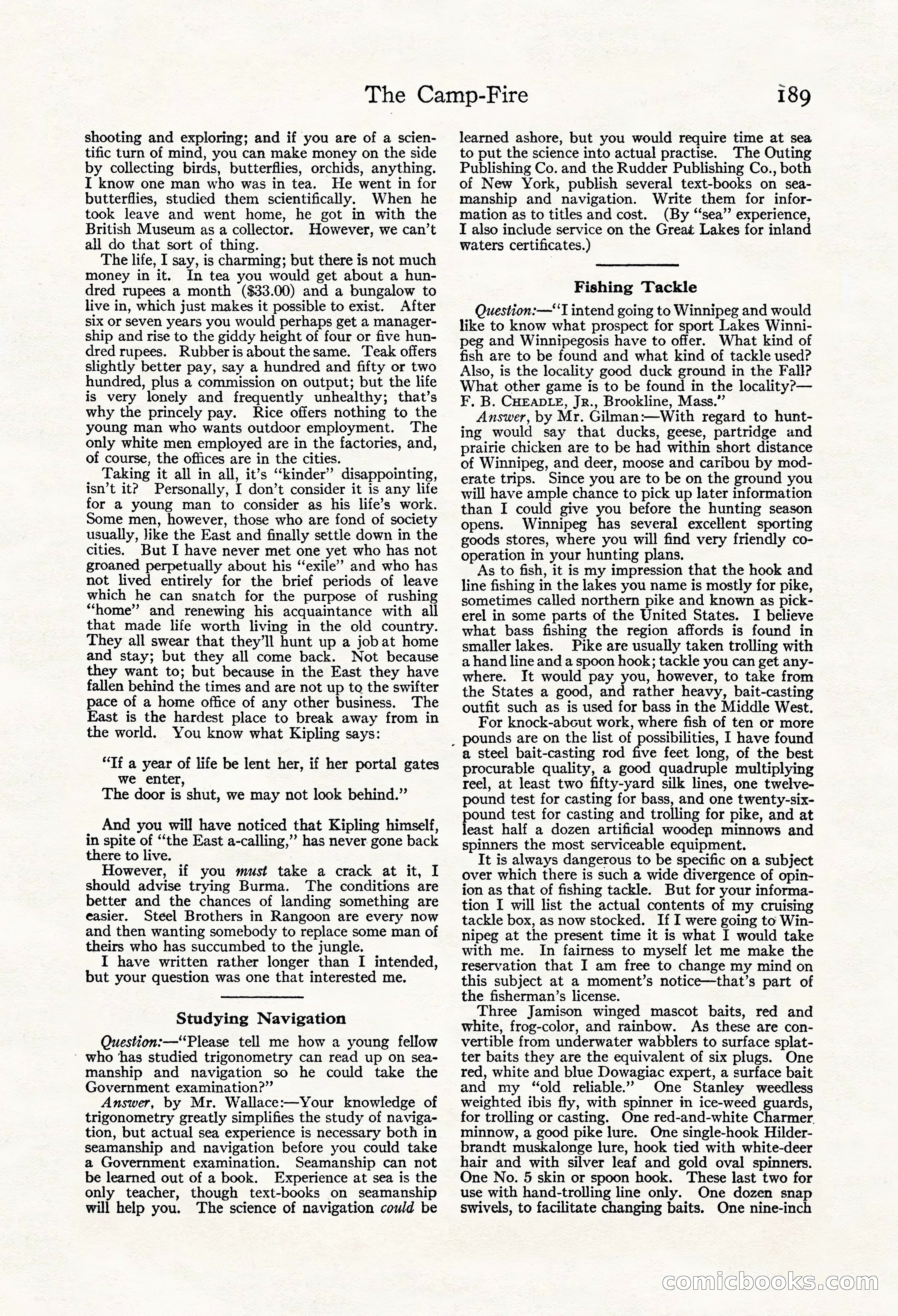
A restored page from Pulp Fiction, 1917. Page through the whole issue in the reader above.
📄 Transcribed text from this page (OCR, searchable)
Machine-transcribed from the original scan — historical spelling and the odd misread are preserved.
The Camp-Fire 189 shooting and exploring; and if you are of a scien- tific turn of mind, you can make money on the side by collecting birds, butterflies, orchids, anything. I know one man who was in tea. He went in for butterflies, studied them scientifically. When he took leave and went home, he got in with the British Museum as a collector. However, we can’t all do that sort of thing. The life, I say, is charming; but there is not much money in it. In tea you would get about a hun- dred rupees a month ($33.00) and a bungalow to live in, which just makes it possible to exist. After six or seven years you would perhaps get a manager- ship and rise to the giddy height of four or five hun- dred rupees. Rubber is about thesame. Teak offers slightly better pay, say a hundred and fifty or two hundred, plus a commission on output; but the life is very lonely and frequently unhealthy; that’s why the princely pay. Rice offers nothing to the young man who wants outdoor employment. The only white men employed are in the factories, and, of course, the offices are in the cities. Taking it all in all, it’s ‘‘kinder” disappointing, isn’t it? Personally, I don’t consider it is any life for a young man to consider as his life’s work. Some men, however, those who are fond of society usually, Jike the East and finally settle down in the cities. But I have never met one yet who has not groaned perpetually about his ‘exile’? and who has not lived entirely for the brief periods of leave which he can snatch for the purpose of rushing “home” and renewing his acquaintance with all that made life worth living in the old country. They all swear that they’ll hunt up a jobat home and stay; but they all come back. Not because they want to; but because in the East they have fallen behind the times and are not up to the swifter pace of a home office of any other business. The East is the hardest place to break away from in the world. You know what Kipling says: “Tf a year of life be lent her, if her portal gates we enter, The door is shut, we may not look behind.” And you will have noticed that Kipling himself, in spite of “‘the East a-calling,” has never gone back there to live. However, if you must take a crack at it, I should advise trying Burma. The conditions are better and the chances of landing something are easier. Steel Brothers in Rangoon are every now and then wanting somebody to replace some man of theirs who has succumbed to the jungle. I have written rather longer than I intended, but your question was one that interested me. Studying Navigation Question: —“Please tell me how a young fellow ‘ who ‘has studied trigonometry can read up on sea- manship and navigation so he could take the Government examination?” Answer, by Mr. Wallace:—Your knowledge of trigonometry greatly simplifies the study of naviga- tion, but actual sea experience is necessary both in seamanship and navigation before you could take a Government examination. Seamanship can not be learned out of a book. Experience at sea is the only teacher, though text-books on seamanship will help you. The science of navigation could be learned ashore, but you would require time at sea to put the science into actual practise. The Outing Publishing Co. and the Rudder Publishing Co., both of New York, publish several text-books on sea- manship and navigation. Write them for infor- mation as to titles and cost. (By ‘“‘sea’’ experience, I also include service on the Great Lakes for inland waters certificates.) Fishing Tackle Question: —“T intend going to Winnipeg and would like to know what prospect for sport Lakes Winni- peg and Winnipegosis have to offer. What kind of fish are to be found and what kind of tackle used? Also, is the locality good duck ground in the Fallp What other game is to be found in the localityp— F. B. CHEADLE, Jr., Brookline, Mass.” Answer, by Mr. Gilman:—With regard to hunt- ing would say that ducks, geese, partridge and prairie chicken are to be had within short distance of Winnipeg, and deer, moose and caribou by mod- erate trips. Since you are to be on the ground you will have ample chance to pick up later information than I could give you before the hunting season opens. Winnipeg has several excellent sporting goods stores, where you will find very friendly co- operation in your hunting plans. As to fish, it is my impression that the hook and line fishing in the lakes you name is mostly for pike, sometimes called northern pike and known as pick- erel in some parts of the United States. I believe what bass fishing the region affords is found in smaller lakes. Pike are usually taken trolling with a hand line and a spoon hook; tackle you can get any- where. It would pay you, however, to take from the States a good, and rather heavy, bait-casting outfit such as is used for bass in the Middle West. For knock-about work, where fish of ten or more _ pounds are on the list of possibilities, I have found a steel bait-casting rod five feet long, of the best procurable quality, a good quadruple multiplying reel, at least two fifty-yard silk lines, one twelve- pound test for casting for bass, and one twenty-six- pound test for casting and trolling for pike, and at least half a dozen artificial wooden minnows and spinners the most serviceable equipment. It is always dangerous to be specific on a subject over which there is such a wide divergence of opin- ion as that of fishing tackle. But for your informa- tion I will list the actual contents of my cruising tackle box, as now stocked. If I were going to Win- nipeg at the present time it is what I would take with me. In fairness to myself let me make the reservation that I am free to change my mind on this subject at a moment’s notice—that’s part of the fisherman’s license. Three Jamison winged mascot baits, red and white, frog-color, and rainbow. As these are con- vertible from underwater wabblers to surface splat- ter baits they are the equivalent of six plugs. One red, white and blue Dowagiac expert, a surface bait and my “old reliable.” One Stanley weedless weighted ibis fly, with spinner in ice-weed guards, for trolling or casting. One red-and-white Charmer, minnow, a good pike lure. One single-hook Hilder- brandt muskalonge lure, hook tied with white-deer hair and with silver leaf and gold oval spinners. One No. 5 skin or spoon hook. These last two for use with hand-trolling line only. One dozen snap swivels, to facilitate changing baits. One nine-inch C© Clo@@ =