
Pulp Fiction, 1917 · page 193 of 196
Adventure Magazine, Mid-September 1917 — page 193: what you’re looking at
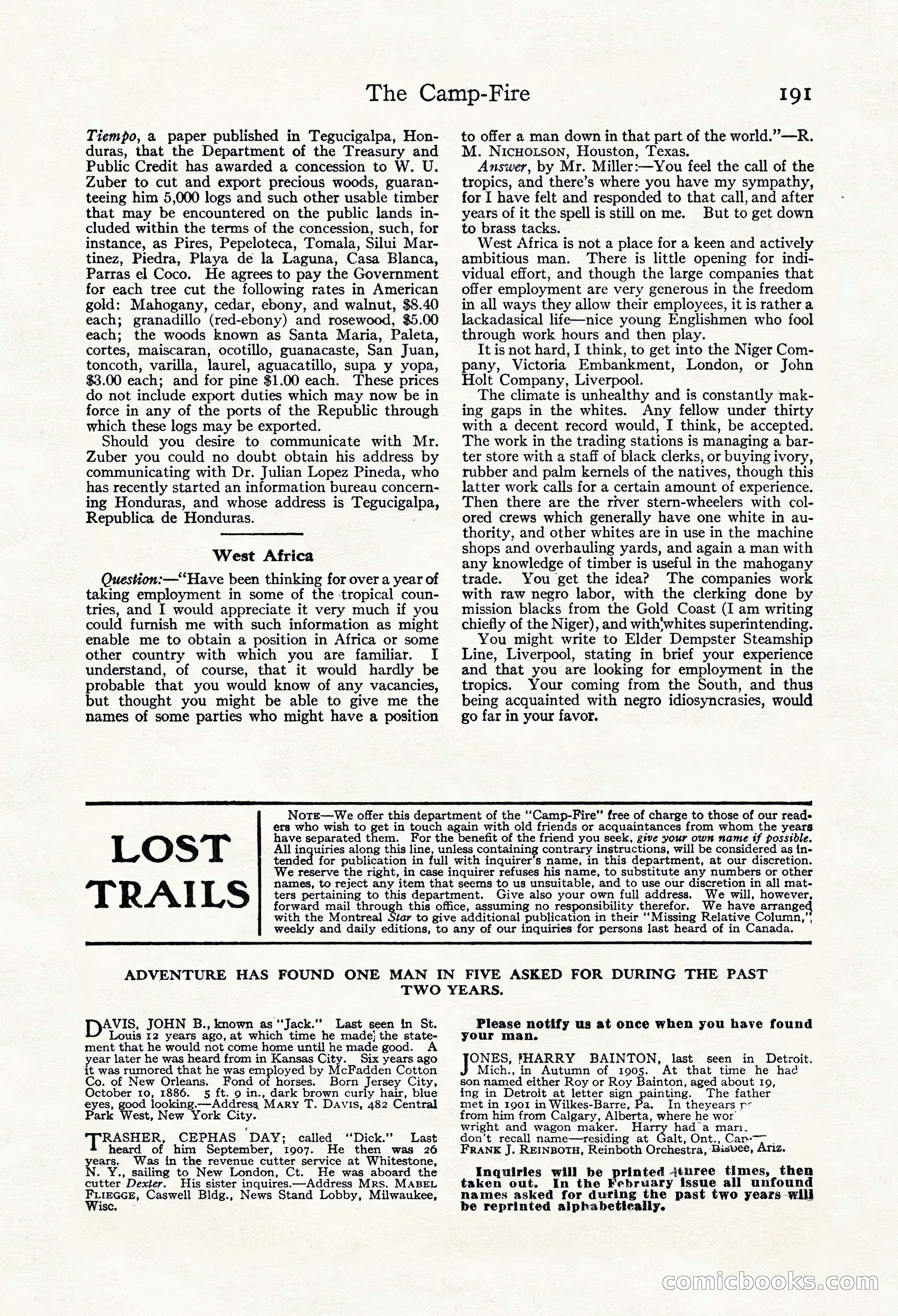
A restored page from Pulp Fiction, 1917. Page through the whole issue in the reader above.
📄 Transcribed text from this page (OCR, searchable)
Machine-transcribed from the original scan — historical spelling and the odd misread are preserved.
The Camp-Fire Tiempo, a paper published in Tegucigalpa, Hon- duras, that the Department of the Treasury and Public Credit has awarded a concession to W. U. Zuber to cut and export precious woods, guaran- teeing him 5,000 logs and such other usable timber that may be encountered on the public lands in- cluded within the terms of the concession, such, for instance, as Pires, Pepeloteca, Tomala, Silui Mar- tinez, Piedra, Playa de la Laguna, Casa Blanca, Parras el Coco. He agrees to pay the Government for each tree cut the following rates in American gold: Mahogany, cedar, ebony, and walnut, $8.40 each; granadillo (red-ebony) and rosewood, $5.00 each; the woods known as Santa Maria, Paleta, cortes, maiscaran, ocotillo, guanacaste, San Juan, toncoth, varilla, laurel, aguacatillo, supa y yopa, $3.00 each; and for pine $1.00 each. These prices do not include export duties which may now be in force in any of the ports of the Republic through which these logs may be exported. Should you desire to communicate with Mr. Zuber you could no doubt obtain his address by communicating with Dr. Julian Lopez Pineda, who has recently started an information bureau concern- ing Honduras, and whose address is Tegucigalpa, Republica de Honduras. West Africa Question: —‘‘Have been thinking for over a year of taking employment in some of the ‘tropical coun- tries, and I would appreciate it very much if you could furnish me with such information as might enable me to obtain a position in Africa or some other country with which you are familiar. I understand, of course, that it would hardly be probable that you would know of any vacancies, but thought you might be able to give me the names of some parties who might have a position IQI to offer a man down in that part of the world.”—R. M. NicHouson, Houston, Texas. Answer, by Mr. Miller:—You feel the call of the tropics, and there’s where you have my sympathy, for I have felt and responded to that call, and after years of it the spell is still on me. But to get down to brass tacks. West Africa is not a place for a keen and actively ambitious man. There is little opening for indi- vidual effort, and though the large companies that offer employment are very generous in the freedom in all ways they allow their employees, it is rather a lackadasical life—nice young Englishmen who fool through work hours and then play. It is not hard, I think, to get into the Niger Com- pany, Victoria Embankment, London, or John Holt Company, Liverpool. The climate is unhealthy and is constantly mak- ing gaps in the whites. Any fellow under thirty with a decent record would, I think, be accepted. The work in the trading stations is managing a bar- ter store with a staff of black clerks, or buying ivory, rubber and palm kernels of the natives, though this latter work calls for a certain amount of experience. Then there are the river stern-wheelers with col- ored crews which generally have one white in au- thority, and other whites are in use in the machine shops and overhauling yards, and again a man with any knowledge of timber is useful in the mahogany trade. You get the idea? The companies work with raw negro labor, with the clerking done by mission blacks from the Gold Coast (I am writing chiefly of the Niger), and with'whites superintending. You might write to Elder Dempster Steamship Line, Liverpool, stating in brief your experience and that you are looking for employment in the tropics. Your coming from the South, and thus being acquainted with negro idiosyncrasies, would go far in your favor. Note—We offer this department of the ‘‘Camp-Fire’”’ free of charge to those of our read« ers who wish to LOST TRAILS We reserve the right, in case inquirer refuses names, to reject any item that seems to us unsuitable, and to use our discretion in all mat- ters pertaining to this department. forward mail through this office, Star to give additional publication in their ‘‘Missing Relative Column,’‘ with the Montreal et in touch again with old friends or acquaintances from whom the years have separated them. For the benefit of the friend you seek, give your own name tf possible. All inquiries along this line, unless containing contrary instructions, will be considered as in- bended for publication in full with inquirer’s name, in this department, at our discretion. his name, to substitute any numbers or other We will, however, Give also your own full address. We have arranged assuming no responsibility therefor. weekly and daily editions, to any of our inquiries for persons last heard of in Canada. ADVENTURE HAS FOUND ONE MAN IN FIVE ASKED FOR DURING THE PAST TWO YEARS. DAVES. JOHN B., known as “‘Jack.’’ Last seen in St. Louis 12 years ago, at which time he made} the state- ment that he would not come home until he made good. year later he was heard from in Kansas City. Six years ago it was rumored that he was employed by McFadden Cotton Co. of New Orleans. Fond of horses. Born Jersey City, October 10, 1886. 5 ft. 9 in., dark brown curly hair, blue eyes, good looking.—Addresg Mary T. Davis, 482 Central Park West, New York City. RASHER, CEPHAS DAY; called ‘Dick.’’ Last heard of him September, 1907. He then was 26 Magar Was in the revenue cutter service at Whitestone, . Y., sailing to New London, Ct. He was aboard the cutter Dexter. His sister inquires.—Address Mrs. MABEL ee Caswell Bldg., News Stand Lobby, Milwaukee, ic; = Please notify us at once when you have found your man. ONES, fHARRY BAINTON, last seen in Detroit. Mich., in Autumn of 1905. At that time he had son named either Roy or Roy Bainton, aged about I9, ing in Detroit at letter sign painting. The father met in 1901 in Wilkes-Barre, Pa. In theyears r- from him from Calgary, Alberta, where he wor wright and wagon maker. Ha had a mari. don’t recall name—residing ae Cal Ont:; Caner - FRANK J. REINBOTH, Reinboth Orchestra, Risvee, Ariz. Inquiries will be printed jthree times, then taken out. In the February issue all unfound names asked for during the past two years will be reprinted alphabetieally. clo@olk< Up) © ©