
Pulp Fiction, 1917 · page 190 of 196
Adventure Magazine, Mid-September 1917 — page 190: what you’re looking at
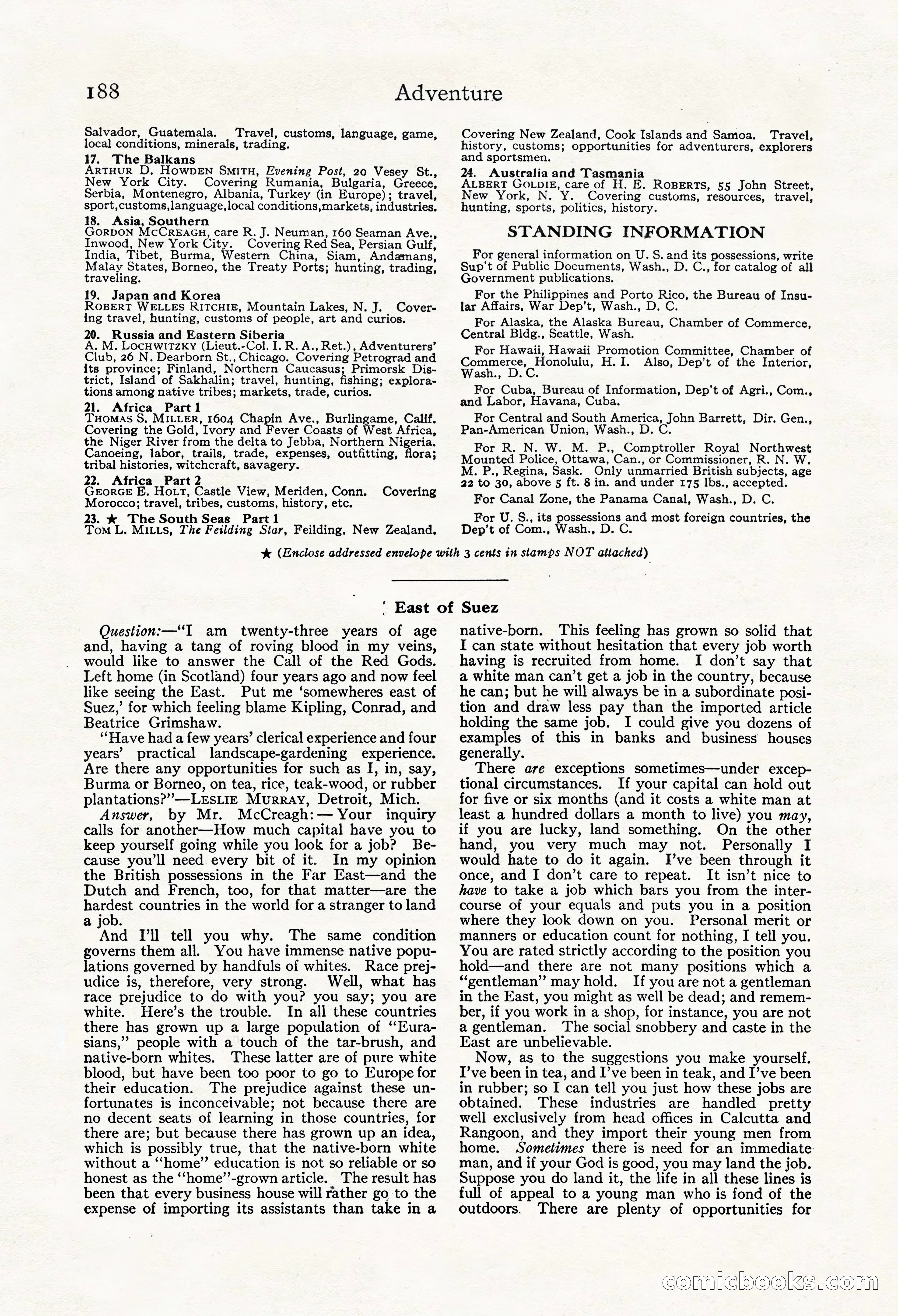
A restored page from Pulp Fiction, 1917. Page through the whole issue in the reader above.
📄 Transcribed text from this page (OCR, searchable)
Machine-transcribed from the original scan — historical spelling and the odd misread are preserved.
188 Salvador, Guatemala. Travel, customs, language, game, local conditions, minerals, trading. 17. The Balkans ARTHUR D. HowDEN SMITH, Evening Post, 20 Vesey St., New York City. Covering Rumania, Bulgaria, Greece, Serbia, Montenegro, Albania, Turkey (in Europe); travel, sport, customs ,language,local conditions, markets, industries. 18. Asia, Southern GORDON McCREAGH, care R. J. Neuman, 160 Seaman Ave. Inwood, New York City. Covering Red Sea, Persian Gulf, India, Tibet, Burma, Western China, Siam, Andamans, Malay States, Borneo, the Treaty Ports; hunting, trading, traveling. 19. Japan and Korea ROBERT WELLES RITCHIE, Mountain Lakes, N. J. Cover- ing travel, hunting, customs of people, art and. curios. 20. Russia and Eastern Siberia A. M. LocHwitzxky (Lieut.-Col. I. R. A., Ret.), Adventurers’ Club, 26 N. Dearborn St., Chicago. Covering Petrograd and its province; Finland, Northern Caucasus; Primorsk Dis- trict, Island of Sakhalin; travel, hunting, fishing; explora- tions among native tribes; markets, trade, curios. 21. Africa Partl THOMAS S. MILLER, 1604 Chapin Ave., Burlingame, Calif. Covering the Gold, ‘Ivory and Fever Coasts of West Africa, the Niger River from the delta to Jebba, Northern Nigeria. Canoeing, labor, trails, trade, expenses, outfitting, flora; tribal histories, witchcraft, savagery. 22. Africa Part 2 GeEorGE E. Hott, Castle View, Meriden, Conn. Morocco; travel, tribes, customs, history, etc. 23. * The South Seas Part 1 Tom L. MILs, The Feilding Star, Feilding, New Zealand. Covering Adventure Covering New Zealand, Cook Islands and Samoa. Travel, history, customs; opportunities for adventurers, explorers and sportsmen. 24. Australia and Tasmania ALBERT GOLDIE, care of H. E. Roperts, 55 John Street, New York, ye Covering customs, resources, travel, hunting, sports, politics, history. STANDING INFORMATION For general information on U. S. and its possessions, write Sup’t of Public Documents, Wash., D. C., for catalog of all Government publications. For the Philippines and Porto Rico, the Bureau of Insu- lar Affairs, War Dep’t, Wash., D. C. For Alaska, the Alaska Bureau, Chamber of Commerce, Central Bldg., Seattle, Wash. For Hawaii, Hawaii Promotion Committee, Chamber of ae Honolulu, H.1. Also, Dep’t of the Interior, Wash. Cc, For ‘Cuba. Bureau of Information, Dep’t of Agri., Com., and Labor, Havana, Cuba. For Central and South America, John Barrett, Dir. Gen., Pan-American Union, Wash., D. C, For R. N. W. M. P., Comptroller Royal Northwest Mounted Police, Ottawa, "Cane or Commissioner, R. N. W. M. P., Regina, Sask. Only unmarried British subjects, age 22 to 30, above 5 ft. 8 in. and under 175 lbs., accepted. For Canal Zone, the Panama Canal, Wash., D. C. For U. S., its possessions and most foreign countries, the Dep't of Com., Wash., : * (Enclose addressed envelope with 3 cents in stamps NOT attached) ' East of Suez Question: —“I am twenty-three years of age and, having a tang of roving blood in my veins, would like to answer the Call of the Red Gods. Left home (in Scotland) four years ago and now feel like seeing the East. Put me ‘somewheres east of Suez,’ for which feeling blame Kipling, Conrad, and Beatrice Grimshaw. “Have had a few years’ clerical experience and four years’ practical landscape-gardening experience. Are there any opportunities for such as I, in, say, Burma or Borneo, on tea, rice, teak-wood, or rubber plantations?” —LEsLiE Murray, Detroit, Mich. Answer, by Mr. McCreagh:— Your inquiry calls for another—How much capital have you to keep yourself going while you look for a job? Be- cause you'll need.every bit of it. In my opinion the British possessions in the Far East—and the Dutch and French, too, for that matter—are the hardest countries in the world for a stranger to land a job. ed T’ll tell you why. The same condition governs them all. You have immense native popu- lations governed by handfuls of whites. Race prej- udice is, therefore, very strong. Well, what has race prejudice to do with you? you say; you are white. Here’s the trouble. In all these countries there has grown up a large population of “Eura- sians,” people with a touch of the tar-brush, and native-born whites. These latter are of pure white blood, but have been too poor to go to Europe for their education. The prejudice against these un- fortunates is inconceivable; not because there are no decent seats of learning in those countries, for there are; but because there has grown up an idea, which is possibly true, that the native-born white without a “‘home’”’ education is not so reliable or so honest as the ‘‘Shome’’-grown article. The result has been that every business house will rather go to the expense of importing its assistants than take in a native-born. ‘This feeling has grown so solid that I can state without hesitation that every job worth having is recruited from home. I don’t say that a white man can’t get a job in the country, because he can; but he will always be in a subordinate posi- tion and draw less pay than the imported article holding the same job. I could give you dozens of examples of this in banks and business houses generally. There are exceptions sometimes—under excep- tional circumstances. If your capital can hold out for five or six months (and it costs a white man at least a hundred dollars a month to live) you may, if you are lucky, land something. On the other hand, you very much may not. Personally I would hate to do it again. I’ve been through it once, and I don’t care to repeat. It isn’t nice to have to take a job which bars you from the inter- course of your equals and puts you in a position where they look down on you. Personal merit or manners or education count for nothing, I tell you. You are rated strictly according to the position you hold—and there are not many positions which a “gentleman” may hold. If you are not a gentleman in the East, you might as well be dead; and remem- ber, if you work in a shop, for instance, you are not a gentleman. ‘The social snobbery and caste in the East are unbelievable. Now, as to the suggestions you make yourself. I’ve been in tea, and I’ve been in teak, and I’ve been in rubber; so I can tell you just how these jobs are obtained. These industries are handled pretty well exclusively from head offices in Calcutta and Rangoon, and they import their young men from home. Sometimes there is need for an immediate: man, and if your God is good, you may land the job. Suppose you do land it, the life in all these lines is full of appeal to a young man who is fond of the outdoors. There are plenty of opportunities for COmicloo C©