
Pulp Fiction, 1917 · page 148 of 196
Adventure Magazine, Mid-September 1917 — page 148: what you’re looking at
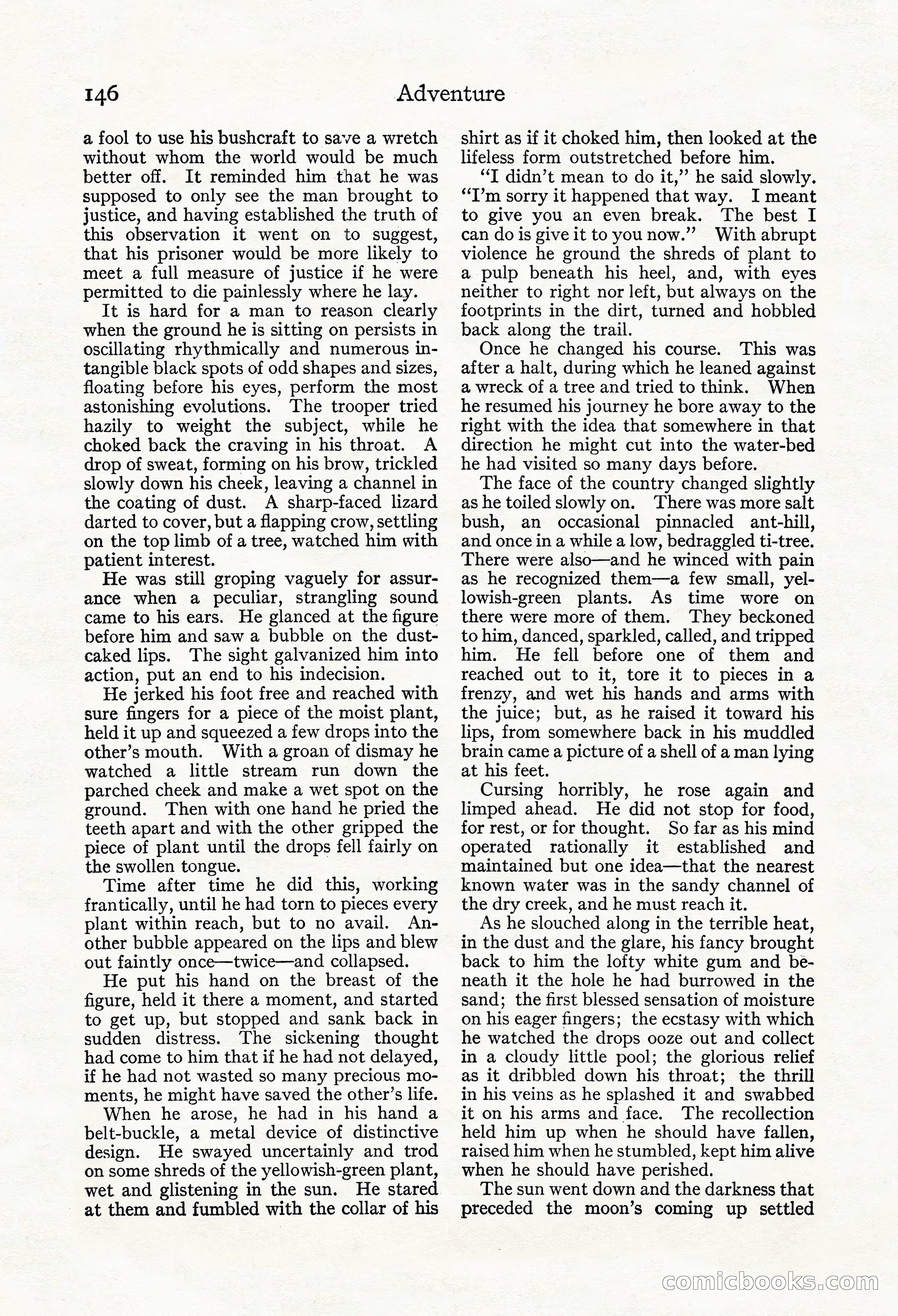
A restored page from Pulp Fiction, 1917. Page through the whole issue in the reader above.
📄 Transcribed text from this page (OCR, searchable)
Machine-transcribed from the original scan — historical spelling and the odd misread are preserved.
146 a fool to use his bushcraft to save a wretch without whom the world would be much better off. It reminded him that he was supposed to only see the man brought to justice, and having established the truth of this observation it went on to suggest, that his prisoner would be more likely to meet a full measure of justice if he were permitted to die painlessly where he lay. It is hard for a man to reason clearly when the ground he is sitting on persists in oscillating rhythmically and numerous in- tangible black spots of odd shapes and sizes, floating before his eyes, perform the most astonishing evolutions. The trooper tried hazily to weight the subject, while he choked back the craving in his throat. A drop of sweat, forming on his brow, trickled slowly down his cheek, leaving a channel in the coating of dust. A sharp-faced lizard darted to cover, but a flapping crow, settling on the top limb of a tree, watched him with patient interest. He was still groping vaguely for assur- ance when a peculiar, strangling sound came to his ears. He glanced at the figure before him and saw a bubble on the dust- caked lips. The sight galvanized him into action, put an end to his indecision. He jerked his foot free and reached with sure fingers for a piece of the moist plant, held it up and squeezed a few drops into the other’s mouth. With a groan of dismay he watched a little stream run down the parched cheek and make a wet spot on the ground. Then with one hand he pried the teeth apart and with the other gripped the piece of plant until the drops fell fairly on the swollen tongue. Time after time he did this, working frantically, until he had torn to pieces every plant within reach, but to no avail. An- other bubble appeared on the lips and blew out faintly once—twice—and collapsed. He put his hand on the breast of the figure, held it there a moment, and started to get up, but stopped and sank back in sudden distress. The sickening thought had come to him that if he had not delayed, if he had not wasted so many precious mo- ments, he might have saved the other’s life. When he arose, he had in his hand a belt-buckle, a metal device of distinctive design. He swayed uncertainly and trod on some shreds of the yellowish-green plant, wet and glistening in the sun. He stared ~ at them and fumbled with the collar of his Adventure shirt as if it choked him, then looked at the lifeless form outstretched before him. “I didn’t mean to do it,”’ he said slowly. ‘I’m sorry it happened that way. I meant to give you an even break. The best I can do is give it to you now.” With abrupt violence he ground the shreds of plant to a pulp beneath his heel, and, with eyes neither to right nor left, but always on the footprints in the dirt, turned and hobbled back along the trail. Once he changed his course. This was after a halt, during which he leaned against a wreck of a tree and tried to think. When he resumed his journey he bore away to the right with the idea that somewhere in that direction he might cut into the water-bed he had visited so many days before. The face of the country changed slightly as he toiled slowly on. There was more salt bush, an occasional pinnacled ant-hill, and once in a while a low, bedraggled ti-tree. There were also—and he winced with pain as he recognized them—a few small, yel- lowish-green plants. As time wore on there were more of them. They beckoned to him, danced, sparkled, called, and tripped him. He fell before one of them and reached out to it, tore it to pieces in a frenzy, and wet his hands and arms with the juice; but, as he raised it toward his lips, from somewhere back in his muddled brain came a picture of a shell of a man lying at his feet. Cursing horribly, he rose again and limped ahead. He did not stop for food, for rest, or for thought. So far as his mind operated rationally it established and maintained but one idea—that the nearest known water was in the sandy channel of the dry creek, and he must reach it. As he slouched along in the terrible heat, in the dust and the glare, his fancy brought back to him the lofty white gum and be- neath it the hole he had burrowed in the sand; the first blessed sensation of moisture on his eager fingers; the ecstasy with which he watched the drops ooze out and collect in a cloudy little pool; the glorious relief as it dribbled down his throat; the thrill in his veins as he splashed it and swabbed it on his arms and face. The recollection held him up when he should have fallen, raised him when he stumbled, kept him alive when he should have perished. The sun went down and the darkness that preceded the moon’s coming up settled COMmiclsoo ©