
Pulp Fiction, 1917 · page 149 of 196
Adventure Magazine, Mid-September 1917 — page 149: what you’re looking at
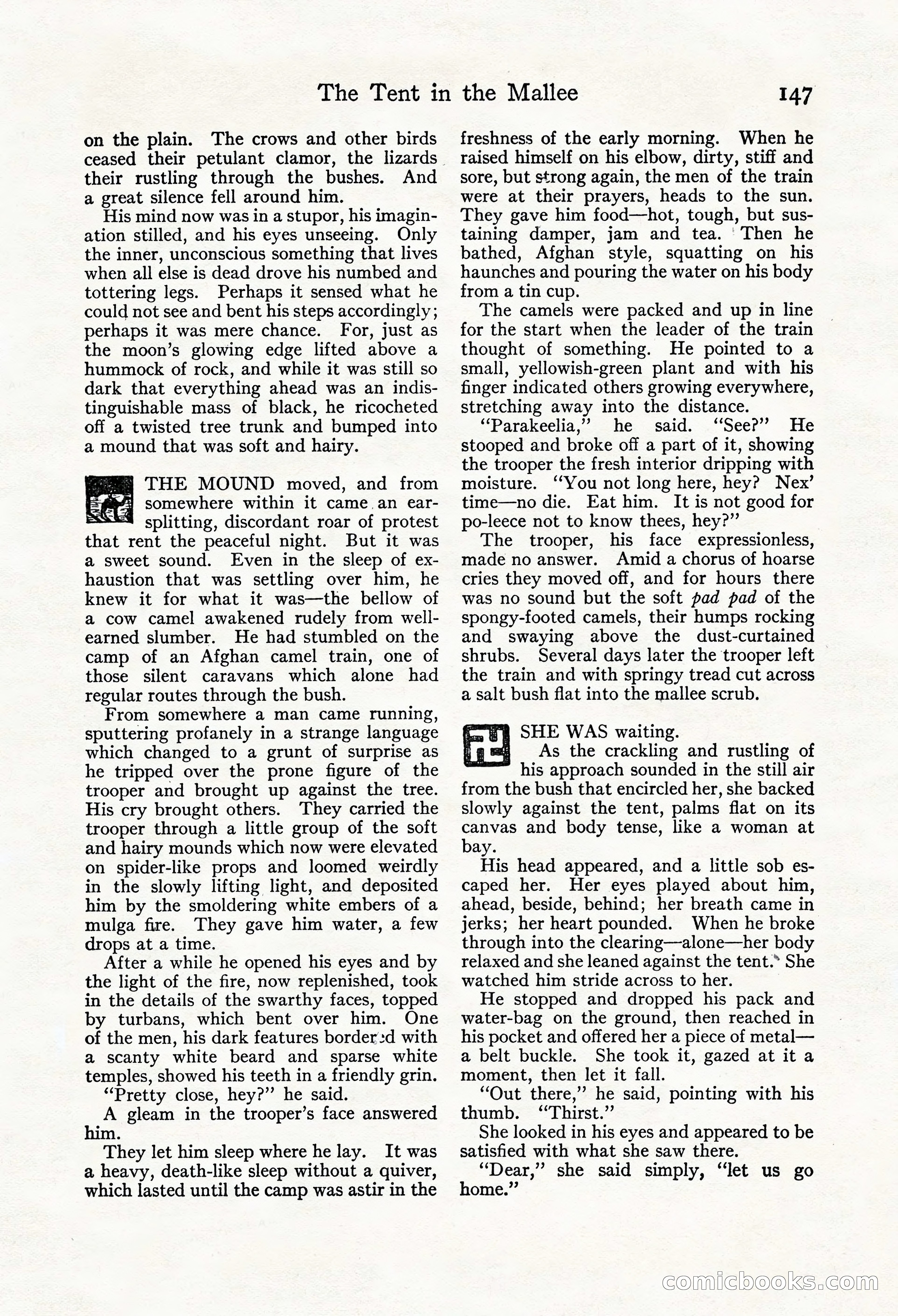
A restored page from Pulp Fiction, 1917. Page through the whole issue in the reader above.
📄 Transcribed text from this page (OCR, searchable)
Machine-transcribed from the original scan — historical spelling and the odd misread are preserved.
The Tent in the Mallee on the plain. The crows and other birds ceased their petulant clamor, the lizards their rustling through the bushes. And a great silence fell around him. His mind now was in a stupor, his imagin- ation stilled, and his eyes unseeing. Only the inner, unconscious something that lives when all else is dead drove his numbed and tottering legs. Perhaps it sensed what he could not see and bent his steps accordingly; perhaps it was mere chance. For, just as the moon’s glowing edge lifted above a hummock of rock, and while it was still so dark that everything ahead was an indis- tinguishable mass of black, he ricocheted off a twisted tree trunk and bumped into a mound that was soft and hairy. a THE MOUND moved, and from somewhere within it came an ear- splitting, discordant roar of protest that rent the peaceful night. But it was a sweet sound. Even in the sleep of ex- haustion that was settling over him, he knew it for what it was—the bellow of a cow camel awakened rudely from well- earned slumber. He had stumbled on the camp of an Afghan camel train, one of those silent caravans which alone had regular routes through the bush. From somewhere a man came running, sputtering profanely in a strange language which changed to a grunt of surprise as he tripped over the prone figure of the trooper and brought up against the tree. His cry brought others. They carried the trooper through a little group of the soft and hairy mounds which now were elevated on spider-like props and loomed weirdly in the slowly lifting light, and deposited him by the smoldering white embers of a mulga fire. They gave him water, a few drops at a time. After a while he opened his eyes and by the light of the fire, now replenished, took in the details of the swarthy faces, topped by turbans, which bent over him. One of the men, his dark features border:d with a scanty white beard and sparse white temples, showed his teeth in a friendly grin. “Pretty close, hey?” he said. A gleam in the trooper’s face answered him. They let him sleep where he lay. It was a heavy, death-like sleep without a quiver, which lasted until the camp was astir in the ae 147 freshness of the early morning. When he raised himself on his elbow, dirty, stiff and sore, but strong again, the men of the train were at their prayers, heads to the sun. They gave him food—hot, tough, but sus- taining damper, jam and tea. ‘Then he bathed, Afghan style, squatting on his haunches and pouring the water on his body from a tin cup. The camels were packed and up in line for the start when the leader of the train thought of something. He pointed to a small, yellowish-green plant and with his finger indicated others growing everywhere, stretching away into the distance. ‘‘Parakeelia,’” he said. ‘See?’ He stooped and broke off a part of it, showing the trooper the fresh interior dripping with moisture. ‘‘You not long here, hey? Nex’ time—no die. Eat him. It is not good for po-leece not to know thees, hey?” The trooper, his face expressionless, made no answer. Amid a chorus of hoarse cries they moved off, and for hours there was no sound but the soft pad pad of the spongy-footed camels, their humps rocking and swaying above the dust-curtained shrubs. Several days later the trooper left the train and with springy tread cut across a salt bush flat into the mallee scrub. ea SHE WAS waiting. # As the crackling and rustling of his approach sounded in the still air from the bush that encircled her, she backed slowly against the tent, palms flat on its canvas and body tense, like a woman at bay. His head appeared, and a little sob es- caped her. Her eyes played about him, ahead, beside, behind; her breath came in jerks; her heart pounded. When he broke through into the clearing—alone—her body relaxed and she leaned against the tent.* She watched him stride across to her. He stopped and dropped his pack and water-bag on the ground, then reached in his pocket and offered her a piece of metal— a belt buckle. She took it, gazed at it a moment, then let it fall. “Out there,” he said, pointing with his thumb. “Thirst.” She looked in his eyes and appeared to be satisfied with what she saw there. “Dear,” she said simply, “let us go home.” COmicloo CO