
Pulp Fiction, 1917 · page 147 of 196
Adventure Magazine, Mid-September 1917 — page 147: what you’re looking at
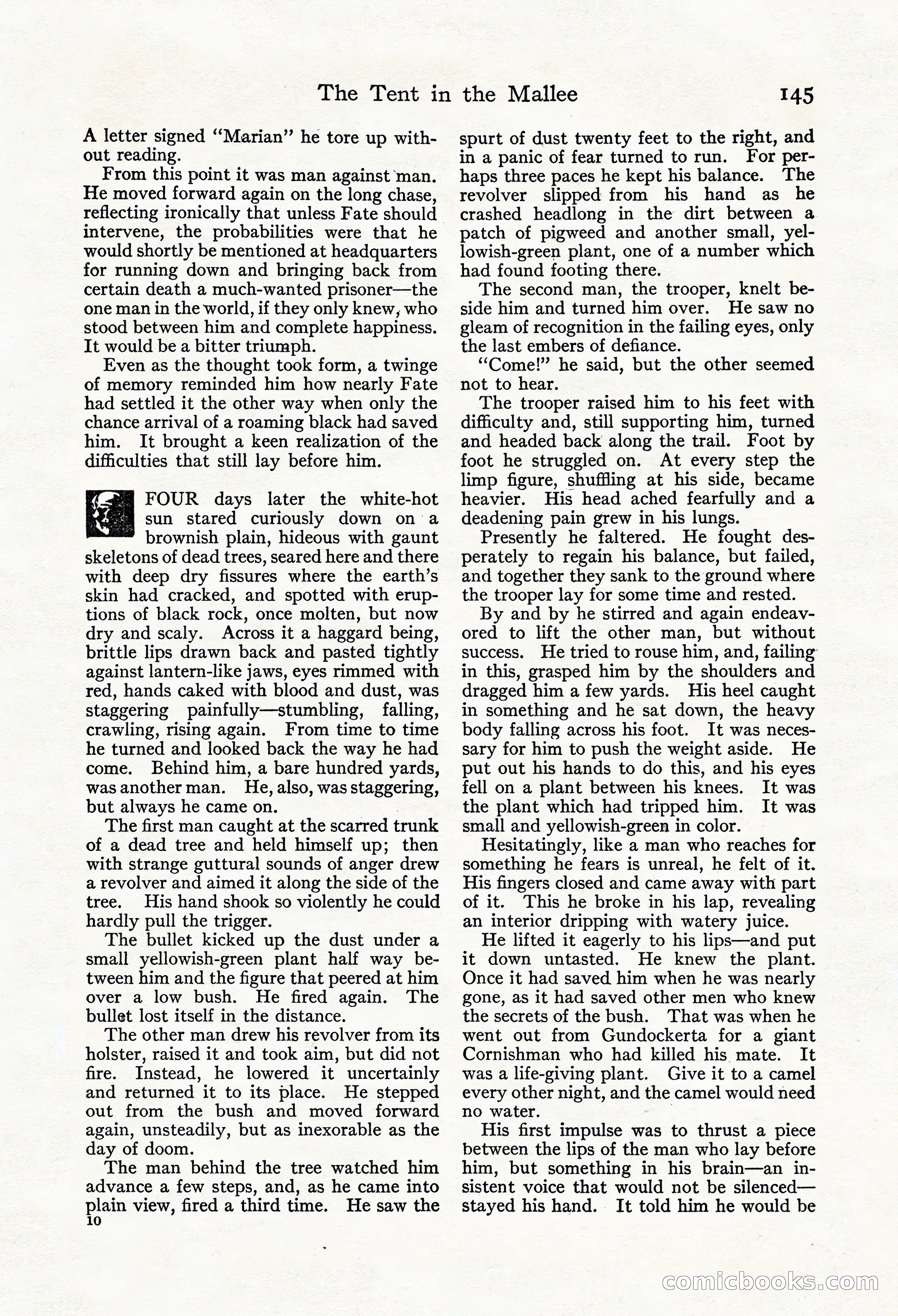
A restored page from Pulp Fiction, 1917. Page through the whole issue in the reader above.
📄 Transcribed text from this page (OCR, searchable)
Machine-transcribed from the original scan — historical spelling and the odd misread are preserved.
The Tent in the Mallee A letter signed “Marian” he tore up with- out reading. From this point it was man against ‘man. He moved forward again on the long chase, reflecting ironically that unless Fate should intervene, the probabilities were that he would shortly be mentioned at headquarters for running down and bringing back from certain death a much-wanted prisoner—the one man in the world, if they only knew, who stood between him and complete happiness. It would be a bitter triumph. Even as the thought took form, a twinge of memory reminded him how nearly Fate had settled it the other way when only the chance arrival of a roaming black had saved him. It brought a keen realization of the difficulties that still lay before him. va FOUR days later the white-hot ™ sun stared curiously down on a * brownish plain, hideous with gaunt skeletons of dead trees, seared here and there with deep dry fissures where the earth’s skin had cracked, and spotted with erup- tions of black rock, once molten, but now dry and scaly. Across it a haggard being, brittle lips drawn back and pasted tightly against lantern-like jaws, eyes rimmed with red, hands caked with blood and dust, was staggering painfully—stumbling, falling, crawling, rising again. From time to time he turned and looked back the way he had come. Behind him, a bare hundred yards, was anotherman. He, also, was staggering, but always he came on. The first man caught at the scarred trunk of a dead tree and held himself up; then with strange guttural sounds of anger drew a revolver and aimed it along the side of the tree. His hand shook so violently he could hardly pull the trigger. The bullet kicked up the dust under a small yellowish-green plant half way be- tween him and the figure that peered at him over a low bush. He fired again. The bullet lost itself in the distance. The other man drew his revolver from its holster, raised it and took aim, but did not fire. Instead, he lowered it uncertainly and returned it to its place. He stepped out from the bush and moved forward again, unsteadily, but as inexorable as the day of doom. The man behind the tree watched him advance a few steps, and, as he came into pa view, fired a third time. He saw the 0 145 spurt of dust twenty feet to the right, and in a panic of fear turned to run. For per- haps three paces he kept his balance. The revolver slipped from his hand as he crashed headlong in the dirt between a patch of pigweed and another small, yel- lowish-green plant, one of a number which had found footing there. The second man, the trooper, knelt be- side him and turned him over. He saw no gleam of recognition in the failing eyes, only the last embers of defiance. “Come!” he said, but the other seemed not to hear. The trooper raised him to his feet with difficulty and, still supporting him, turned and headed back along the trail. Foot by foot he struggled on. At every step the limp figure, shuffling at his side, became heavier. His head ached fearfully and a deadening pain grew in his lungs. Presently he faltered. He fought des- perately to regain his balance, but failed, and together they sank to the ground where the trooper lay for some time and rested. By and by he stirred and again endeav- ored to lift the other man, but without success. He tried to rouse him, and, failing in this, grasped him by the shoulders and dragged him a few yards. His heel caught in something and he sat down, the heavy body falling across his foot. It was neces- sary for him to push the weight aside. He put out his hands to do this, and his eyes fell on a plant between his knees. It was the plant which had tripped him. It was small and yellowish-green in color. Hesitatingly, like a man who reaches for something he fears is unreal, he felt of it. His fingers closed and came away with part of it. This he broke in his lap, revealing an interior dripping with watery juice. He lifted it eagerly to his lips—and put it down untasted. He knew the plant. Once it had saved. him when he was nearly gone, as it had saved other men who knew the secrets of the bush. That was when he went out from Gundockerta for a giant Cornishman who had killed his mate. It was a life-giving plant. Give it to a camel every other night, and the camel would need no water. His first impulse was to thrust a piece between the lips of the man who lay before him, but something in his brain—an in- sistent voice that would not be silenced— stayed his hand. It told him he would be COmicloo C©