
Pulp Fiction, 1917 · page 146 of 196
Adventure Magazine, Mid-September 1917 — page 146: what you’re looking at
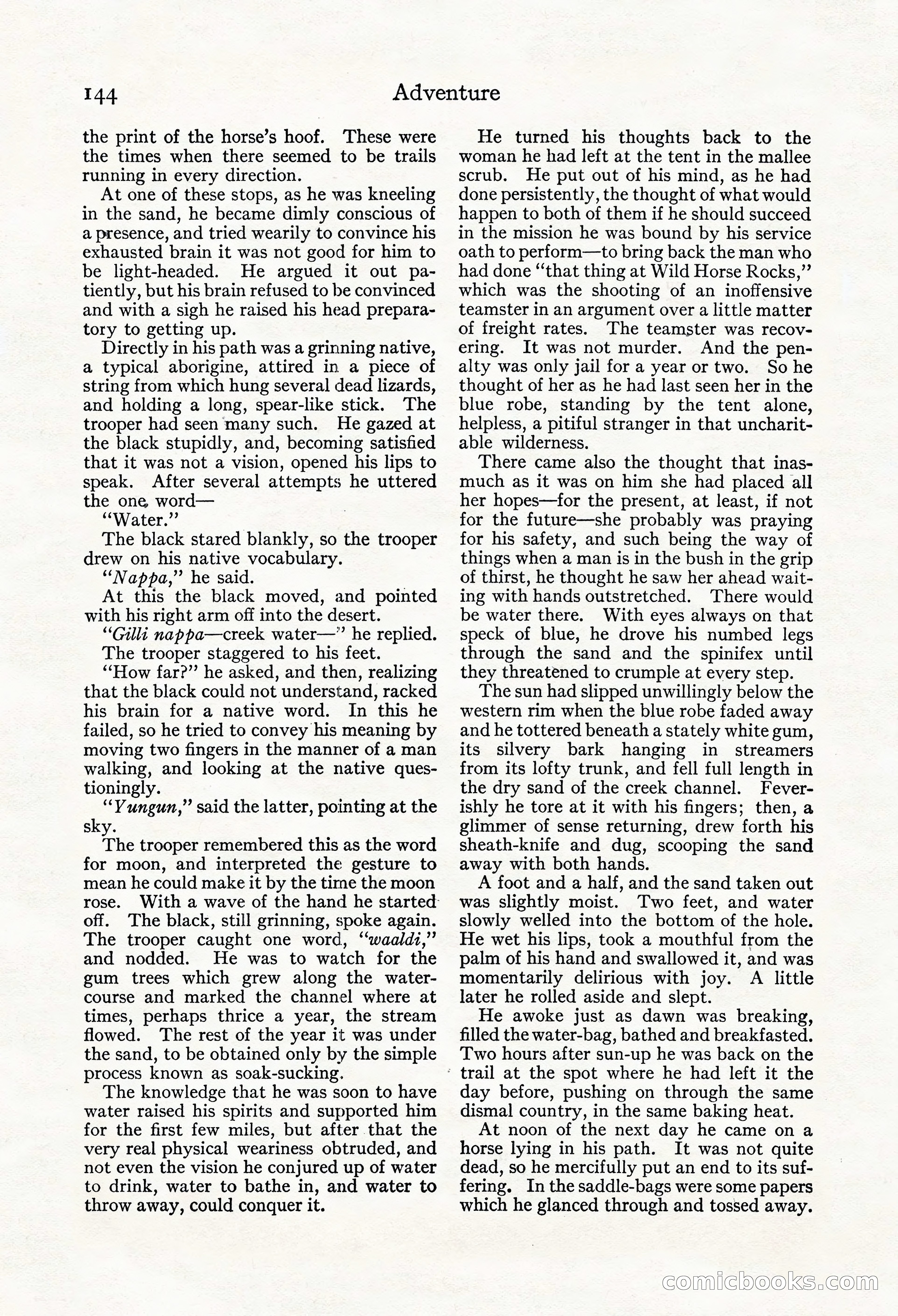
A restored page from Pulp Fiction, 1917. Page through the whole issue in the reader above.
📄 Transcribed text from this page (OCR, searchable)
Machine-transcribed from the original scan — historical spelling and the odd misread are preserved.
144 the print of the horse’s hoof. These were the times when there seemed to be trails running in every direction. At one of these stops, as he was kneeling in the sand, he became dimly conscious of a presence, and tried wearily to convince his exhausted brain it was not good for him to be light-headed. He argued it out pa- tiently, but his brain refused to be convinced and with a sigh he raised his head prepara- tory to getting up. Directly in his path was a grinning native, a typical aborigine, attired in a piece of string from which hung several dead lizards, and holding a long, spear-like stick. The trooper had seen many such. He gazed at the black stupidly, and, becoming satisfied that it was not a vision, opened his lips to speak. After several attempts he uttered the one, word— “Water.” : The black stared blankly, so the trooper drew on his native vocabulary. “Nappa,” he said. At this the black moved, and pointed with his right arm off into the desert. “Gilli nappa—creek water—”’ he replied. The trooper staggered to his feet. ‘“‘How far?” he asked, and then, realizing that the black could not understand, racked his brain for a native word. In this he failed, so he tried to convey his meaning by moving two fingers in the manner of a man walking, and looking at the native ques- tioningly. “Vungun,” said the latter, pointing at the sky. The trooper remembered this as the word for moon, and interpreted the gesture to mean he could make it by the time the moon rose. off. The black, still grinning, spoke again. The trooper caught one word, ‘“‘waaldz,”’ and nodded. He was to watch for the gum trees which grew along the water- course and marked the channel where at times, perhaps thrice a year, the stream flowed. The rest of the year it was under the sand, to be obtained only by the simple process known as soak-sucking. The knowledge that he was soon to have water raised his spirits and supported him for the first few miles, but after that the very real physical weariness obtruded, and not even the vision he conjured up of water to drink, water to bathe in, and water to throw away, could conquer it. With a wave of the hand he started: Adventure He turned his thoughts back to the woman he had left at the tent in the mallee scrub. He put out of his mind, as he had done persistently, the thought of what would happen to both of them if he should succeed in the mission he was bound by his service oath to perform—to bring back the man who had done “that thing at Wild Horse Rocks,” which was the shooting of an inoffensive teamster in an argument over a little matter of freight rates. The teamster was recov- ering. It was not murder. And the pen- alty was only jail for a year ortwo. Sohe thought of her as he had last seen her in the blue robe, standing by the tent alone, helpless, a pitiful stranger in that uncharit- able wilderness. There came also the thought that inas- much as it was on him she had placed all her hopes—for the present, at least, if not for the future—she probably was praying for his safety, and such being the way of things when a man is in the bush in the grip of thirst, he thought he saw her ahead wait- ing with hands outstretched. There would be water there. With eyes always on that speck of blue, he drove his numbed legs through the sand and the spinifex until they threatened to crumple at every step. The sun had slipped unwillingly below the western rim when the blue robe faded away and he tottered beneath a stately white gum, its silvery bark hanging in streamers from its lofty trunk, and fell full length in the dry sand of the creek channel. Fever- ishly he tore at it with his fingers; then, a glimmer of sense returning, drew forth his sheath-knife and dug, scooping the sand away with both hands. A foot and a half, and the sand taken out was slightly moist. Two feet, and water slowly welled into the bottom of the hole. He wet his lips, took a mouthful from the palm of his hand and swallowed it, and was momentarily delirious with joy. A little later he rolled aside and slept. He awoke just as dawn was breaking, filled the water-bag, bathed and breakfasted. Two hours after sun-up he was back on the ‘ trail at the spot where he had left it the day before, pushing on through the same dismal country, in the same baking heat. At noon of the next day he came on a horse lying in his path. It was not quite dead, so he mercifully put an end to its suf- fering. In the saddle-bags were some papers which he glanced through and tossed away. CoOMmiclsoo CO