
Pulp Fiction, 1917 · page 145 of 196
Adventure Magazine, Mid-September 1917 — page 145: what you’re looking at
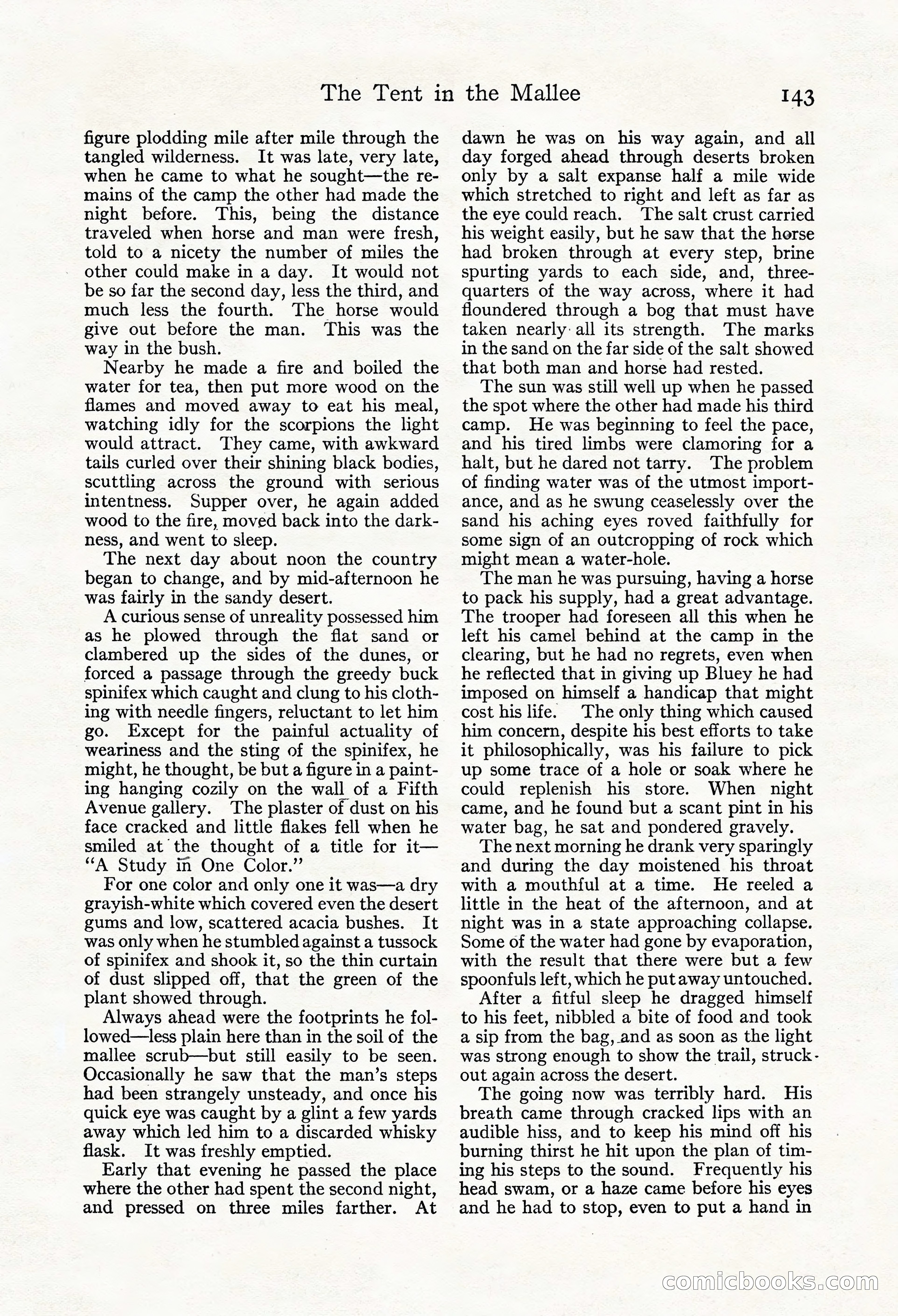
A restored page from Pulp Fiction, 1917. Page through the whole issue in the reader above.
📄 Transcribed text from this page (OCR, searchable)
Machine-transcribed from the original scan — historical spelling and the odd misread are preserved.
The Tent in the Mallee figure plodding mile after mile through the tangled wilderness. It was late, very late, when he came to what he sought—the re- mains of the camp the other had made the night before. This, being the distance traveled when horse and man were fresh, told to a nicety the number of miles the other could make in a day. It would not be so far the second day, less the third, and much less the fourth. The horse would give out before the man. This was the way in the bush. Nearby he made a fire and boiled the water for tea, then put more wood on the flames and moved away to eat his meal, watching idly for the scorpions the light would attract. They came, with awkward tails curled over their shining black bodies, scuttling across the ground with serious intentness. Supper over, he again added wood to the fire, moved back into the dark- ness, and went to sleep. The next day about noon the country began to change, and by mid-afternoon he was fairly in the sandy desert. A curious sense of unreality possessed him as he plowed through the flat sand or clambered up the sides of the dunes, or forced a passage through the greedy buck spinifex which caught and clung to his cloth- ing with needle fingers, reluctant to let him go. Except for the painful actuality of weariness and the sting of the spinifex, he might, he thought, be but a figure in a paint- ing hanging cozily on the wall of a Fifth Avenue gallery. The plaster of dust on his face cracked and little flakes fell when he smiled at the thought of a title for it— “A Study in One Color.” For one color and only one it was—a dry grayish-white which covered even the desert gums and low, scattered acacia bushes. It was only when he stumbled against a tussock of spinifex and shook it, so the thin curtain of dust slipped off, that the green of the plant showed through. Always ahead were the footprints he fol- lowed—less plain here than in the soil of the mallee scrub—but still easily to be seen. Occasionally he saw that the man’s steps had been strangely unsteady, and once his quick eye was caught by a glint a few yards away which led him to a discarded whisky flask. It was freshly emptied. Early that evening he passed the place where the other had spent the second night, and pressed on three miles farther. At 143 dawn he was on his way again, and all day forged ahead through deserts broken only by a salt expanse half a mile wide which stretched to right and left as far as the eye could reach. The salt crust carried his weight easily, but he saw that the horse had broken through at every step, brine spurting yards to each side, and, three- quarters of the way across, where it had floundered through a bog that must have taken nearly: all its strength. The marks in the sand on the far side of the salt showed that both man and horse had rested. The sun was still well up when he passed the spot where the other had made his third camp. He was beginning to feel the pace, and his tired limbs were clamoring for a halt, but he dared not tarry. The problem of finding water was of the utmost import- ance, and as he swung ceaselessly over the sand his aching eyes roved faithfully for some sign of an outcropping of rock which might mean a water-hole. The man he was pursuing, having a horse to pack his supply, had a great advantage. The trooper had foreseen all this when he left his camel behind at the camp in the clearing, but he had no regrets, even when he reflected that in giving up Bluey he had imposed on himself a handicap that might cost his life. The only thing which caused him concern, despite his best efforts to take it philosophically, was his failure to pick up some trace of a hole or soak where he could replenish his store. When night came, and he found but a scant pint in his water bag, he sat and pondered gravely. The next morning he drank very sparingly and during the day moistened his throat with a mouthful at a time. He reeled a little in the heat of the afternoon, and at night was in a state approaching collapse. Some of the water had gone by evaporation, with the result that there were but a few spoonfuls left, which he put away untouched. After a fitful sleep he dragged himself to his feet, nibbled a bite of food and took a sip from the bag, and as soon as the light was strong enough to show the trail, struck- out again across the desert. The going now was terribly hard. His breath came through cracked lips with an audible hiss, and to keep his mind off his burning thirst he hit upon the plan of tim- ing his steps to the sound. Frequently his head swam, or a haze came before his eyes and he had to stop, even to put a hand in COmicloo C©