
Pulp Fiction, 1922 · page 159 of 196
Adventure Magazine Cover — page 159: what you’re looking at
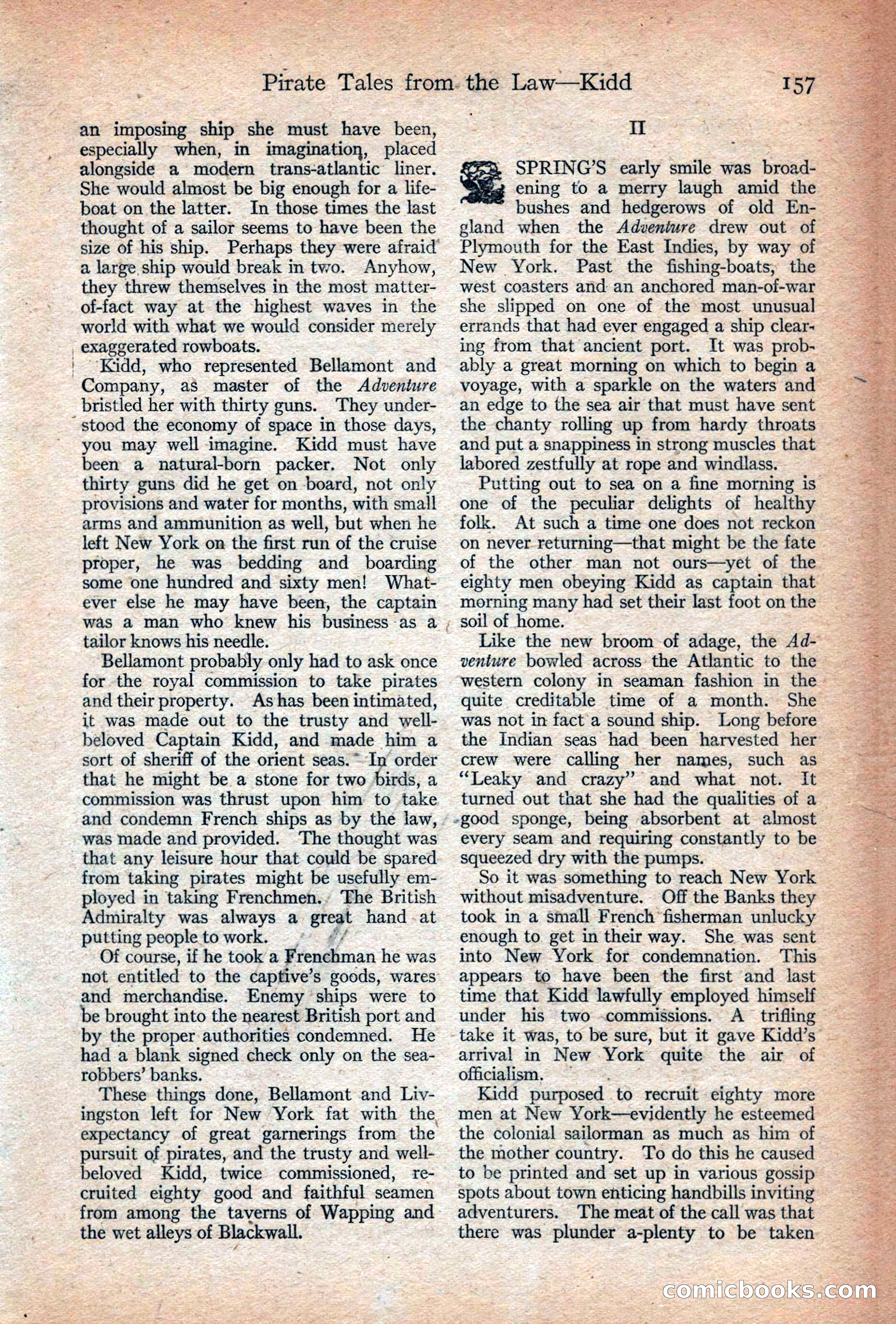
A restored page from Pulp Fiction, 1922. Page through the whole issue in the reader above.
📄 Transcribed text from this page (OCR, searchable)
Machine-transcribed from the original scan — historical spelling and the odd misread are preserved.
Pirate Tales from: the Law—Kidd an imposing ship she must have been, especially when, in imagination, placed alongside a modern trans-atlantic liner. She would almost be big enough for a life- boat on the latter. In those times the last thought of a sailor seems to have been the size of his ship. Perhaps they were afraid a large ship would break in two. Anyhow, they threw themselves in the most matter- of-fact way at the highest waves in the world with what we would consider merely exaggerated rowboats. ' ‘Kidd, who represented Bellamont and Company, as master of the Adventure bristled her with thirty guns. They under- stood the economy of space in those days, you may well imagine. Kidd must have been a natural-born packer. Not only thirty guns did he get on board, not only provisions and water for months, with smail arms and ammunition as well, but when he left New York on the first run of the cruise proper, he was bedding and_ boarding some one hundred and sixty men! What- ever else he may have been, the captain was a man who knew his business-as a ; tailor knows his needle. Bellamont probably only had to ask once for the royal commission to take pirates and their property. Ashas been intimated, it was made out to the trusty and well- beloved Captain Kidd, and made him a sort of sheriff of the orient seas. ~ In order that he might be a stone for two birds, a commission was thrust upon him to take and condemn French ships as by the law, - was made and provided. The thought was _ that any leisure hour that could be spared from taking pirates might be usefully em- ployed in taking Frenchmen., The British Admiralty was always a greg hand - at putting people to work. ~~ Of course, if he took a Frenchman he was not entitled to the captive’s goods, wares and merchandise. Enemy ships were to be brought into the nearest British port and by the proper authorities condemned. He had a blank signed check only on the sea- robbers’ banks. These things done, Bellamont and Liy- ingston left for New York fat with the. expectancy of great garnerings from the pursuit of pirates, and the trusty and well- beloved Kidd, twice commissioned, re- cruited eighty good and faithful seamen from among the taverns of Wapping and the wet alleys of Blackwall. SS Il ening to a merry laugh amid the : gland when the Adventure drew out of — Plymouth for the East Indies, by way of — ; < New York. Past the fishing-boats, the west coasters and an anchored man-of-war she slipped on one of the most unusual errands that had ever engaged a ship clears ing from that ancient port. It was prob- ably a great morning on which to begin a_ voyage, with a sparkle on the waters and an edge to the sea air that must have sent the chanty rolling up from hardy throats and put a snappiness in strong muscles that labored zestfully at rope and windlass. - Putting out to sea on a fine morning is. one of the peculiar delights of healthy folk. At such a time one does not reckon on never returning—that might be the fate - of the other man not ours—yet of the eighty men obeying Kidd as captain that morning many had set their last foot onthe __ soil of home. Like the new broom of adage, the Ad- venture bowled across the Atlantic to the western colony in seaman fashion in the quite creditable time of a month. She was not in fact a sound ship. Long before the Indian seas had been harvested her — pe crew were calling her names, such as “Leaky and crazy” turned out that she had the qualities of a_ ‘.good sponge, being absorbent at almost. every seam and requiring constantly to be squeezed dry with the pumps. So it was something to reach New York Bae without misadventure. Off the Banks they took in a small French fisherman unlucky enough to get in their way. She was sent — into New York for condemnation. This appears to have been the first and last time that Kidd lawfully employed himself under his two ~commissions. arrival in N ew York quite the air of officialism. Kidd purposed to recruit eighty more men at New York—evidently he esteemed the colonial sailorman as much as him of the mother country. To do this he caused to be printed and set up in various gossip spots about town enticing handbills inviting adventurers. The meat of the call was that there was plunder a-plenty to be taken. SPRING’S early smile was broad: = bushes and hedgerows of old En- — ‘and what not. “It = A trifing ‘take it was, to be sure, but it gave Kidd’s” VAM eS SA) baits hi ‘ ea, 3 ’ ; » Sih rT Bee Lr ou vais \ a4’ | Fe ct , ? : HD ¢ . Rav 4 p Vie. A "| Ws + ay Aik i. # yt 1 Me ths pe Rg oe ae Bas butt ts Wee + y ¥ A. oh ral «8 ‘ * Oey f " WG oe vi -ComiIrecboo Se yn as