
Pulp Fiction, 1922 · page 160 of 196
Adventure Magazine Cover — page 160: what you’re looking at
A restored page from Pulp Fiction, 1922. Page through the whole issue in the reader above.
📄 Transcribed text from this page (OCR, searchable)
Machine-transcribed from the original scan — historical spelling and the odd misread are preserved.
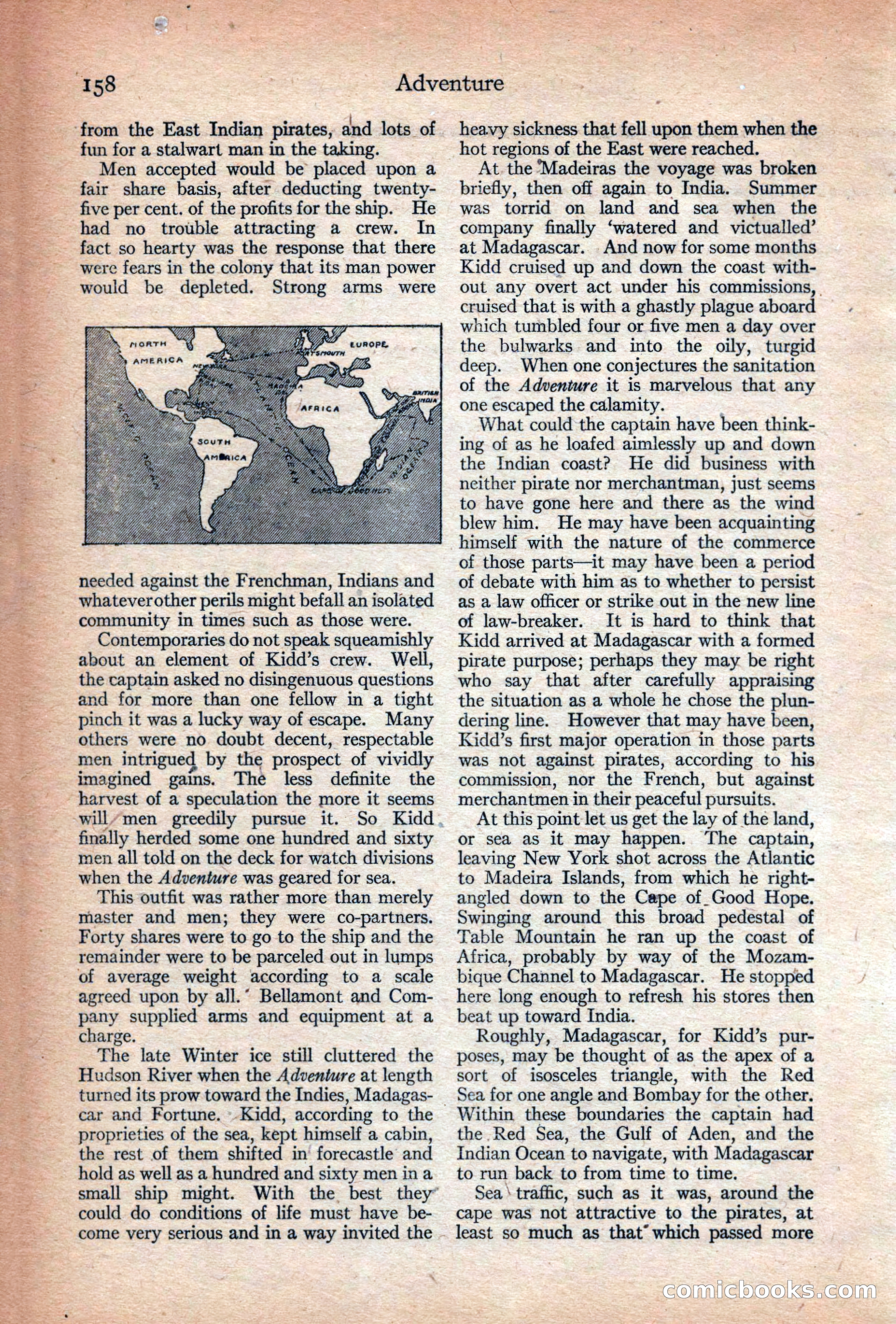
= had no trouble attracting a crew. fact so hearty was the response that there = ‘from the East Indian pirates, and lots of fun for a stalwart man in the taking. Men accepted would be placed upon a fair share basis, after deducting twenty- _ five per cent. of the profits for the ship. He In were fears in the colony that its man power would be depleted. Strong arms were MmoRTH ‘ AMERIC Se er Ly OW. wh iy é ies a #9 tii hi ip de > LM pM MYO) Gi Mis “y Yyy Uy Spy Wy needed against the Frenchman, Indians and whateverother perils might befall an isolated community in times such as those were. Contemporaries do not speak squeamishly about an element of Kidd’s crew. Well, the captain asked no disingenuous questions and for more than one fellow in a tight pinch it was a lucky way of escape. Many others were no doubt decent, respectable men intrigued by the prospect of vividly imagined gains. The less definite the harvest of a speculation the more it seems _ -willymen greedily pursue it. So Kidd, finally herded some one hundred and sixty men all told on the deck for watch divisions when the Adventure was geared for sea. This outfit was rather more than merely master and men; they were co-partners. Forty shares were to go to the ship and the remainder were to be parceled out in lumps of average weight according to a scale agreed upon by all.” Bellamont and Com- pany supplied arms and equipment at a charge. The late Winter ice still cluttered the Hudson River when the Adventure at length turned its prow toward the Indies, Madagas- car and Fortune. Kidd, according to the proprieties of the sea, kept himself a cabin, the rest of them shifted in forecastle and hold as well as a hundred and sixty men ina small ship might. could do conditions of life must have be- come very serious and in a way invited the - With the best they” Adventure » heavy sickness that fell upon them when the hot regions of the East were reached. At. the “Madeiras the voyage was broken briefly, then off again to India. Summer was torrid on land and sea when the company finally ‘watered and victualled’ at Madagascar. And now for some months Kidd cruised up and down the coast with- out any overt act under his commissions, | cruised that is with a ghastly plague aboard which tumbled four or five men a day over the bulwarks and into the oily, turgid deep. When one conjectures the sanitation of the Adventure it is marvelous that any one escaped the calamity. What could the captain have been think- ing of as he loafed aimlessly up and down the Indian coast? He did business with neither pirate nor merchantman, just seems to have gone here and there as the wind blew him. He may have been acquainting himself with the nature of the commerce of those parts—it may have been a period of debate with him as to whether to persist as a law officer or strike out in the new line of law-breaker. It is hard to think that Kidd arrived at Madagascar with a formed pirate purpose; perhaps they may be right who say that after carefully appraising the situation as a whole he chose the plun- dering line. However that may have been, Kidd’s first major operation in those parts was not against pirates, according to his commission, nor the French, but against merchantmen in their peaceful pursuits. At this point let us get the lay of the land, or sea as it may happen. The captain, leaving New York shot across the Atlantic to Madeira Islands, from which he right- angled down to the Cape of_Good Hope. Swinging around this broad pedestal of Table Mountain he ran up the coast of Africa, probably by way of the Mozam- bique Channel to Madagascar. He stopped here long enough to refresh his stores then beat up toward India. Roughly, Madagascar, for Kidd’s pur- poses, may be thought of as the apex of a sort of isosceles triangle, with the Red Sea for one angle and Bombay for the other. - Within these boundaries the captain had the Red Sea, the Gulf of Aden, and the Indian Ocean to navigate, with Madagascar to run back to from time to time. Sea \ traffic, such as it was, around the cape was not attractive to the pirates, at least so much as that’ which passed more 0)(0)(0) (E@)