
Pulp Fiction, 1922 · page 158 of 196
Adventure Magazine Cover — page 158: what you’re looking at
A restored page from Pulp Fiction, 1922. Page through the whole issue in the reader above.
📄 Transcribed text from this page (OCR, searchable)
Machine-transcribed from the original scan — historical spelling and the odd misread are preserved.
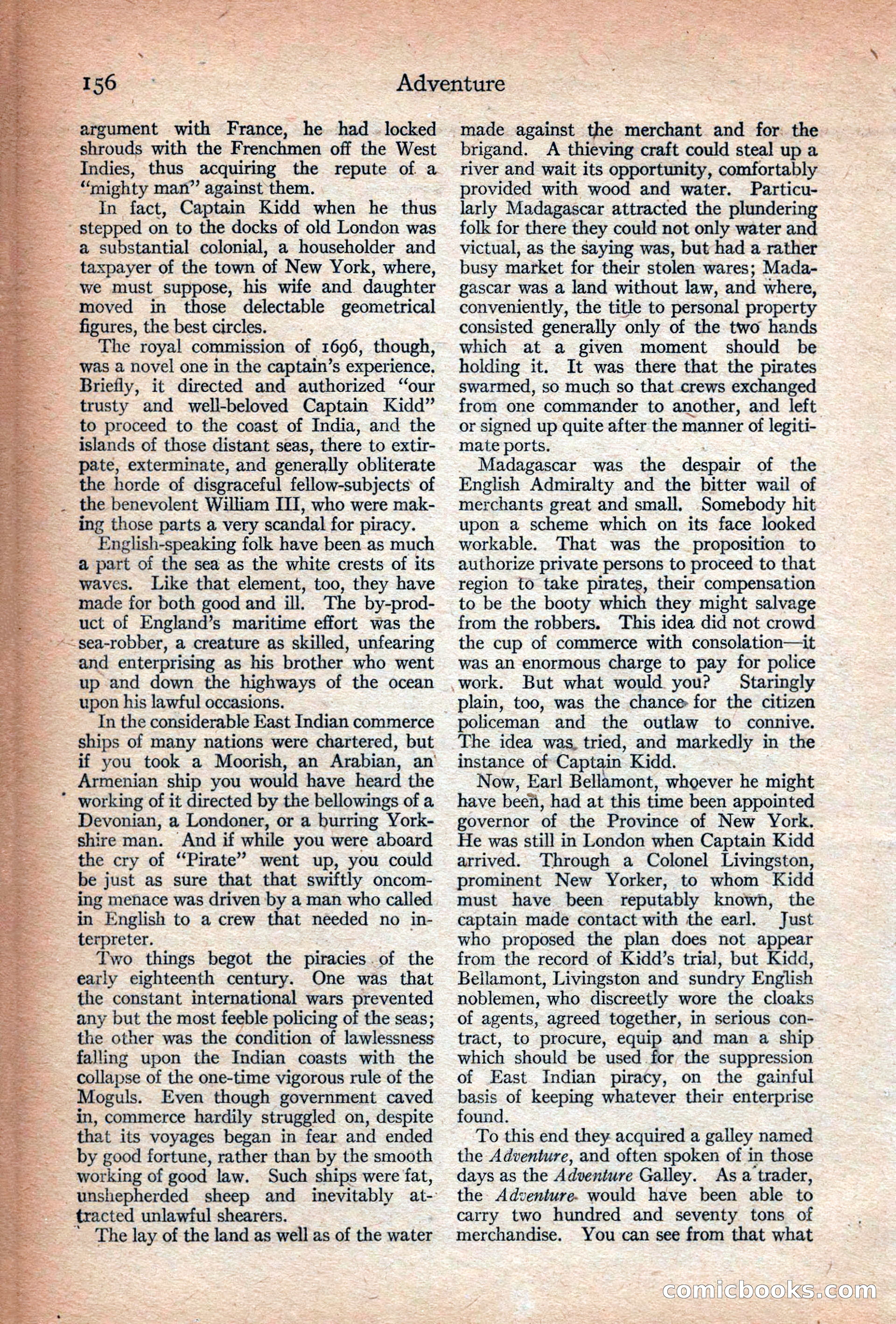
; Sond: with the Frenchmen off the West pe thus acquiring the repute of a “mighty man” against them. In fact, Captain Kidd when he thus ~ stepped on to the docks of old London was a substantial colonial, a householder and mapaver of the town of New York, where, we must suppose, his wife and. daughter moved in those delectable geometrical _ figures, the best circles. The royal commission of 1696, though, ‘was a novel one in the captain’s experience. Prielly. it directed and authorized “our trusty and well-beloved Captain Kidd” to proceed to the coast of India, and the _ islands of those distant seas, there to extir- _ pate, exterminate, and generally obliterate the horde of disgraceful fellow-subjects of - the benevolent William III, who were mak- ing those parts a very scandal for piracy. _ English-speaking folk have been as much _-—« a part of the sea as the white crests of its waves. Like that element, too, they have : as made for both good and ill. The by-prod- -. _uct of England’s maritime effort was the '_ *<sea-robber, a creature as skilled, unfearing = = and enterprising as his brother who went up and down the highways of the ocean upon his lawful occasions. a In the considerable East Indian commerce -__ ships of many nations were chartered, but if you took a Moorish, an Arabian, an’ Armenian ship you would have heard the " working of it directed by the bellowings of a - Devonian, a Londoner, or a burring York- shire man. ‘And if while you were aboard = = the cry of “Pirate” went up, you could be just as sure that that swiftly oncom- _. ing menace was driven by a man who called : in English to a crew that needed no in- terpreter. Two things begot the piracies . of the early eighteenth century. One was that the constant international wars prevented any but the most feeble policing of the seas; the other was the condition of lawlessness falling upon the Indian coasts with the _ collapse of the one-time vigorous rule of the — Moguls. Even though government caved _ in, commerce hardily struggled on, despite that its voyages began in fear and ended __ by good fortune, rather than by the smooth ‘working of good law. Such ships were fat, -_ unshepherded sheep and _ inevitably at - tracted unlawful shearers. ‘ The lay of the land as well as of the water a -. i -work. But what would you? brigand. A thieving craft could steal up a river and wait its opportunity, comfortably provided with wood and water. Particu- larly Madagascar attracted the plundering folk for there they could not only water and victual, as the saying was, but had a rather busy market for their stolen wares; Mada- gascar was a land without law, and where, conveniently, the title to personal property consisted generally only of the two hands which at a given moment should be holding it. It was there that the pirates swarmed, so much so that crews exchanged from one commander to another, and left or signed up quite after the manner of legiti- mate ports. . _ Madagascar was the despair of the English Admiralty and the bitter wail of merchants great and small. Somebody hit upon a scheme which on its face looked workable. That was the proposition to authorize private persons to proceed to that region to take pirates, their compensation to be the booty which they might salvage from the robbers. This idea did not crowd the cup of commerce with consolation—it neae ee the merchant and for: the | was an enormous charge to pay for police © Staringly plain, too, was the chance for the citizen policeman and the outlaw to connive. The idea was, tried, and markedly in the instance of Captain Kidd. . Now, Earl Bellamont, whoever he might have bech, had at this time been appointed governor of the Province of New York, He was still in London when Captain Kidd arrived. Through a Colonel Livingston, prominent New Yorker, to whom Kidd must have been. reputably known, the captain made contact with the earl. Just who proposed the plan does not appear from the record of Kidd’s trial, but Kidd, Bellamont, Livingston and sundry English noblemen, who discreetly wore the cloaks of agents, agreed together, in serious con- tract, to procure, equip and man a ship which should be used for the suppression of East Indian piracy, on the gainful basis of keeping whatever their enterprise found. To this end they acquired a galley named the Adventure, and often spoken of in those days as the Adventure Galley. As a trader, the Adventure. would have been able to carry two hundred and seventy tons of merchandise. You can see from that what COLIC OOOKS (E©)