
Pulp Fiction, 1922 · page 157 of 196
Adventure Magazine Cover — page 157: what you’re looking at
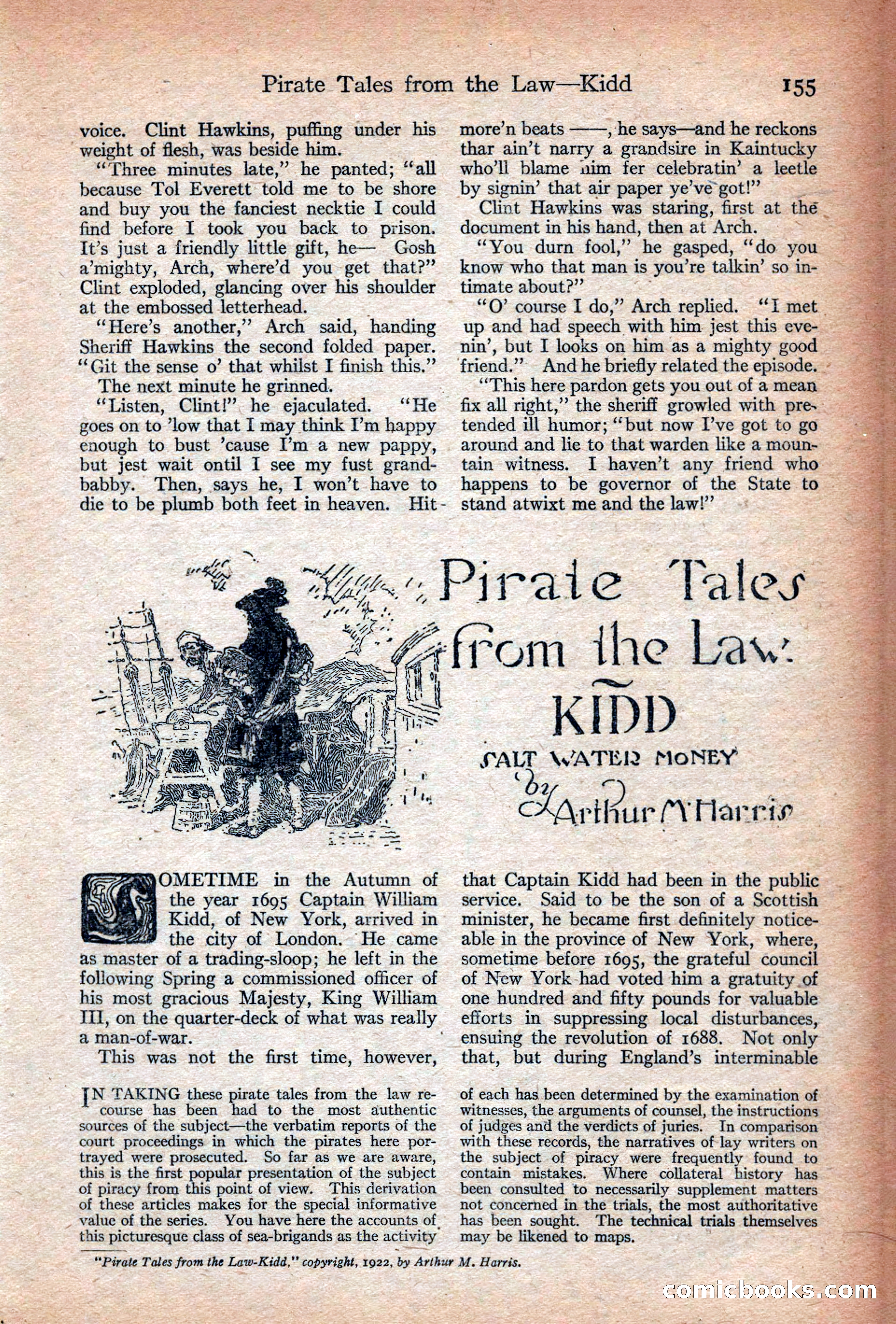
A restored page from Pulp Fiction, 1922. Page through the whole issue in the reader above.
📄 Transcribed text from this page (OCR, searchable)
Machine-transcribed from the original scan — historical spelling and the odd misread are preserved.
eae Pirate. Tales from the Law—Kidd voice. Clint Hawkins, puffing under his weight of flesh, was beside him. \ “Three minutes late,” he panted; ‘ ‘all because Tol Everett told me to be shore and buy you the fanciest necktie I could find before I took you back to prison. It’s just a friendly little gift, he— Gosh a’mighty, Arch, where’d you get that?” Clint exploded, glancing over his shoulder at the embossed letterhead. “Here’s another,’ Arch said, handing Sheriff Hawkins the second folded paper. “Git the sense o’ that whilst I finish this.” The next minute he grinned. “Listen, Clint!” he ejaculated. goes on to “low that I may think I’m happy enough to bust ’cause I’m a new pappy, but jest wait ontil I see my fust grand- babby. Then, says he, I won’t have to die to be plumb both feet in heaven. Hit- Mle vs Py raiec q" rom the Law. see \ el " Eye in the Autumn of the year 1695 Captain William a Kidd, of New York, arrived in the city of London. He came as master of a trading-sloop; he left in the following Spring a commissioned officer of his most gracious Majesty, King William Tit, on the quarter-deck of what was really a man-of-war. This was not the first time, however, [N TAKING these pirate tales from the law re- course has been had to the most authentic sources of the subject—the verbatim reports of the court proceedings in which the pirates here por- trayed were prosecuted. So far as we are aware, this is the first popular presentation of the subject of piracy from this point of view. This derivation of these articles makes for the special informative value of the series. You have here the accounts of. this picturesque class of sea-brigands as the activity cg: “Pirate Tales from the Law-Kidd,"’ copyright, 1922, oe Arthur M. Harris. - by signin’ that air paper ye’ve got! timate about?”’ ihe 7 “He more’n beats ——,, he says—and he fect thar ain’t narry a grandsire in Kaintucky who'll blame uim fer celebratin’ a leetle ~ }?? Clint Hawkins was staring, first at the _ document in his hand, then at Arch. > “You durn fool,” ‘he gasped, “do. 4 know who that man is you ’re talkin’ so in-— “‘O’ course I do,” Arch replied. up and had speech with him jest this eve-— nin’, but T looks on him as a mighty good a os 3 met 2s n<¢ And he briefly related the episode, - = ‘This here pardon gets yououtofamean fix all right,” the sheriff growled with pre. tended ill humor; “but now I’ve got to go around and lie to that warden like amoun- tain witness. I hayen’t any friend who — happens to be governor of the State to. stand atwixt me and the leet - KIDD eae WATER MONEY Laotian Harri that Captain Kidd had been-i in the pubes: service. minister, he became first definitely notice- able in the province of New York, where, sometime before 1695, the grateful council of New York-had voted him a gratuity of one hundred and fifty pounds for valuable efforts in suppressing local disturbances, ‘ensuing the revolution of 1688. Not only that, but during England’s interminable lales — Said to be the son of a Scottish = of each has been determined by the examination of witnesses, the arguments of counsel, the instructions oe of judges and the verdicts of juries. with these records, the narratives of lay writers on In comparison the subject of piracy were frequently found to contain mistakes. Where collateral history has been consulted to necessarily supplement matters not concerned in the trials, the most authoritative — has been sought. may be likened to maps. The technical trials. themselves ea . JOO