
Pulp Fiction, 1922 · page 156 of 196
Adventure Magazine Cover — page 156: what you’re looking at
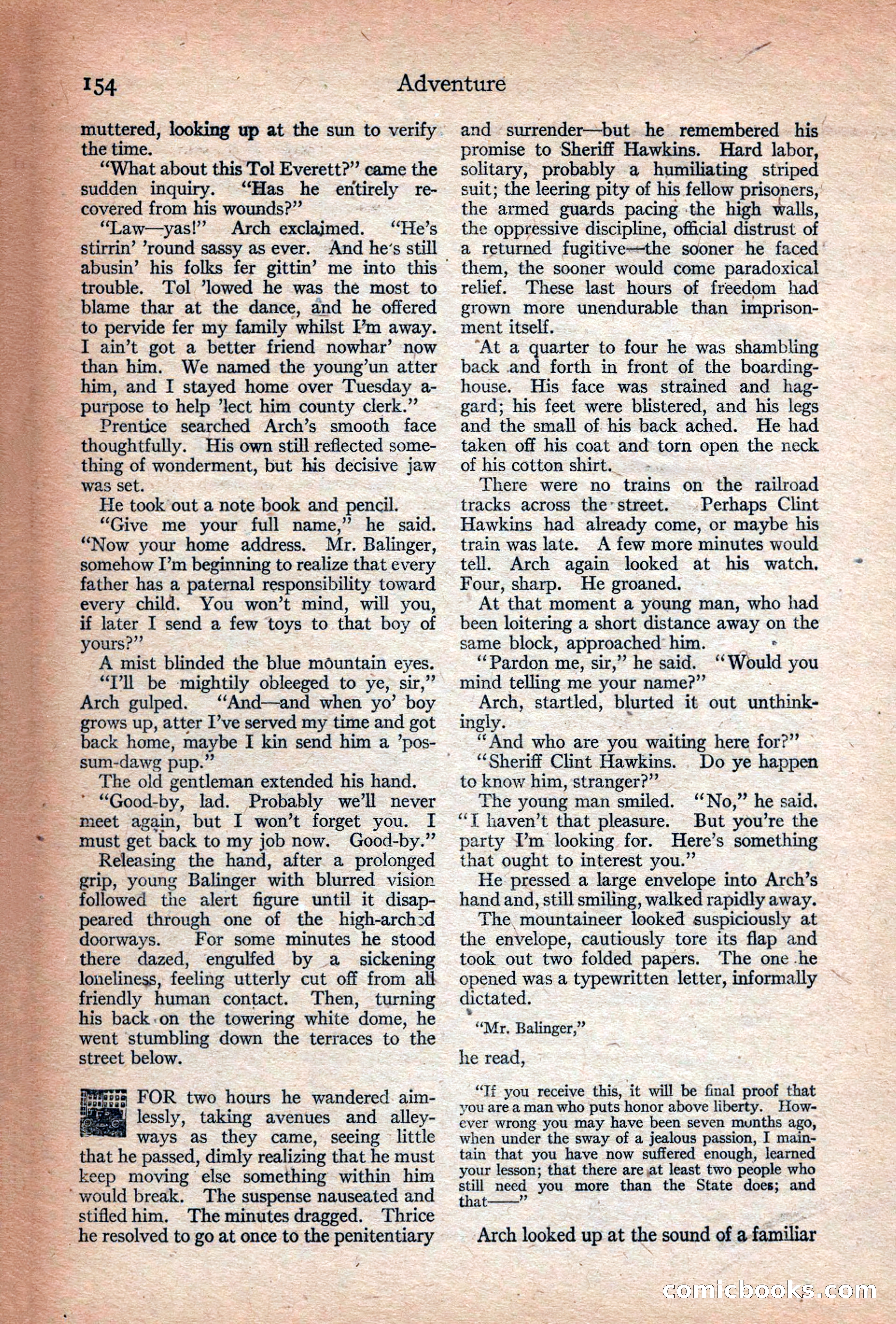
A restored page from Pulp Fiction, 1922. Page through the whole issue in the reader above.
📄 Transcribed text from this page (OCR, searchable)
Machine-transcribed from the original scan — historical spelling and the odd misread are preserved.
thetime. — = “What about this Tol Everett?” came the Sa sudden inquiry. “Has he entirely re- = povared from his wounds?” “Law—yas!” Arch exclajmed. “He’s > stirrin’ ‘round sassy as ever. And he’s still 1 Tol ‘lowed he was the most to me thar at the dance, and he offered ~ to pervide fer my family ‘whilst Pm away. = ain’t got a better friend nowhar’ now _ than him. We named the young’un atter _ him, and I stayed home over Tuesday a- : = purpose to help “lect him county clerk.” ___ Prentice searched Arch’s smooth face | thoughtfully. His own still reflected some- oe of wonderment, but his decisive jaw was set. ‘He took’out a note book and pencil. = “Give me your full name,” he said. - “Now your home address. Mr. Balinger, somehow I’m beginning to realize that every ___ father has a paternal responsibility toward every child. You won’t mind, will you, iE inter I send a few toys to that boy of a. yours?” A mist blinded the blue mountain eyes. — “Pil be mightily obleeged to ye, sir,” Arch gulped. ‘“And—and when yo’ boy _—-_—s grows up, atter I’ve served my time and got — sum-dawg pup.’ The old gentleman extended his hand. es. = a “Good-by, lad. Probably we'll never meet again, but I won’t forget you. I -* ‘must get back to my job now. Good-by.” Ss = Releasing the hand, after a prolonged _ grip, young Balinger with blurred vision Bs followed the alert figure until it disap- ae through one of the high-archod _ doorways. For some minutes he stood _ there dazed, engulfed by a sickening ; loneliness, feeling utterly cut off from alk friendly human contact. Then, turning _ his back.on the towering white ‘dome, he a fe weet ‘stumbling down the terraces to ’ the street below. = ae FOR two hours he wandered. aim- gape lessly, taking avenues and alley- +a ways as they came, seeing little = 2 3 “that he passed, dimly realizing that he must i keep moving else something within him ‘would break. The suspense nauseated and stifled him. The minutes dragged. Thrice SS ate resolved to go at once to the penitentiary Bd =a = . Siricteered, sooksing up at : the sun to verify s busin’ his folks fer gittin’ me into this — back home, maybe I kin send him a ’pos- | Bea, eee st aera a tig ee a ESR IE ny PE ett Eng en oe er gee a oe I a ip een ey ee ee = oe SE On a oe ee SR ee ee * = Ae an atte OR RE a = ae Saaz : — OR arr eS. a * 28 i = 3 ik, Po Sere ose ota aes ay =: tous Say. es, 0 ast a —— - Pipe eae ne ae CASSIS “ re meas = oe -s!= ; ; ce re =a Sn Rae ; pie DSS Hee ere ==> ‘ - +. se ae - oe SS 7 > a —- — _ J - ae of 2 : « and - surrender—but. he remembered his promise to Sheriff Hawkins. Hard labor, solitary, probably a humiliating striped suit; the leering pity of his fellow priso a the armed guards pacing the high the oppressive discipline, official distrust of a returned fugitive—the sooner he faced’ them, the sooner would come paradoxical relief. grown more unendurable than imprison- ment itself. “At a quarter to four he was shambling back soa forth in front of the boarding- house. His face was strained and hag- gard; his feet were blistered, and his legs and the small of his back ached. He had taken off his coat and torn open the neck of his cotton shirt. —- There were no trains on the railroad tracks across the’street. Perhaps Clint Hawkins had already come, or maybe his train was late. A few more minutes would tell. Arch again looked at his watch, Four, sharp. He groaned. At that moment a young man, who had been loitering a short distance away on the same block, approached him. — = “Pardon me, sir,” he said. “Would you mind telling me your name?” Arch, startled, blurted it out unthink- ingly. “And who are you waiting heme for?” “Sheriff Clint Hawkins. . Do ye happen to know him, stranger?” - The young man smiled. ‘‘No,” he said. “TY haven’t that pleasure. But you’re the party I’m looking for. Here’s something that ought to interest you.” He pressed a large envelope into Arch’s These last hours of freedom had ~ hand and, still smiling, walked rapidly away. — The mountaineer looked suspiciously at the envelope, cautiously tore its flap and took out two folded papers. The one -he opened was a typewritten letter, informally ~ dictated. “Mr, Balinger,” he read, “Tf you receive this, it will be final proof that you are a man who puts honor above liberty. How- ever wrong you may have been seven munths ago, when under the sway of a jealous passion, I main- tain that you have now suffered enough, learned your lesson; that there are,at least two people who te need you more than the State does; and 2t——— ‘Arch looked up at the sound of a-familiar (CO) MICLOOOKS (O)