
Pulp Fiction, 1922 · page 184 of 200
Adventure Magazine Cover — page 184: what you’re looking at
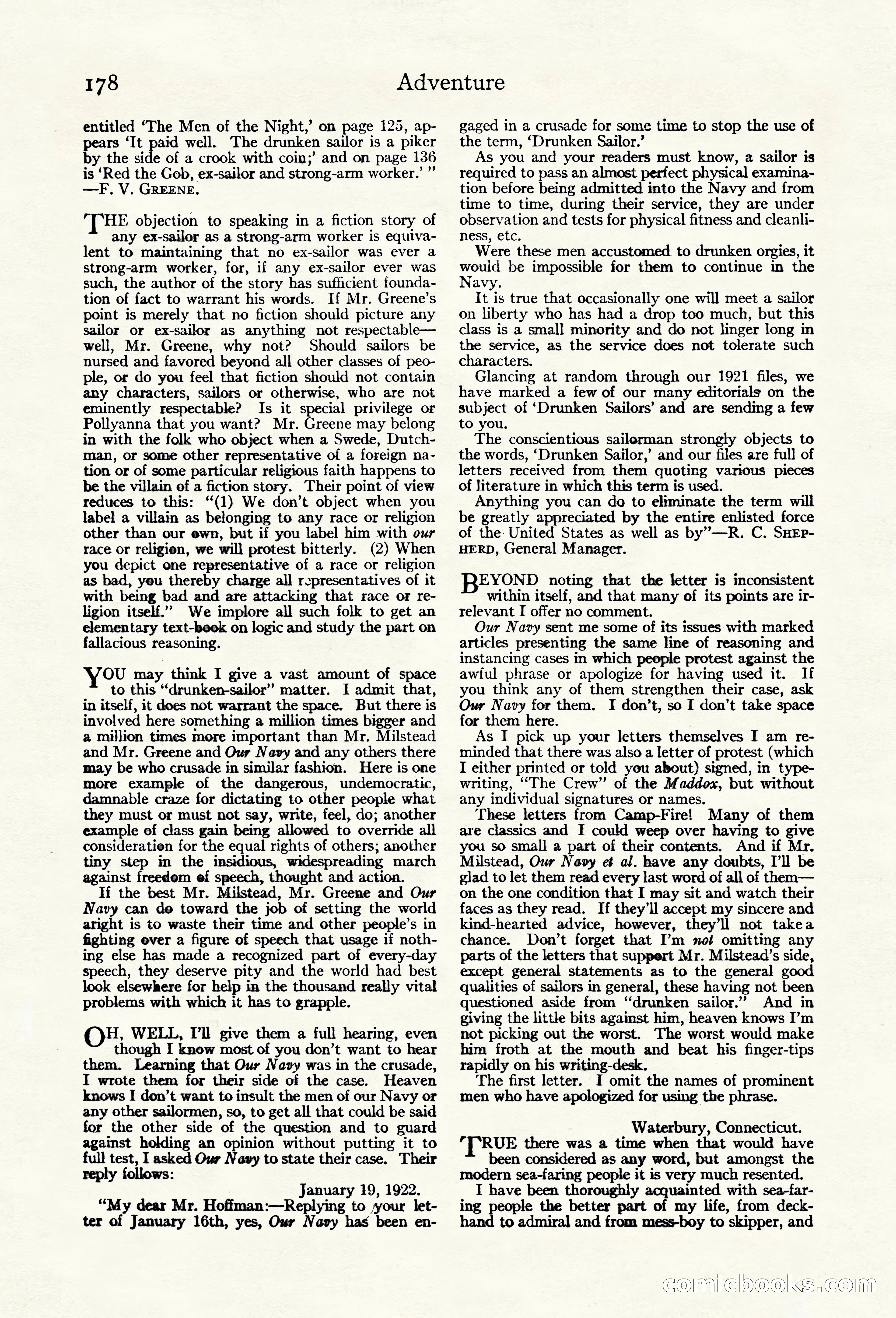
A restored page from Pulp Fiction, 1922. Page through the whole issue in the reader above.
📄 Transcribed text from this page (OCR, searchable)
Machine-transcribed from the original scan — historical spelling and the odd misread are preserved.
178 entitled ‘The Men of the Night,’ on page 125, ap- pears ‘It paid well. The drunken sailor is a piker by the side of a crook with coin;’ and on page 136 is ‘Red the Gob, ex-sailor and strong-arm worker.’ ” —F. V. GREENE. "THE objection to speaking in a fiction story of any ex-sailor as a strong-arm worker is equiva- lent to maintaining that no ex-sailor was ever a strong-arm worker, for, if any ex-sailor ever was such, the author of the story has sufficient founda- tion of fact to warrant his words. If Mr. Greene’s point is merely that no fiction should picture any sailor or ex-sailor as anything not respectable— well, Mr. Greene, why not? Should sailors be nursed and favored beyond all other classes of peo- ple, or do you feel that fiction should not contain any characters, sailors or otherwise, who are not eminently respectable? Is it special privilege or Pollyanna that you want? Mr. Greene may belong in with the folk who object when a Swede, Dutch- man, or some other representative of a foreign na- tion or of some particular religious faith happens to be the villain of a fiction story. Their point of view reduces to this: ‘(1) We don’t object when you label a villain as belonging to any race or religion other than our ewn, but if you label him with our race or religien, we will protest bitterly. (2) When you depict one representative of a race or religion as bad, you thereby charge all representatives of it with being bad and are attacking that race or re- ligion itself.”” We implore all such folk to get an elementary text-book on logic and study the part on fallacious reasoning. you may think I give a vast amount of space to this “drunken-sailor” matter. I admit that, in itself, it does not warrant the space. But there is involved here something a million times bigger and a million times more important than Mr. Milstead and Mr. Greene and Our Navy and any others there may be who crusade in similar fashion. Here is one more example of the dangerous, undemocratic, damnable craze for dictating to other people what they must or must not say, write, feel, do; another example of class gain being allowed to override all consideratien for the equal rights of others; another tiny step in the insidious, widespreading march against freedem ef speech, thought and action. If the best Mr. Milstead, Mr. Greene and Our Navy can de toward the job of setting the world aright is to waste their time and other people’s in fighting ever a figure of speech that usage if noth- ing else has made a recognized part of every-day speech, they deserve pity and the world had best look elsewhere for help in the thousand really vital problems with which it has to grapple. OH, WELL, I'll give them a full hearing, even though I know most of you don’t want to hear them. Learning that Our Navy was in the crusade, I wrote them for their side of the case. Heaven knows I don’t want to insult the men of our Navy or any other sailormen, so, to get all that could be said for the other side of the question and to guard against holding an opinion without putting it to full test, I asked Our Navy to state their case. Their reply follows: January 19, 1922. “My dear Mr. Hoffman:—Replying to jour let- ter of January 16th, yes, Our Navy has been en- Adventure gaged in a crusade for some time to stop the use of the term, ‘Drunken Sailor.’ As you and your readers must know, a sailor ts required to pass an almost perfect physical examina- tion before being admitted into the Navy and from time to time, during their service, they are under observation and tests for physical fitness and cleanli- ness, etc. Were these men accustomed to drunken orgies, it would be impossible for them to continue in the Navy. It is true that occasionally one will meet a sailor on liberty who has had a drop too much, but this class is a small minority and do not linger long in the service, as the service does not tolerate such characters. Glancing at random through our 1921 files, we have marked a few of our many editorials on the subject of ‘Drunken Sailors’ and are sending a few to you. The conscientious sailorman strongly objects to the words, ‘Drunken Sailor,’ and our files are full of letters received from them quoting various pieces of literature in which this term is used. Anything you can do to eliminate the term will be greatly appreciated by the entire enlisted force of the United States as well as by”—R. C. SHEP- HERD, General Manager. BEYOND noting that the letter is inconsistent within itself, and that many of its points are ir- relevant I offer no comment. Our Navy sent me some of its issues with marked articles presenting the same line of reasoning and instancing cases in which people protest against the awful phrase or apologize for having used it. If you think any of them strengthen their case, ask Our Navy for them. I don’t, so I don’t take space for them here. : As I pick up your letters themselves I am re- minded that there was also a letter of protest (which I either printed or told you about) signed, in type- writing, ‘“The Crew” of the Maddox, but without any individual signatures or names. These letters from Camp-Fire! Many of them are classics and I could weep over having to give you so small a part of their contents. And if Mr. Milstead, Our Navy et al. have any doubts, I’ll be glad to let them read every last word of all of them— on the one condition that I may sit and watch their faces as they read. If they'll accept my sincere and kind-hearted advice, however, they’ll not ee : chance. Don’t forget that I’m not omit parts of the letters that suppert Mr. Milstead’s ada except general statements as to the general good qualities of sailors in general, these having not been questioned aside from “drunken sailor.’ And in giving the little bits against him, heaven knows I’m not picking out the worst. The worst would make him froth at the mouth and beat his finger-tips rapidly on his writing-desk. The first letter. I omit the names of prominent men who have apologized for using the phrase. Waterbury, Connecticut. ‘TRUE there was a time when that would have been considered as any word, but amongst the modern sea-faring people it is very much resented. I have been thoroughly acquainted with sea-far- ing people the better part of my life, from deck- hand to admiral and from mess-boy to skipper, and MICLOOOKS C@