
Pulp Fiction, 1922 · page 185 of 200
Adventure Magazine Cover — page 185: what you’re looking at
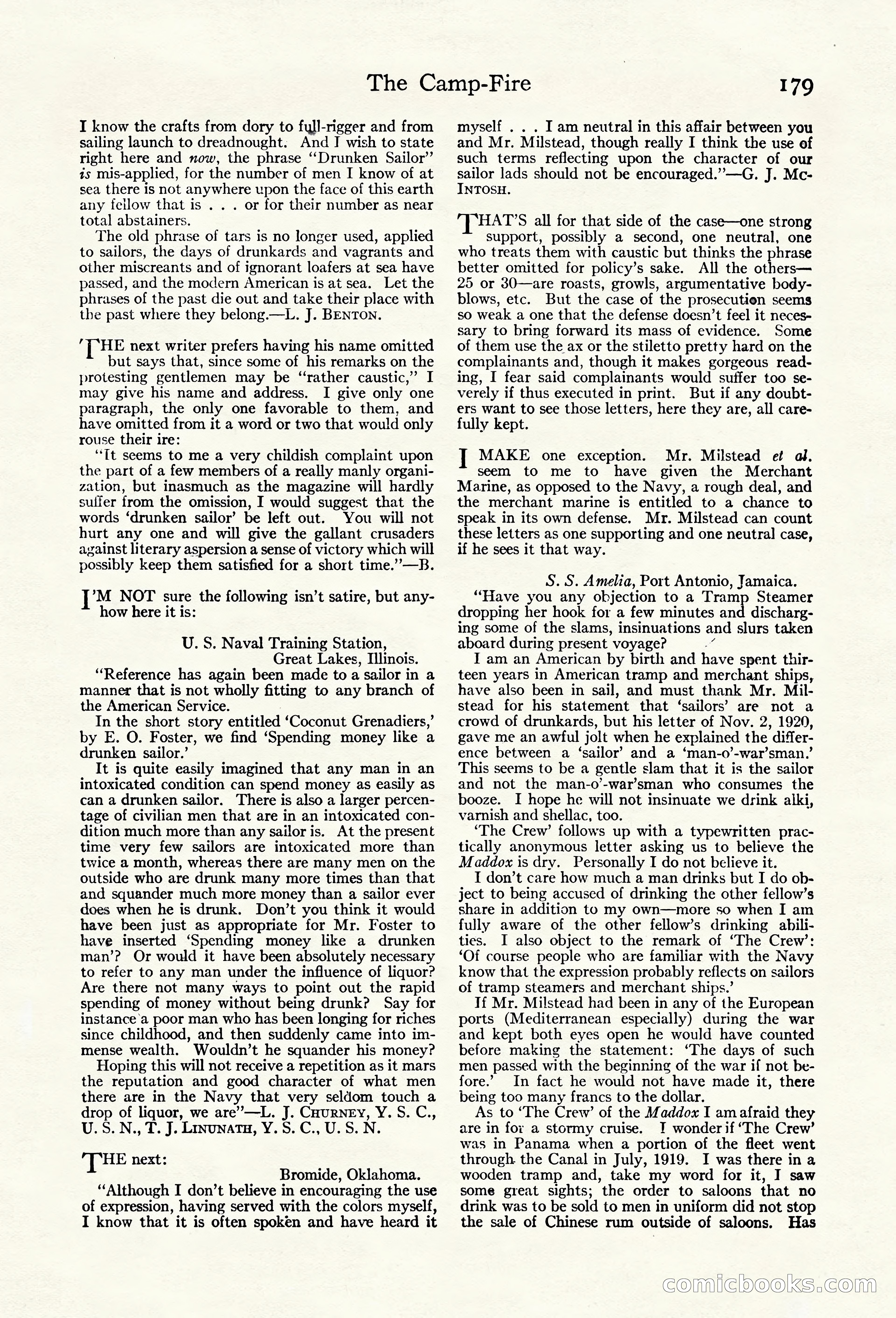
A restored page from Pulp Fiction, 1922. Page through the whole issue in the reader above.
📄 Transcribed text from this page (OCR, searchable)
Machine-transcribed from the original scan — historical spelling and the odd misread are preserved.
The Camp-Fire I know the crafts from dory to fuyll-rigger and from sailing launch to dreadnought. And I wish to state right here and now, the phrase “Drunken Sailor’ ts mis-applied, for the number of men I know of at sea there is not anywhere upon the face of this earth any fellow that is . . . or for their number as near total abstainers. The old phrase of tars is no longer used, applied to sailors, the days of drunkards and vagrants and other miscreants and of ignorant loafers at sea have passed, and the modern American is at sea. Let the phrases of the past die out and take their place with the past where they belong.—L. J. BENTON. ‘THE next writer prefers having his name omitted but says that, since some of his remarks on the protesting gentlemen may be “rather caustic,” I may give his name and address. I give only one paragraph, the only one favorable to them, and have omitted from it a word or two that would only rouse their ire: ‘“‘[t seems to me a very childish complaint upon the part of a few members of a really manly organi- zation, but inasmuch as the magazine will hardly suffer from the omission, I would suggest that the words ‘drunken sailor’ be left out. You will not hurt any one and will give the gallant crusaders against literary aspersion a sense of victory which will possibly keep them satisfied for a short time.”—B. [™M NOT sure the following isn’t satire, but any- how here it is: U. S. Naval Training Station, Great Lakes, Illinois. “Reference has again been made to a sailor in a manner that is not wholly fitting to any branch of the American Service. . In the short story entitled ‘Coconut Grenadiers,’ by E. O. Foster, we find ‘Spending money like a drunken sailor.’ It is quite easily imagined that any man in an intoxicated condition can spend money as easily as can a drunken sailor. There is also a larger percen- tage of civilian men that are in an intoxicated con- dition much more than any sailor is. At the present time very few sailors are intoxicated more than twice a month, whereas there are many men on the outside who are drunk many more times than that and squander much more money than a sailor ever does when he is drunk. Don’t you think it would have been just as appropriate for Mr. Foster to have inserted ‘Spending money like a drunken man’? Or would it have been absolutely necessary to refer to any man under the influence of liquor? Are there not many ways to point out the rapid spending of money without being drunk? Say for instance'a poor man who has been longing for riches since childhood, and then suddenly came into im- mense wealth. Wouldn’t he squander his money? Hoping this will not receive a repetition as it mars the reputation and good character of what men there are in the Navy that very seldom touch a drop of liquor, we are’—L. J. CHuRNEY, Y. S. C., U.S.N., T. J. Linunata, Y.S.C., U.S. N. "THE next: Bromide, Oklahoma. ‘“‘Although I don’t believe in encouraging the use of expression, having served with the colors myself, I know that it is often spoken and have heard it 179 myself . . . Iam neutral in this affair between you and Mr. Milstead, though really I think the use of such terms reflecting upon the character of our sailor lads should not be encouraged.’ —G. J. Mc- INTOSH. ‘THAT'S all for that side of the case—one strong support, possibly a second, one neutral, one who treats them with caustic but thinks the phrase better omitted for policy’s sake. All the others— 29 or 30—are roasts, growls, argumentative body- blows, etc. But the case of the prosecution seems so weak a one that the defense doesn’t feel it neces- sary to bring forward its mass of evidence. Some of them use the ax or the stiletto pretty hard on the complainants and, though it makes gorgeous read- ing, I fear said complainants would suffer too se- verely if thus executed in print. But if any doubt- ers want to see those letters, here they are, all care- fully kept. | MAKE one exception. Mr. Milstead et al. seem to me to have given the Merchant Marine, as opposed to the Navy, a rough deal, and the merchant marine is entitled to a chance to speak in its own defense. Mr. Milstead can count these letters as one supporting and one neutral case, if he sees it that way. S. S. Amelia, Port Antonio, Jamaica. “Have you any objection to a Tramp Steamer dropping her hook for a few minutes and discharg- ing some of the slams, insinuations and slurs taken aboard during present voyage? I am an American by birth and have spent thir- teen years in American tramp and merchant ships, have also been in sail, and must thank Mr. Mil- stead for his statement that ‘sailors’ are not a crowd of drunkards, but his letter of Nov. 2, 1920, gave me an awful jolt when he explained the differ- ence between a ‘sailor’ and a ‘man-o’-war’sman.’ This seems to be a gentle slam that it is the sailor and not the man-o’-war’sman who consumes the booze. I hope he will not insinuate we drink alki, varnish and shellac, too. ‘The Crew’ follows up with a typewritten prac- tically anonymous letter asking us to believe the Maddox is dry. Personally I do not believe it. I don’t care how much a man drinks but I do ob- ject to being accused of drinking the other fellow’s share in addition to my own—more so when I am fully aware of the other fellow’s drinking abili- ties. I also object to the remark of ‘The Crew’: ‘Of course people who are familiar with the Navy know that the expression probably reflects on sailors of tramp steamers and merchant ships.’ If Mr. Milstead had been in any of the European ports (Mediterranean especially) during the war and kept both eyes open he would have counted before making the statement: “The days of such men passed with the beginning of the war if not be- fore.’ In fact he would not have made it, there being too many francs to the dollar. As to ‘The Crew’ of the Maddox I am afraid they are in fox a stormy cruise. J wonder if ‘The Crew’ was in Panama when a portion of the fleet went through the Canal in July, 1919. I was there in a wooden tramp and, take my word for it, I saw some great sights; the order to saloons that no drink was to be sold to men in uniform did not stop the sale of Chinese rum outside of saloons. Has DOO) AMG SS (©