
Pulp Fiction, 1922 · page 183 of 200
Adventure Magazine Cover — page 183: what you’re looking at
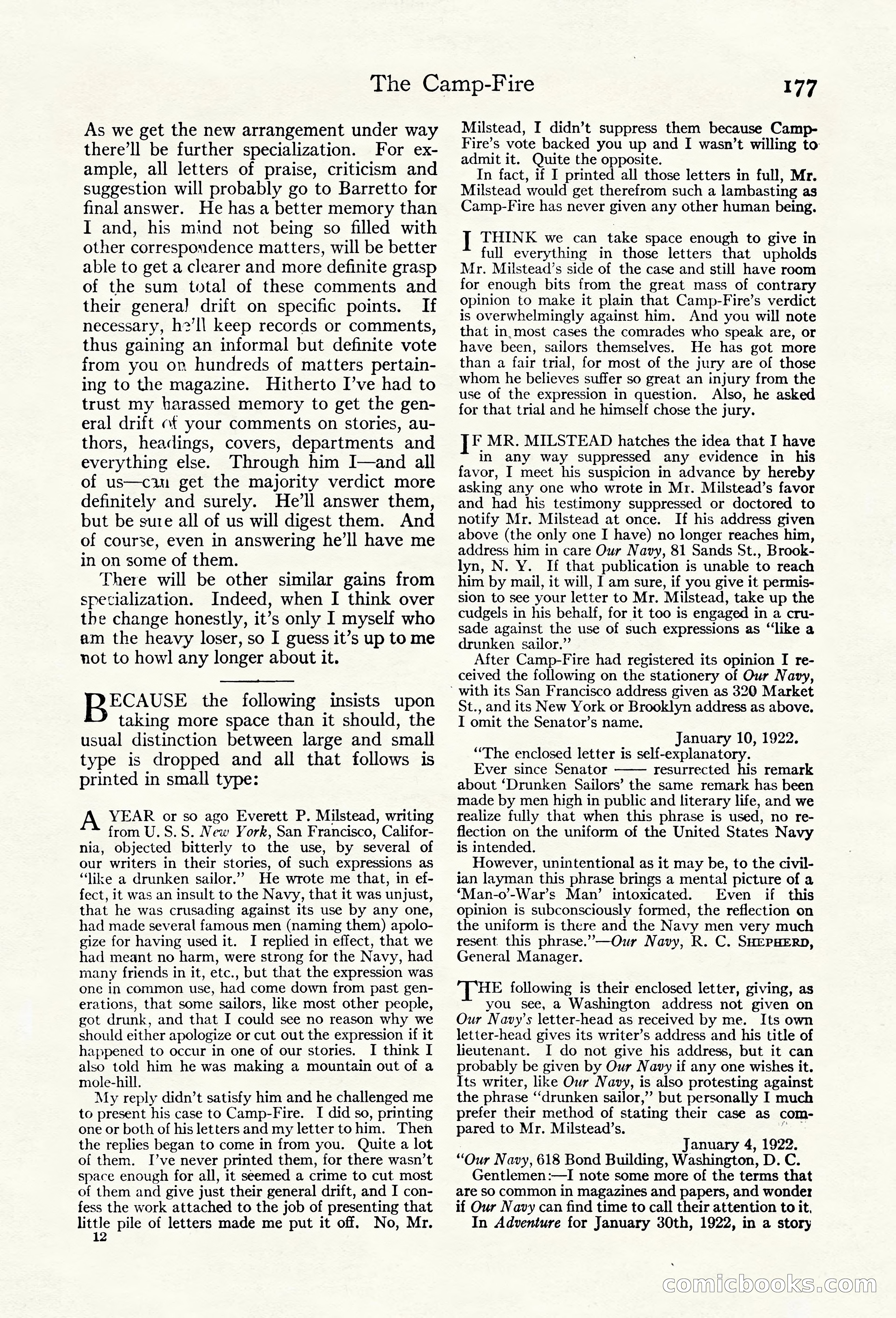
A restored page from Pulp Fiction, 1922. Page through the whole issue in the reader above.
📄 Transcribed text from this page (OCR, searchable)
Machine-transcribed from the original scan — historical spelling and the odd misread are preserved.
The Camp-Fire As we get the new arrangement under way there’ll be further specialization. For ex- ample, all letters of praise, criticism and suggestion will probably go to Barretto for final answer. He has a better memory than I and, his mind not being so filled with other correspondence matters, will be better able to get a clearer and more definite grasp of the sum total of these comments and their genera) drift on specific points. If necessary, h2’ll keep records or comments, thus gaining an informal but definite vote from you on hundreds of matters pertain- ing to the magazine. Hitherto I’ve had to trust my harassed memory to get the gen- eral drift «{ your comments on stories, au- thors, headings, covers, departments and everything else. Through him IJ—and all of us—cin get the majority verdict more definitely and surely. He'll answer them, but be sure all of us will digest them. And of course, even in answering he’ll have me in on some of them. There will be other similar gains from specialization. Indeed, when I think over the change honestly, it’s only I myself who am the heavy loser, so I guess it’s up to me not to howl any longer about it. eens the following insists upon 4/ taking more space than it should, the usual distinction between large and small type is dropped and all that follows is printed in small type: A YEAR or so ago Everett P. Milstead, writing from U.S.S. New York, San Francisco, Califor- nia, objected bitterly to the use, by several of our writers in their stories, of such expressions as “like a drunken sailor.”’ He wrote me that, in ef- fect, it was an insult to the Navy, that it was unjust, that he was crusading against its use by any one, had made several famous men (naming them) apolo- gize for having used it. I replied in effect, that we had meant no harm, were strong for the Navy, had many friends in it, etc., but that the expression was one in common use, had come down from past gen- erations, that some sailors, like most other people, got drunk, and that I could see no reason why we should either apologize or cut out the expression if it happened to occur in one of our stories. I think I also told him he was making a mountain out of a mole-hill. My reply didn’t satisfy him and he challenged me to present his case to Camp-Fire. I did so, printing one or both of his letters and my letter tohim. Then the replies began to come in from you. Quite a lot of them. I’ve never printed them, for there wasn’t space enough for all, it seemed a crime to cut most of them and give just their general drift, and I con- fess the work attached to the job of presenting that little pile of letters made me put it off. No, Mr. 12 177 Milstead, I didn’t suppress them because Camp- Fire’s vote backed you up and I wasn’t willing to admit it. Quite the opposite. In fact, if I printed all those letters in full, Mr. Milstead would get therefrom such a lambasting as Camp-Fire has never given any other human being. I THINK we can take space enough to give in full everything in those letters that upholds Mr. Milstead’s side of the case and still have room for enough bits from the great mass of contrary opinion to make it plain that Camp-Fire’s verdict is overwhelmingly against him. And you will note that in,most cases the comrades who speak are, or have been, sailors themselves. He has got more than a fair trial, for most of the jury are of those whom he believes suffer so great an injury from the use of the expression in question. Also, he asked for that trial and he himself chose the jury. JF MR. MILSTEAD hatches the idea that I have in any way suppressed any evidence in his favor, I meet his suspicion in advance by hereby asking any one who wrote in Mr. Milstead’s favor and had his testimony suppressed or doctored to notify Mr. Milstead at once. If his address given above (the only one I have) no longer reaches him, address him in care Our Navy, 81 Sands St., Brook- lyn, N. Y. If that publication is unable to reach him by mail, it will, I am sure, if you give it permis- sion to see your letter to Mr. Milstead, take up the cudgels in his behalf, for it too is engaged in a cru- sade against the use of such expressions as “like a drunken sailor.” After Camp-Fire had registered its opinion I re- ceived the following on the stationery of Our Navy, ‘ with its San Francisco address given as 320 Market St., and its New York or Brooklyn address as above. I omit the Senator’s name. January 10, 1922. “The enclosed letter is self-explanatory. Ever since Senator resurrected his remark about ‘Drunken Sailors’ the same remark has been made by men high in public and literary life, and we realize fully that when this phrase is used, no re- flection on the uniform of the United States Navy is intended. However, unintentional as it may be, to the civil- ian layman this phrase brings a mental picture of a ‘Man-o’-War’s Man’ intoxicated. Even if this opinion is subconsciously formed, the reflection on the uniform is there and the Navy men very much resent this phrase.”—Our Navy, R. C. SHEPHERD, General Manager. "THE following is their enclosed letter, giving, as you see, a Washington address not given on Our Navy’s letter-head as received by me. Its own letter-head gives its writer’s address and his title of lieutenant. I do not give his address, but it can probably be given by Our Navy if any one wishes it. Its writer, like Our Navy, is also protesting against the phrase “drunken sailor,” but personally I much prefer their method of stating their case as com- pared to Mr. Milstead’s. oe January 4, 1922. “Our Navy, 618 Bond Building, Washington, D. C. Gentlemen :—I note some more of the terms that are sO common in magazines and papers, and wonder if Our Navy can find time to call their attention to it, In Adventure for January 30th, 1922, in a story MICLOOOKS C@