
Pulp Fiction, 1922 · page 182 of 200
Adventure Magazine Cover — page 182: what you’re looking at
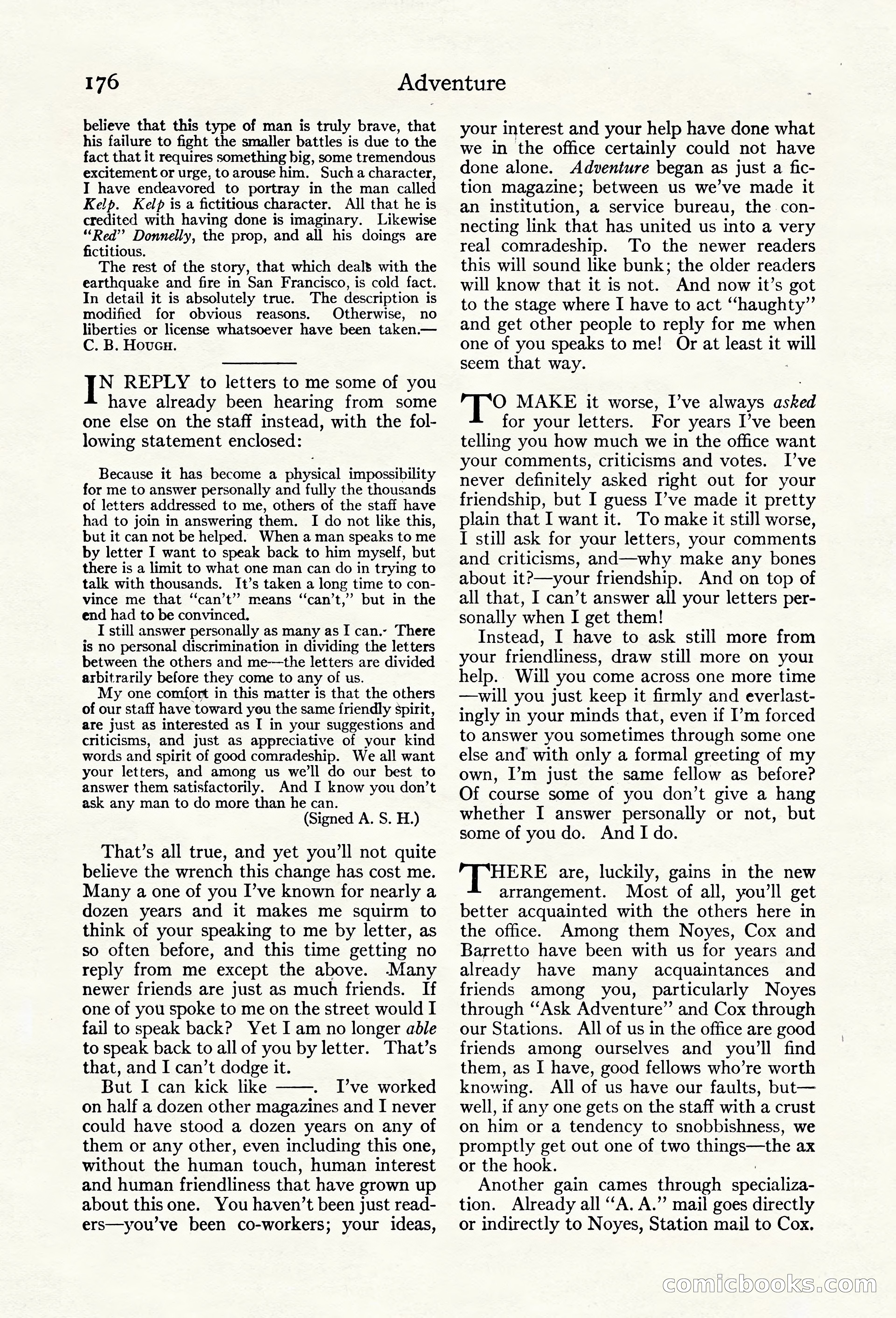
A restored page from Pulp Fiction, 1922. Page through the whole issue in the reader above.
📄 Transcribed text from this page (OCR, searchable)
Machine-transcribed from the original scan — historical spelling and the odd misread are preserved.
176 believe that this type of man is truly brave, that his failure to fight the smaller battles is due to the fact that it requires something big, some tremendous excitement or urge, to arouse him. Such a character, I have endeavored to portray in the man called Kelp. Kelp is a fictitious character. All that he is credited with having done is imaginary. Likewise “Red” Donnelly, the prop, and all his doings are fictitious. The rest of the story, that which deals with the earthquake and fire in San Francisco, is cold fact. In detail it is absolutely true. The description is modified for obvious reasons. Otherwise, no liberties or license whatsoever have been taken.— C. B. Houcu. ey REPLY to letters to me some of you have already been hearing from some one else on the staff instead, with the fol- lowing statement enclosed: Because it has become a physical impossibility for me to answer personally and fully the thousands of letters addressed to me, others of the staff have had to join in answering them. I do not like this, but it can not be helped. When aman speaks to me by letter I want to speak back to him myself, but there is a limit to what one man can do in trying to talk with thousands. It’s taken a long time to con- vince me that ‘‘can’t” means “can’t,” but in the end had to be convinced. I still answer personally as many as I can.- There is no personal discrimination in dividing the letters between the others and me—the letters are divided arbitrarily before they come to any of us. My one comfort in this matter is that the others of our staff have toward you the same friendly spirit, are just as interested as I in your suggestions and criticisms, and just as appreciative of your kind words and spirit of good comradeship. We all want your letters, and among us we'll do our best to answer them satisfactorily. And I know you don’t ask any man to do more than he can. (Signed A. S. H.) That’s all true, and yet you'll not quite believe the wrench this change has cost me. Many a one of you I’ve known for nearly a dozen years and it makes me squirm to think of your speaking to me by letter, as so often before, and this time getting no reply from me except the above. -Many newer friends are just as much friends. If one of you spoke to me on the street would I fail to speak back? Yet I am no longer able to speak back to all of you by letter. That’s that, and I can’t dodge it. But I can kick like I’ve worked on half a dozen other magazines and I never could have stood a dozen years on any of them or any other, even including this one, without the human touch, human interest and human friendliness that have grown up about this one. You haven’t been just read- ers—you’ve been co-workers; your ideas, Adventure your interest and your help have done what we in the office certainly could not have done alone. Adventure began as just a fic- tion magazine; between us we’ve made it an institution, a service bureau, the con- necting link that has united us into a very real comradeship. To the newer readers this will sound like bunk; the older readers will know that it is not. And now it’s got to the stage where I have to act “haughty”’ and get other people to reply for me when one of you speaks to me! Or at least it will seem that way. O MAKE it worse, I’ve always asked for your letters. For years I’ve been telling you how much we in the office want your comments, criticisms and votes. I’ve never definitely asked right out for your friendship, but I guess I’ve made it pretty plain that I want it. To make it still worse, I still ask for your letters, your comments and criticisms, and—why make any bones about it?—your friendship. And on top of all that, I can’t answer all your letters per- sonally when I get them! Instead, I have to ask still more from your friendliness, draw still more on yout help. Will you come across one more time —will you just keep it firmly and everlast- ingly in your minds that, even if I’m forced to answer you sometimes through some one else and with only a formal greeting of my own, I’m just the same fellow as before? Of course some of you don’t give a hang whether I answer personally or not, but some of you do. And I do. HERE are, luckily, gains in the new arrangement. Most of all, you'll get better acquainted with the others here in the office. Among them Noyes, Cox and Barretto have been with us for years and already have many acquaintances and friends among you, particularly Noyes through “Ask Adventure” and Cox through our Stations. All of us in the office are good friends among ourselves and you'll find them, as I have, good fellows who’re worth knowing. All of us have our faults, but— well, if any one gets on the staff with a crust on him or a tendency to snobbishness, we promptly get out one of two things—the ax or the hook. . Another gain cames through specializa- tion. Already all ‘‘A. A.” mail goes directly or indirectly to Noyes, Station mail to Cox. MICLOOOKS C@