
Pulp Fiction, 1922 · page 181 of 200
Adventure Magazine Cover — page 181: what you’re looking at
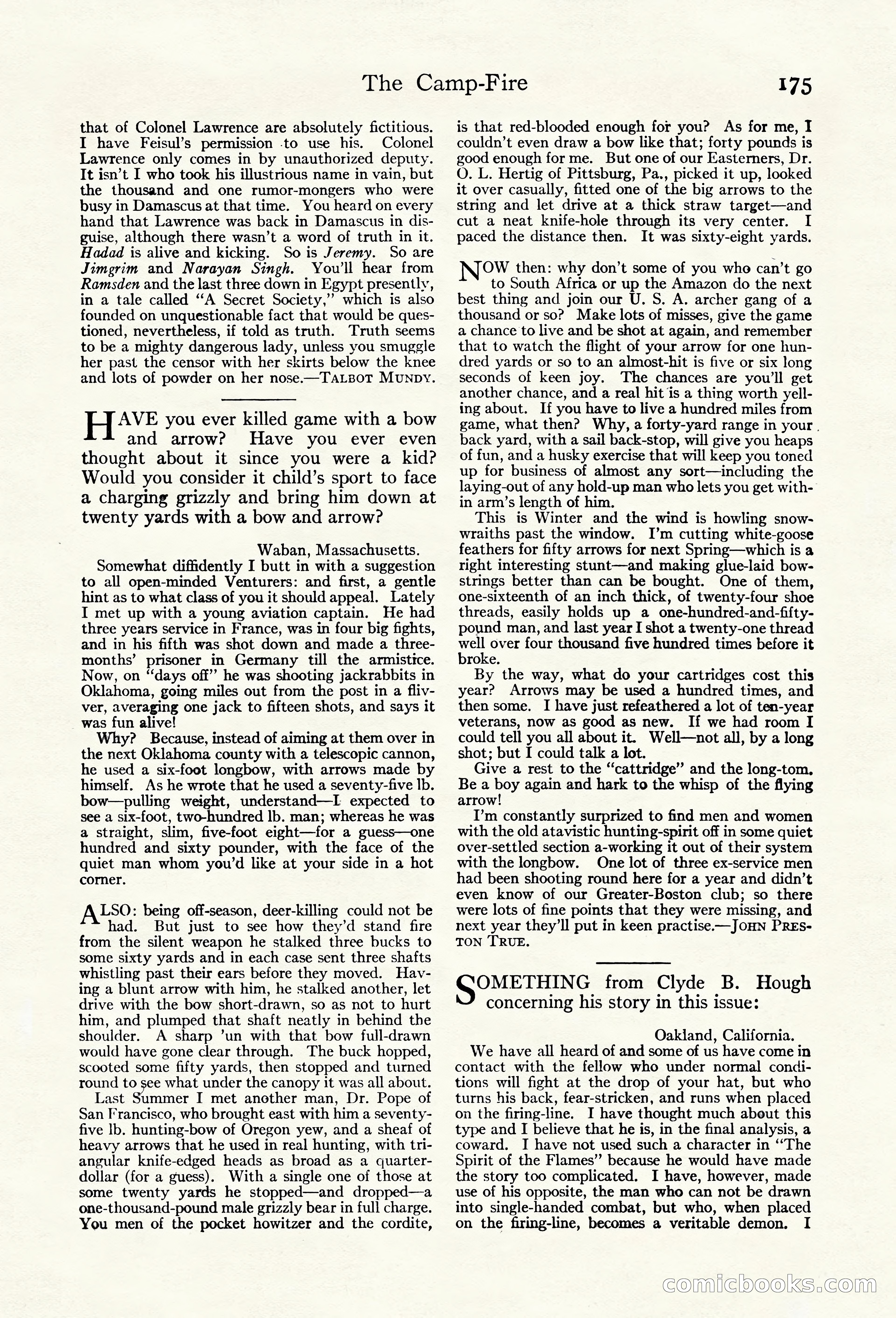
A restored page from Pulp Fiction, 1922. Page through the whole issue in the reader above.
📄 Transcribed text from this page (OCR, searchable)
Machine-transcribed from the original scan — historical spelling and the odd misread are preserved.
The Camp-Fire that of Colonel Lawrence are absolutely fictitious. I have Feisul’s permission -to use his. Colonel Lawrence only comes in by unauthorized deputy. It isn’t I who took his illustrious name in vain, but the thousand and one rumor-mongers who were busy in Damascus at that time. You heard on every hand that Lawrence was back in Damascus in dis- guise, although there wasn’t a word of truth in it. Hadad is alive and kicking. Sois Jeremy. So are Jimgrim and Narayan Singh. You'll hear from Ramsden and the last three down in Egypt presently, in a tale called “‘A Secret Society,” which is also founded on unquestionable fact that would be ques- tioned, nevertheless, if told as truth. Truth seems to be a mighty dangerous lady, unless you smuggle her past the censor with her skirts below the knee and lots of powder on her nose.—TALsot Munpy. jqiee you ever killed game with a bow and arrow? Have you ever even thought about it since you were a kid? Would you consider it child’s sport to face a charging grizzly and bring him down at twenty yards with a bow and arrow? Waban, Massachusetts. Somewhat diffidently I butt in with a suggestion to all open-minded Venturers: and first, a gentle hint as to what class of you it should appeal. Lately I met up with a young aviation captain. He had three years service in France, was in four big fights, and in his fifth was shot down and made a three- months’ prisoner in Germany till the armistice. Now, on “days off” he was shooting jackrabbits in Oklahoma, going miles out from the post in a fliv- ver, averaging one jack to fifteen shots, and says it was fun alive! Why? Because, instead of aiming at them over in the next Oklahoma county with a telescopic cannon, he used a six-foot longbow, with arrows made by himself. As he Bae, that he used a seventy-five Ib. bow—pulling weight, understand—I expected to see a six-foot, two- undred lb. man; whereas he was a straight, slim, five-foot eight—for a guess—one hundred and sixty pounder, with the face of the quiet man whom you'd like at your side in a hot corner. ALSO: being off-season, deer-killing could not be had. But just to see how they’d stand fire from the silent weapon he stalked three bucks to some sixty yards and in each case sent three shafts whistling past their ears before they moved. Hav- ing a blunt arrow with him, he stalked another, let drive with the bow short-drawn, so as not to hurt him, and plumped that shaft neatly in behind the shoulder. A sharp ’un with that bow full-drawn would have gone clear through. The buck hopped, scooted some fifty yards, then stopped and turned round to see what under the canopy it was all about. Last Summer I met another man, Dr. Pope of San Francisco, who brought east with hima seventy- five lb. hunting-bow of Oregon yew, and a sheaf of heavy arrows that he used in real hunting, with tri- angular knife-edged heads as broad as a quarter- dollar (for a guess). With a single one of those at some twenty yards he stopped—and dropped—a one-thousand-pound male grizzly bear in full charge. You men of the pocket howitzer and the cordite, 175 is that red-blooded enough for you? As for me, I couldn’t even draw a bow like that; forty pounds is good enough forme. But one of our Easterners, Dr. O. L. Hertig of Pittsburg, Pa., picked it up, looked it over casually, fitted one of the big arrows to the string and let drive at a thick straw target—and cut a neat knife-hole through its very center. I paced the distance then. It was sixty-eight yards. Now then: why don’t some of you who can’t go to South Africa or up the Amazon do the next best thing and join our U. S. A. archer gang of a thousand or so? Make lots of misses, give the game a chance to live and be shot at again, and remember that to watch the flight of your arrow for one hun- dred yards or so to an almost-hit is five or six long seconds of keen joy. The chances are you'll get another chance, and a real hit is a thing worth yell- ing about. If you have to live a hundred miles from game, what then? Why, a forty-yard range in your . back yard, with a sail back-stop, will give you heaps of fun, and a husky exercise that will keep you toned up for business of almost any sort—including the laying-out of any hold-up man who lets you get with- in arm’s length of him. This is Winter and the wind is howling snow- wraiths past the window. I’m cutting white-goose feathers for fifty arrows for next Spring—which is a right interesting stunt—and making glue-laid bow- strings better than can be bought. One of them, one-sixteenth of an inch thick, of twenty-four shoe threads, easily holds up a one-hundred-and- fifty- pound man, and last year I shot a twenty-one thread well ove four thousand five hundred times before it roke, By the way, what do your cartridges cost this year? Arrows may be used a hundred times, and then some. I have just refeathered a lot of ten-year veterans, now as good as new. If we had room I could tell you all about it. Well—not all, by a long shot; but I could talk a lot. Give a rest to the “‘cattridge” and the long-tom. Be a boy again and hark to the whisp of the flying arrow! I’m constantly surprized to find men and women with the old atavistic hunting-spirit off in some quiet over-settled section a-working it out of their system with the longbow. One lot of three ex-service men had been shooting round here for a year and didn’t even know of our Greater-Boston club; so there were lots of fine points that they were missing, and next year they’ll put in keen practise—JOHN PRES- TON TRUE. Cera from Clyde B. Hough concerning his story in this issue: Oakland, California. We have all heard of and some of us have come in contact with the fellow who under normal condi- tions will fight at the drop of your hat, but who turns his back, fear-stricken, and runs when placed on the firing-line. I have thought much about this type and I believe that he is, in the final analysis, a coward. I have not used such a character in ‘‘The Spirit of the Flames’’ because he would have made the story too complicated. I have, however, made use of his opposite, the man who can not be drawn into single-handed combat, but who, when placed on the firing-line, becomes a veritable demon. I MICLOOOKS C@