
Pulp Fiction, 1922 · page 180 of 200
Adventure Magazine Cover — page 180: what you’re looking at
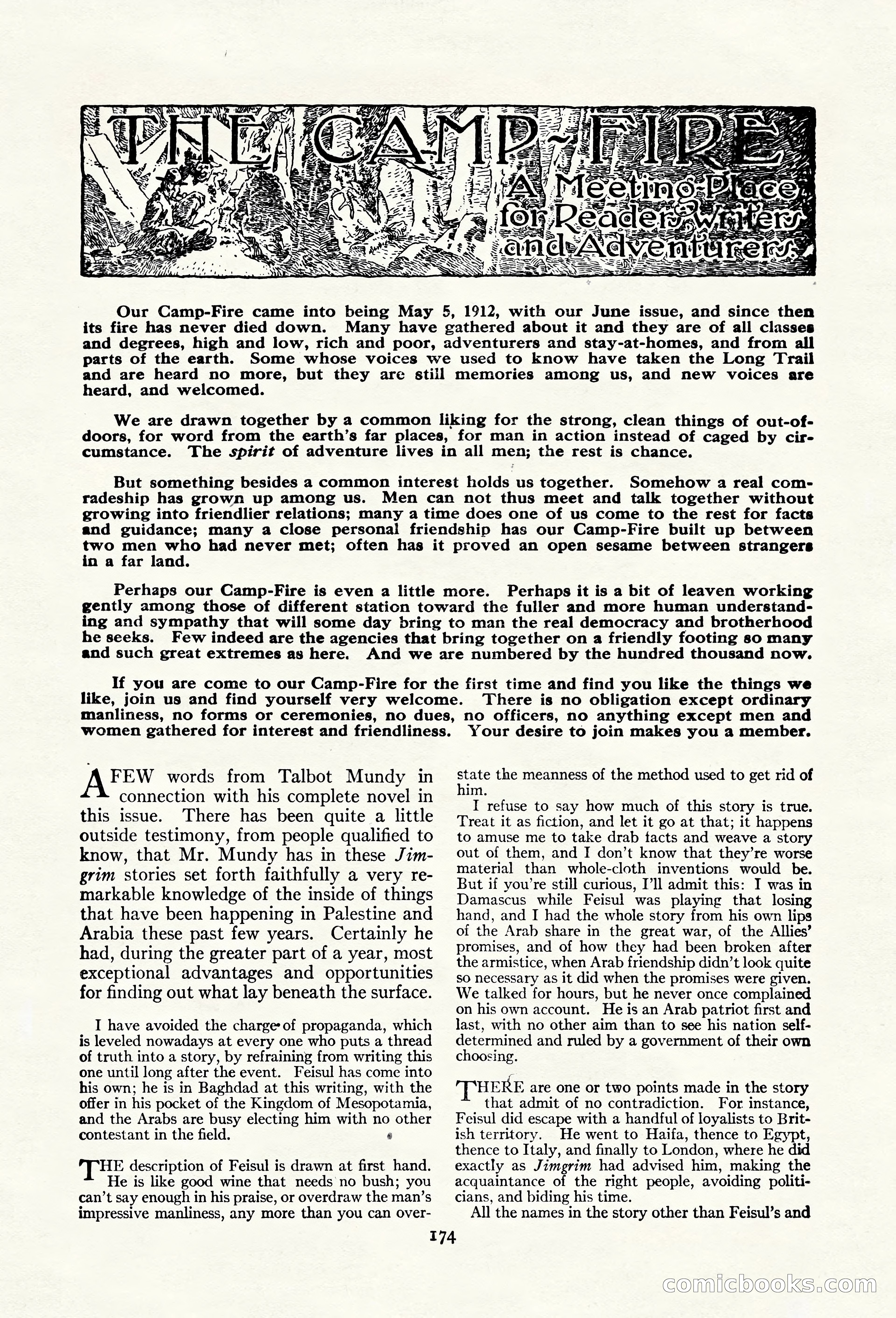
A restored page from Pulp Fiction, 1922. Page through the whole issue in the reader above.
📄 Transcribed text from this page (OCR, searchable)
Machine-transcribed from the original scan — historical spelling and the odd misread are preserved.
Our Camp-Fire came into being May 5, 1912, with our June issue, and since then its fire has never died down. Many have gathered about it and they are of all classes and degrees, high and low, rich and poor, adventurers and stay-at-homes, and from all parts of the earth. Some whose voices we used to know have taken the Long Trail and are heard no more, but they are still memories among us, and new voices are heard, and welcomed. We are drawn together by a common liking for the strong, clean things of out-of- doors, for word from the earth’s far places, for man in action instead of caged by cir- cumstance. The spirit of adventure lives in all men; the rest is chance. But something besides a common interest holds us together. Somehow a real com- radeship has grown up among us. Men can not thus meet and talk together without growing into friendlier relations; many a time does one of us come to the rest for facts and guidance; many a close personai friendship has our Camp-Fire built up between two ae who had never met; often has it proved an open sesame between strangers in a far land. Perhaps our Camp-Fire is even a little more. Perhaps it is a bit of leaven working gently among those of different station toward the fuller and more human understand- ing and sympathy that will some day bring to man the real democracy and brotherhood he seeks. Few indeed are the agencies that bring together on a friendly footing so many and such great extremes as here. And we are numbered by the hundred thousand now. If you are come to our Camp-Fire for the first time and find you like the things we like, join us and find yourself very welcome. There is no obligation except ordinary manliness, no forms or ceremonies, no dues, no officers, no anything except men and women gathered for interest and friendliness. Your desire to join makes you a member. FEW words from Talbot Mundy in connection with his complete novel in this issue. There has been quite a little outside testimony, from people qualified to know, that Mr. Mundy has in these Jim- grim stories set forth faithfully a very re- markable knowledge of the inside of things that have been happening in Palestine and Arabia these past few years. Certainly he had, during the greater part of a year, most exceptional advantages and opportunities for finding out what lay beneath the surface. I have avoided the charge of propaganda, which is leveled nowadays at every one who puts a thread of truth into a story, by refraining from writing this one until long after the event. Feisul has come into his own; he is in Baghdad at this writing, with the offer in his pocket of the Kingdom of Mesopotamia, and the Arabs are busy electing him with no other contestant in the field. © "THE description of Feisul is drawn at first hand. He is like good wine that needs no bush; you can’t say enough in his praise, or overdraw the man’s impressive manliness, any more than you can over- ale the meanness of the method used to get rid of im. I refuse to say how much of this story is true. Treat it as fiction, and let it go at that; it happens to amuse me to take drab tacts and weave a story out of them, and I don’t know that they’re worse material than whole-cloth inventions would be. But if you’re still curious, I'll admit this: I was in Damascus while Feisul was playing that losing hand, and I had the whole story from his own lips of the Arab share in the great war, of the Allies’ promises, and of how they had been broken after the armistice, when Arab friendship didn’t look quite so necessary as it did when the promises were given. We talked for hours, but he never once complained on his own account. He is an Arab patriot first and last, with no other aim than to see his nation self- determined and ruled by a government of their own choosing. HERE are one or two points made in the story that admit of no contradiction. For instance, Feisul did escape with a handful of loyalists to Brit- ish territory. He went to Haifa, thence to Egypt, thence to Italy, and finally to London, where he did exactly as Jimgrim had advised him, making the acquaintance of the right people, avoiding politi- cians, and biding his time. All the names in the story other than Feisul’s and 174 CoOmiclbool< (©