
Pulp Fiction, 1922 · page 179 of 200
Adventure Magazine Cover — page 179: what you’re looking at
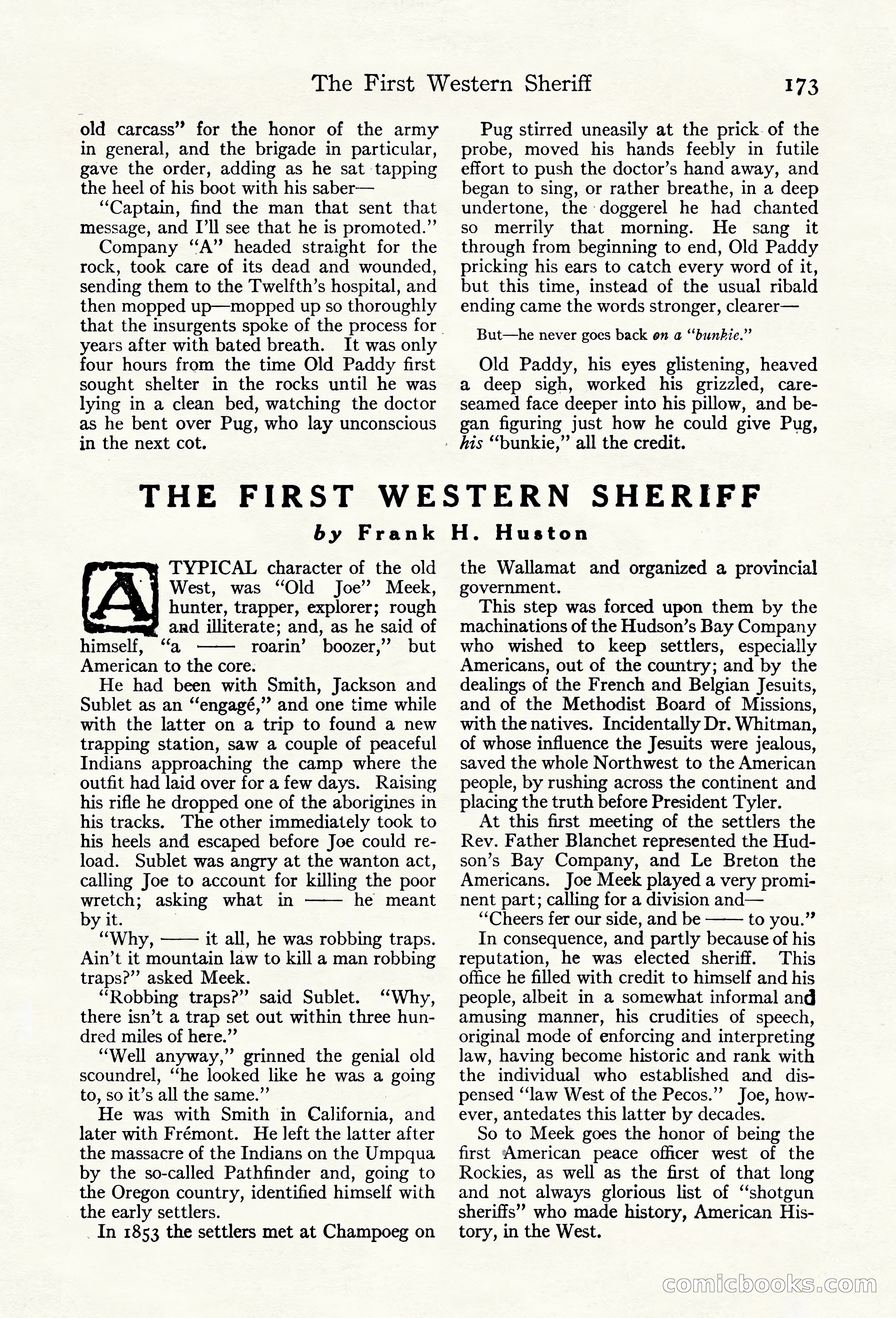
A restored page from Pulp Fiction, 1922. Page through the whole issue in the reader above.
📄 Transcribed text from this page (OCR, searchable)
Machine-transcribed from the original scan — historical spelling and the odd misread are preserved.
The First Western Sheriff old carcass” for the honor of the army in general, and the brigade in particular, gave the order, adding as he sat tapping the heel of his boot with his saber— “Captain, find the man that sent that message, and I’ll see that he is promoted.” Company “A” headed straight for the rock, took care of its dead and wounded, sending them to the Twelfth’s hospital, and then mopped up—mopped up so thoroughly that the insurgents spoke of the process for | years after with bated breath. It was only four hours from the time Old Paddy first sought shelter in the rocks until he was lying in a clean bed, watching the doctor as he bent over Pug, who lay unconscious in the next cot. 173 Pug stirred uneasily at the prick-of the probe, moved his hands feebly in futile effort to push the doctor’s hand away, and began to sing, or rather breathe, in a deep undertone, the doggerel he had chanted so merrily that morning. He sang it through from beginning to end, Old Paddy pricking his ears to catch every word of it, but this time, instead of the usual ribald ending came the words stronger, clearer— But—he never goes back on a “‘bunkie.”’ Old Paddy, his eyes glistening, heaved a deep sigh, worked his grizzled, care- seamed face deeper into his pillow, and be- gan figuring just how he could give Pug, _ his “bunkie,”’ all the credit. THE FIRST WESTERN SHERIFF by Frank H. Huston . TYPICAL character of the old West, was “Old Joe” Meek, hunter, trapper, explorer; rough and illiterate; and, as he said of himself, ‘a roarin’ boozer,’ but American to the core. He had been with Smith, Jackson and Sublet as an “engagé,’”’ and one time while with the latter on a trip to found a new trapping station, saw a couple of peaceful Indians approaching the camp where the outfit had laid over for a few days. Raising his rifle he dropped one of the aborigines in his tracks. The other immediately took to his heels and escaped before Joe could re- load. Sublet was angry at the wanton act, calling Joe to account for killing the poor wretch; asking what in he meant by it. “Why, it all, he was robbing traps. Ain’t it mountain law to kill a man robbing traps?” asked Meek. “Robbing traps?” said Sublet. ‘“‘Why, there isn’t a trap set out within three hun- dred miles of here.” ‘Well anyway,” grinned the genial old scoundrel, ‘‘he looked like he was a going to, so it’s all the same.’ He was with Smith in California, and later with Frémont. He left the latter after the massacre of the Indians on the Umpqua by the so-called Pathfinder and, going to the Oregon country, identified himself with the early settlers. _In 1853 the settlers met at Champoeg on the Wallamat and organized a provincial government. This step was forced upon them by the machinations of the Hudson’s Bay Company who wished to keep settlers, especially Americans, out of the country; and by the dealings of the French and Belgian Jesuits, and of the Methodist Board of Missions, with the natives. Incidentally Dr. Whitman, of whose influence the Jesuits were jealous, saved the whole Northwest to the American people, by rushing across the continent and placing the truth before President Tyler. At this first meeting of the settlers the Rev. Father Blanchet represented the Hud- son’s Bay Company, and Le Breton the Americans. Joe Meek played a very promi- nent part; calling tor a division and— “‘Cheers fer our side, and be to you.” In consequence, and partly because of his reputation, he was elected sheriff. This office he filled with credit to himself and his people, albeit in a somewhat informal and amusing manner, his crudities of speech, original mode of enforcing and interpreting law, having become historic and rank with the individual who established and dis- pensed “‘law West of the Pecos.” Joe, how- ever, antedates this latter by decades. So to Meek goes the honor of being the first American peace officer west of the Rockies, as well as the first of that long and not always glorious list of “shotgun sheriffs’ who made history, American His- tory, in the West. DOOLK C©@