
Puck, 1879-07-23 · page 12 of 16
Puck — July 23, 1879 — page 12: what you’re looking at
What you’re looking at
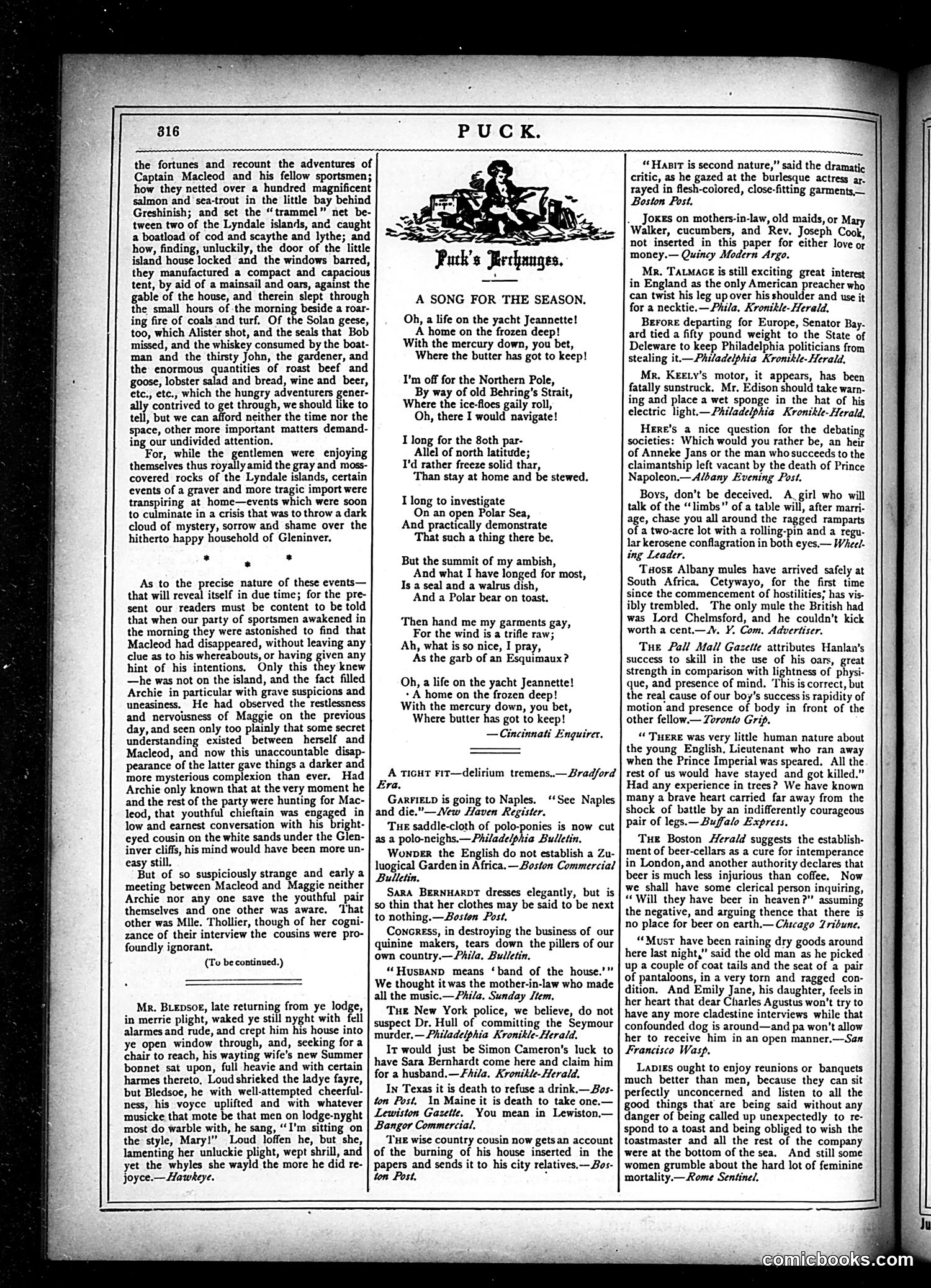
This page contains **"A Song for the Season,"** a humorous poem about Arctic exploration. The illustration shows a figure on ice, likely referencing polar expeditions popular in the 1880s-1890s era. The poem mocks the hardships of Arctic life—freezing temperatures, isolation, and danger—while the speaker romanticizes it as an adventure. Lines like "Oh, a life on the yacht Jeannette! / A home on the frozen deep!" reference the USS *Jeannette*, a real Arctic exploration vessel. The surrounding column contains brief satirical notes on contemporary topics: politics, social customs, and public figures. The overall effect is typical Puck humor: gentle mockery of both polar explorers' bravado and everyday American society.
📄 Transcribed text from this page (OCR, searchable)
Machine-transcribed from the original scan — historical spelling and the odd misread are preserved.
the fortunes and recount the adventures of Captain Macleod and his fellow sportsmen; how they netted over a hundred magnificent salmon and sea-trout in the little bay behind Greshinish; and set the “trammel” net be- tween two of the Lyndale islands, and caught a boatload of cod and scaythe and lythe; and how, finding, unluckily, the door of the little island house locked and the windows barred, they manufactured a compact and capacious tent, by aid of a mainsail and oars, against the gable of the house, and therein slept through the small hours of the morning beside a roar- ing fire of coals and turf. Of the Solan geese, too, which Alister shot, and the seals that Bob missed, and the whiskey consumed by the boat- man and the thirsty John, the gardener, and the enormous quantities of roast beef and goose, lobster salad and bread, wine and beer, etc., etc., which the hungry adventurers gener- ally contrived to get through, we should like to tell, but we can afford neither the time nor the space, other more important matters demand- ing our undivided attention. For, while the gentlemen were enjoying themselves thus royally amid the gray and moss- covered rocks of the Lyndale islands, certain events of a graver and more tragic import were transpiring at home—events which were soon to culminate in a crisis that was to throw a dark cloud of mystery, sorrow and shame over the hitherto happy household of Gleninver. * * * As to the precise nature of these events— that will reveal itself in due time; for the pre- sent our readers must be content to be told that when our party of sportsmen awakened in the morning they were astonished to find that Macleod had disappeared, without leaving any clue as to his whereabouts, or having given any hint of his intentions. Only this they knew —he was not on the island, and the fact filled Archie in particular with grave suspicions and uneasiness. He had observed the restlessness and nervousness of Maggie on the previous day, and scen only too plainly that some secret understanding existed between herself and Macleod, and now this unaccountable disap- pearance of the latter gave things a darker and more mysterious complexion than ever. Had Archie only known that at the very moment he and the rest of the party were hunting for Mac- leod, that youthful chieftain was engaged in low and earnest conversation with his bright- eyed cousin on the white sands under the Glen- inver cliffs, his mind would have been more un- easy still. But of so suspiciously strange and early a meeting between Macleod and Maggie neither Archie nor any one save the youthful pair themselves and one other was aware, ‘That other was Mlle. Thollier, though of her cogni- zance of their interview the cousins were pro- foundly ignorant. (To be continued.) Mr. Biepsoe, late returning from ye lodge, in merrie plight, waked ye still nyght with fell alarmes and rude, and crept him his house into ye open window through, and, seeking for a chair to reach, his wayting wife’s new Summer bonnet sat upon, full heavie and with certain harmes thereto, Loud shrieked the ladye fayre, but Bledsoe, he with well-attempted cheerful- ness, his voyce uplifted and with whatever musicke that mote be that men on lodge-nyght most do warble with, he sang, ‘I’m sitting on the style, Mary!” Loud loffen he, but she, lamenting her unluckie plight, wept shrill, and yet the whyles she wayld the more he did re- joyce.— Hawkeye. A SONG FOR THE SEASON. Oh, a life on the yacht Jeannette! A home on the frozen deep! With the mercury down, you bet, Where the butter has got to keep! I'm off for the Northern Pole, By way of old Behring’s Strait, Where the ice-floes gaily roll, Oh, there I would navigate! I long for the 80th par- Allel of north latitude; I'd rather freeze solid thar, ‘Than stay at home and be stewed. T long to investigate On an open Polar Sea, And practically demonstrate That such a thing there be. But the summit of my ambish, And what I have longed for most, Is a seal and a walrus dish, And a Polar bear on toast. ‘Then hand me my garments gay, For the wind is a trifle raw; Ah, what is so nice, I pray, As the garb of an Esquimaux? Oh, a life on the yacht Jeannette! + A home on the frozen deep! With the mercury down, you bet, Where butter has got to keep! —Cincinnati Enquirer. A ticut Fit—delirium tremens.— Bradford Era. GarriELp is going to Naples. and die."—Mew Haven Register. Tue saddle-cloth of polo-ponies is now cut as a polo-neighs,— Philadelphia Bulletin. Wonver the English do not establish a Zu- luogical Garden in Africa.—Boston Commercial Bulletin, Sara BERNHARDT dresses elegantly, but is so thin that her clothes may be said to be next to nothing.—Bosten Post, Concress, in destroying the business of our quinine makers, tears down the pillers of our own country.— Phila, Bulletin, “‘Huspanp means ‘band of the house.’” We thought it was the mother-in-law who made all the music.— Phila, Sunday Item, Tue New York police, we believe, do not suspect Dr. Hull of committing the Seymour murder.— Philadelphia Kronikle-Herald, Ir would just be Simon Cameron's luck to have Sara Bernhardt come here and claim him for a husband.—Fhila. Kronikle-Herald, In Texas it is death to refuse a drink.—_Bos- ton Post, In Maine it is death to take one.— Lewiston Gazette. You mean in Lewiston,— Bangor Commercial. ‘Tue wise country cousin now getsan account of the burning of his house inserted in the papers and sends it to his city relatives.—Bos- ton Post. a “See Naples “ Hasit is second nature,” said the dramatic critic, as he gazed at the burlesque actress ar. rayed in flesh-colored, close-fitting garments,— Boston Post. Joxes on mothers-in-law, old maids, or Mary Walker, cucumbers, and Rev. Joseph Cook, not inserted in this paper for either love or money.— Quincy Modern Argo. Mr. Tatmace is still exciting great interest in England as the only American preacher who can twist his leg up over his shoulder and use it for a necktie.—Phila, Krontkle-Herald, Berore departing for Europe, Senator Bay- ard tied a fifty pound weight to the State of Deleware to keep Philadelphia politicians from stealing it—Philadelphia Krontkle-Herald, Mr. Keety’s motor, it appears, has been fatally sunstruck. Mr. Edison should take warn- ing and place a wet sponge in the hat of his electric light.—Philadelphia Kronikle-Herald, Here's a nice question for the debating societies: Which would you rather be, an heir of Anneke Jans or the man whosucceeds to the claimantship left vacant by the death of Prince Napoleon.— Albany Evening Post. Boys, don’t be deceived. A_girl who will talk of the “limbs” of a table will, after marri- age, chase you all around the ragged ramparts of a two-acre lot with a rolling-pin and a regu- lar kerosene conflagration in both eyes,— Wheel- ing Leader. Tuose Albany mules have arrived safely at South Africa, Cetywayo, for the first time since the commencement of hostilities; has vis- ibly trembled. The only mule the British had was Lord Chelmsford, and he couldn’t kick worth a cent.—. ¥, Com, Advertiser. Tue Pall Mall Gazette attributes Hanlaa’s success to skill in the use of his oars, great strength in comparison with lightness of physi- que, and presence of mind. ‘This is correct, but the real cause of our boy’s success is rapidity of motion and presence of body in front of the other fellow.— Zoronto Grip. “ Tuere was very little human nature about the young English, Lieutenant who ran away when the Prince Imperial was speared. All the rest of us would have stayed and got killed.” Had any experience in trees? We have known many a brave heart carried far away from the shock of battle by an indifferently courageous pair of legs.— Buffalo Express. Tue Boston Herald suggests the establish- ment of beer-cellars as a cure for intemperance in London, and another authority declares that beer is much less injurious than coffee. Now we shall have some clerical person inquiring, “Will they have beer in heaven?” assuming the negative, and arguing thence that there is no place for beer on earth.— Chucago Tribune, “Must have been raining dry goods around here last night,” said the old man as he picked up a couple of coat tails and the seat of a pair of pantaloons, in a very torn and ragged con- dition, And Emily Jane, his daughter, feels in her heart that dear Charles Agustus won't try to have any more cladestine interviews while that confounded dog is around—and pa won't allow her to receive him in an open manner.—San Francisco Wasp, Lapis ought to enjoy reunions or banquets much better than men, because they can sit perfectly unconcerned and listen to all the good things that are being said without any danger of being called up unexpectedly to re- spond to a toast and being obliged to wish the toastmaster and all the rest of the company were at the bottom of the sea. And still some women grumble about the hard lot of feminine mortality.— Rome Sentinel,