
Puck, 1878-11-13 · page 12 of 16
Puck — November 13, 1878 — page 12: what you’re looking at
What you’re looking at
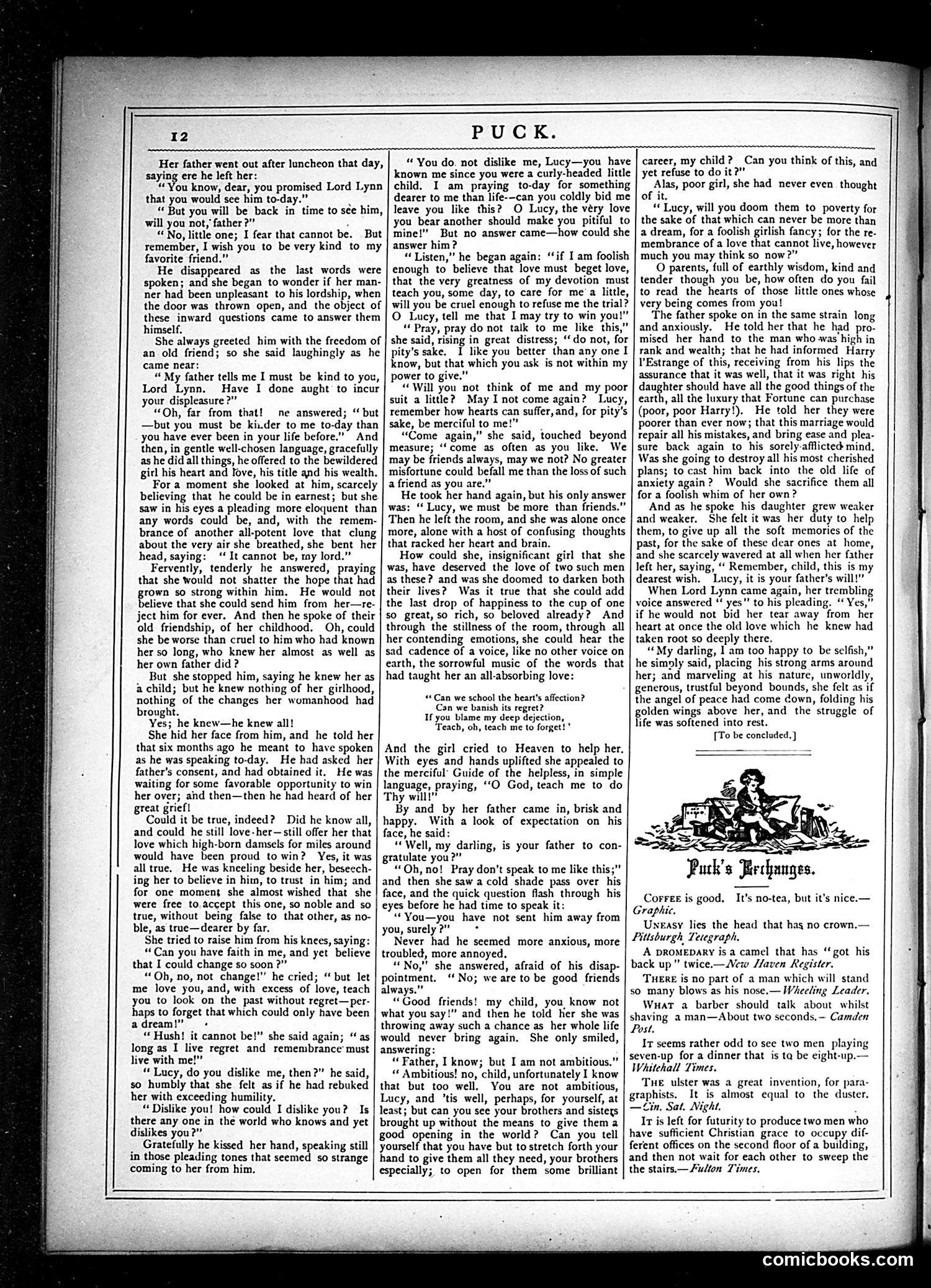
This page contains primarily serialized fiction dialogue rather than political satire. The main narrative depicts a domestic drama involving characters named Lucy and Lord Lynn, with themes of devotion, sacrifice, and marriage expectations. The right column features "Puck's Briefings"—short satirical quips about contemporary society. These include observations on coffee, an untidy person, a dromedary (camel), and social commentary on dinner invitations and "whitebait times." The humor targets everyday Victorian-era social conventions and etiquette rather than specific political figures. Without visible caricatures or explicit political references on this particular page, the satire focuses on general social criticism typical of Puck's miscellaneous commentary sections.
📄 Transcribed text from this page (OCR, searchable)
Machine-transcribed from the original scan — historical spelling and the odd misread are preserved.
12 PUCK. Her father went out after luncheon that day, saying ere he left her: “You know, dear, you promised Lord Lynn that you would see him to-day.” . “ But you will be back in time to see him, will you not, father?” 4 “No, little one; I fear that cannot be. But remember, I wish you to be very kind to my favorite friend.” He disappeared as the last words were spoken; and she began to wonder if her man- ner had been unpleasant to his lordship, when the door was thrown open, and the object of these inward questions came to answer them himself. She always greeted him with the freedom of an old friend; so she said laughingly as he came near: “ My father tells me I must be kind to you, Lord Lynn. Have I done aught to incur your displeasure ?” “Oh, far from that! ne answered; “ but —but you must be kii.der to me to-day than you have ever been in your life before.” And then, in gentle well-chosen language, gracefully as he did all things, he offered to the bewildered girl his heart and love, his title and his wealth. For a moment she looked at him, scarcely believing that he could be in earnest; but she saw in his eyes a pleading more eloquent than any words could be, and, with the remem- brance of another all-potent love that clung about the very air she breathed, she bent her head, saying: “‘ It cannot be, tay lord.” Fervently, tenderly he answered, praying that she would not shatter the hope that had rown so strong within him. He would not believe that she could send him from her—re- ject him for ever. And then he spoke of their old friendship, of her childhood. Oh, could she be worse than cruel to him who had known her so long, who knew her almost as well as her own father did? But she stopped him, saying he knew her as a child; but he knew nothing of her girlhood, nothing of the changes her womanhood had brought. Yes; he knew—he knew all! She hid her face from him, and he told her that six months ago he meant to have spoken as he was speaking to-day. He had asked her father’s consent, and had obtained it. He was waiting for some favorable opportunity to win her over; and then—then he had heard of her great grief! Could it be true, indeed? Did he know all, and could he still love-her—still offer her that love which high-born damsels for miles around would have been proud to win? Yes, it was all true. He was kneeling beside her, beseech- ing her to believe in him, to trust in him; and for one moment she almost wished that she were free to.accept this one, so noble and so true, without being false to that other, as no- ble, as true—dearer by far. She tried to raise him from his knees, saying: “Can you have faith in me, and yet believe that I could change so soon ?” “Oh, no, not change!” he cried; “ but let me love you, and, with excess of love, teach you to look on the past without regret—per- haps to forget that which could only have been adream!” ~ “Hush! it cannot be!” she said again; “as long as I live regret and remembrance must live with me!” “Lucy, do you dislike me, then?” he said, so humbly that she felt as if he had rebuked her with exceeding humility. “ Dislike you! how could I dislike you? Is there any one in thé world who knows and yet dislikes you?” Gratefully he kissed her hand, speaking still in those pleading tones that seemed so strange coming to her from him. “ You do. not dislike me, Lucy—you have known me since you were a curly-headed little child. I am praying to-day for something dearer to me than life--can you coldly bid me leave you like this? O Lucy, the véry love you bear another should make you pitiful to mine!” But no answer came—how could she answer him? “Listen,” he began again: “if I am foolish enough to believe that love must beget love, that the very greatness of my devotion must teach you, some day, to care for me’a little, will you be cruel enough to refuse me the trial? O Lucy, tell me that I may try to win you!” “Pray, pray do not talk to me like this,” she said, rising in great distress; ‘do not, for pity’s sake. I like you better than any one I know, but that which you ask is not within my power to give.” “Will you not think of me and my poor suit a little? May I not come again? Lucy, remember how hearts can suffer, and, for pity’s sake, be merciful to me!” “Come again,” she said, touched beyond measure; ‘come as often as you like. We may be friends always, may we not? No greater misfortune could befall me than the loss of such a friend as you are.” He took her hand again, but his only answer was: “Lucy, we must be more than friends.” Then he left the room, and she was alone once more, alone with a host of confusing thoughts that racked her heart and brain. How could she, insignificant girl that she was, have deserved the love of two such men as these? and was she doomed to darken both their lives? Was it true that she could add the last drop of happiness to the cup of one so great, so rich, so beloved already? And through the stillness of the room, through all her contending emotions, she could hear the sad cadence of a voice, like no other voice on earth, the sorrowful music of the words that had taught her an all-absorbing love: «Can we school the heart’s affection? Can we banish its regret? If you blame my deep dejection, ‘Teach, ob, teach me to forget! * And the girl cried to Heaven to help her, With eyes and hands uplifted she appealed to the merciful’ Guide of the helpless, in simple language, praying, “‘O God, teach me to do Thy willl” By and by her father came in, brisk and happy. With a look of expectation on his face, he said: “Well, my darling, is your father to con- gratulate you?” “Oh, no! Pray don't speak to me like this;” and then she saw a cold shade pass over his face, and the quick question flash through his eyes before he had time to speak it: “‘You—you have not sent him away from you, surely 2” © Never had he seemed more anxious, more troubled, more annoyed, “No,” she answered, afraid of his disap- pointment. ‘No; we are to be good friends always.” “Good friends! my child, you, know not what you say!” and then he told her she was throwing away such a chance as_her whole life would never bring again. She only smiled, answering: “ Father, I know; but I am not ambitious.” “Ambitious! no, child, unfortunately I know that but too well. You are not ambitious, Lucy, and 'tis well, perhaps, for yourself, at least; but can you see your brothers and sisters brought up without the means to give them a good opening in the world? Can you tell yourself that you have but to stretch forth your hand to give them all they need, your brothers especially; to open for them some brilliant career, my child? Can you think of this, and yet refuse to do it?” Alas, poor girl, she had never even thought of it, * Lucy, will you doom them to poverty for the sake of that which can never be more than a dream, for a foolish girlish fancy; for the re- membrance of a love that cannot live, however much you may think so now?” O parents, full of earthly wisdom, kind and tender though you be, how often do you fail to read the hearts of those little ones whose very being comes from you! The father spoke on in the same strain long and anxiously. He told her that he had pro- mised her hand to the man whowwas high in yank and wealth; that he had informed Harry VEstrange of this, receiving from his lips the assurance that it was well, that it was right his daughter should have all the good things of the earth, all the luxury that Fortune can purchase (poor, poor Harry!). He told her they were poorer than ever now; that this marriage would repair all his mistakes, and bring ease and plea- sure back again to his sorely-afflicted mind, Was she going to destroy all his most cherished plans; to cast him back into the old life of anxiety again? Would she sacrifice them all for a foolish whim of her own? ‘And as he spoke his daughter grew weaker and weaker, She felt it was her duty to help them, to give up all the soft memories of the past, for the sake of these dear ones at home, and she scarcely wavered at all when her father left her, saying, “ Remember, child, this is my dearest wish. Lucy, it is your father’s will!” When Lord Lynn came again, her trembling voice answered “ yes” to his pleading, “Yes,” if he would not bid her tear away from her heart at once the old love which he knew had taken root so deeply there. “My darling, 1 am too happy to be selfish,” he simply said, placing his strong arms around her; and marveling at his nature, unworldly, generous, trustful beyond bounds, she felt as if the angel of peace had come down, folding his olden wings above her, and the struggle of ife was softened into rest. [To be concluded. ] 8 Krchanges. Corre is good, It’s no-tea, but it’s nice.— Graphic. Uneasy lies the head that has no crown.— Pittsburgh Telegraph, A pRroMepary is a camel that has “ got his back up” twice.—New Haven Register. Tuere is no part of a man which will stand so many blows as his nose.— Wheeling Leader. Wuat a barber should talk about whilst shaving a man—About two seconds.— Camden Post. It seems rather odd to see two men playing seven-up for a dinner that is ta be eight-up.— Whitehall Times. Tue ulster was a great invention, for para- gtaphists. It is almost equal to the duster. Cin, Sat. Night. Ir is left for futurity to produce two men who have sufficient Christian grace to occupy dif- ferent offices on the second floor of a building, and then not wait for each other to sweep the the stairs,— Fulton Times, comicbooks.com