
Puck, 1878-11-13 · page 11 of 16
Puck — November 13, 1878 — page 11: what you’re looking at
What you’re looking at
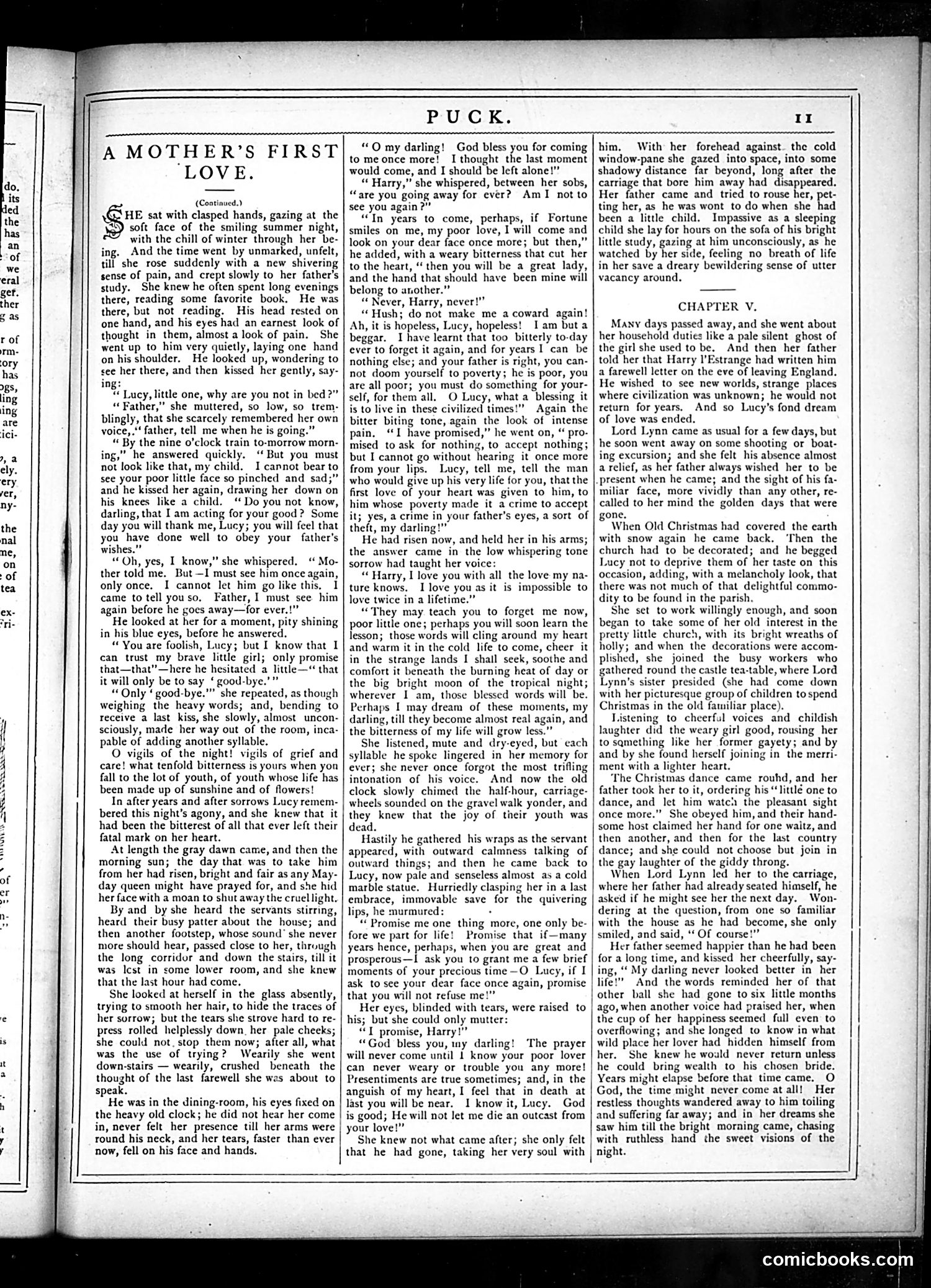
This page from *Puck* contains the continuation of a serialized story titled "A Mother's First Love," featuring dialogue between characters named Lucy, Harry, and others. The text is presented as a narrative story rather than a political cartoon. The content depicts a sentimental domestic drama involving a mother's emotional conflict between her love for her child and her feelings for a man named Harry. There are no visible political cartoons, caricatures, or satirical illustrations on this page—just printed text in column format typical of *Puck's* serialized fiction. This appears to be a romantic/melodramatic story rather than political satire, which was common filler content in satirical magazines of this era alongside their primary cartoon offerings.
📄 Transcribed text from this page (OCR, searchable)
Machine-transcribed from the original scan — historical spelling and the odd misread are preserved.
ex Fe OE PUCK. II A MOTHER’S FIRST ‘LOVE. (Coatiaued.) HE sat with clasped hands, gazing at the sy soft face of the smiling summer night, with the chill of winter through her be- ing. And the time went by unmarked, unfelt, till she rose suddenly with a new shivering sense of pain, and crept slowly to her father’s study. She knew he often spent long evenings there, reading some favorite book. He was there, but not reading. His head rested on one hand, and his eyes had an earnest look of thought in them, almost a look of pain, She went up to him very quietly, laying one hand on his shoulder. He looked up, wondering to see her there, and then kissed her gently, say- ing: Lucy, little one, why are you not in bed?” “Father,” she muttered, so low, so trem- blingly, that she scarcely remembered her own voice,."' father, tell me when he is going.” “ By the nine o'clock train to-morrow morn- ing,” he answered quickly. “But you must not look like that, my child. I cannot bear to see your poor little face so pinched and sad;” and he kissed her again, drawing her down on his knees like a child. “Do you not know, darling, that I am acting for your good? Some day you will thank me, Lucy; you will feel that you have done well to obey your father’s wishes.”” “Oh, yes, I know,” she whispered. “ Mo- ther told me. But —I must see him once again, only once. I cannot let him go like this, 1 came to tell youso. Father, I must see him again before he gocs away—for ever.!"” He looked at her for a moment, pity shining in his blue eyes, before he answered, “You are foolish, Lucy; but I know that I can trust my brave little girl; only promise that—that”—here he hesitated a little—“ that it will only be to say ‘good-bye."” “ Only ‘ good-bye." she repeated, as though weighing the heavy words; and, bending to receive a last kiss, she slowly, almost uncon- sciously, made her way out of the room, inca- pable of adding another syllable. O vigils of the night! vigils of grief and care! what tenfold bitterness is yours when yon fall to the lot of youth, of youth whose life has been made up of sunshine and of flowers! In after years and after sorrows Lucy remem- bered this night’s agony, and she knew that it had been the bitterest of all that ever left their fatal mark on her heart. At length the gray dawn came, and then the morning sun; the day that was to take him from her had risen, bright and fair as any May- day queen might have prayed for, and she hid her face with a moan to shut away the cruel light. By and by she heard the servants stirring, heard their busy patter about the house; and then another footstep, whose sound’ she never more should hear, passed close to her, through the long corridur and down the stairs, till was Icst in some lower room, and she knew that the last hour had come, She looked at herself in the glass absently, trying to smooth her hair, to hide the traces of her sorrow; but the tears she strove hard to re- press rolled helplessly down, her pale cheeks; she could not, stop them now; after all, what was the use of trying? Wearily she went down-stairs — wearily, crushed beneath the thought of the last farewell she was about to speak. He was in the dining-room, his eyes fixed on the heavy old clock; he did not hear her come in, never felt her presence till her arms were round his neck, and her tears, faster than ever now, fell on his face and hands. “O my darling! God bless you for coming to me once more! I thought the last moment would come, and I should be left alone!” “ Harry,” she whispered, between her sobs, “are you going away for ever? AmI not to see you again?” “In years to come, perhaps, if Fortune smiles on me, my poor love, I will come and look on your dear face once more; but then,” he added, with a weary bitterness that cut her to the heart, “ then you will be a great lady, and the hand that should have been mine will belong to another.” “Never, Harry, never!” “Hush; do not_make me a coward again! Ah, it is hopeless, Lucy, hopeless! Iam but a beggar. I have learnt that too bitterly to-day ever to forget it again, and for years I can be nothing else; and your father is right, you can- not doom yourself to poverty; he is poor, you are all poor; you must do something for your- self, for them all. O Lucy, what a blessing it is to live in these civilized tim Again the bitter biting tone, again the look of intense pain. “I have promised,” he went on, “ pro- mised to ask for nothing, to accept nothing; but I cannot go without hearing it once more from your lips. Lucy, tell me, tell the man who would give up his very life for you, that the first love of your heart was given to him, to him whose poverty made it a crime to accept it; yes, a crime in your father’s eyes, a sort of theft, my darling!” He had risen now, and held her in his arms; the answer came in the low whispering tone sorrow had taught her voice: “ Harry, I love you with all the love my na- ture knows. I love you as it is impossible to love twice in a lifetime.” “They may teach you to forget me now, poor littie one; perhaps you will soon learn the lesson; those words will cling around my heart and warm it in the cold life to come, cheer it in the strange lands I shall seek, soothe and comfort it beneath the burning heat of day or the big bright moon of the tropical night; wherever I am, those blessed words will be. Perhaps I may dream of these moments, my darling, till they become almost real again, and the bitterness of my life will grow less.’” She listened, mute and dry-eyed, but cach syllable he spoke lingered in her memory for ever; she never once forgot the most trifling intonation of his voice. And now the old clock slowly chimed the half-hour, carriage- wheels sounded on the gravel walk yonder, and they knew that the joy of their youth was dead. Hastily he gathered his wraps as the servant appeared, with outward calmness talking of outward things; and then he came back to Lucy, now pale and senseless almost as a cold marble statue. Hurriedly clasping her in a last embrace, immovable save for the quivering lips, he murmured: : “ Promise me one thing more, one only be- fore we part for life! Promise that if—many years hence, perhaps, when you are great and prosperous—I ask you to grant me a few brief moments of your precious time —O Lucy, if I ask to see your dear face once again, promise that you will not refuse me!" Her eyes, blinded with tears, were raised to his; but she could only mutter: “T promise, Harry!” “God bless you, tay darling! The prayer will never come until 1 know your poor lover can never weary or trouble you any more! Presentiments are true sometimes; and, in the anguish of my heart, I feel that in death at last you will be near. 1 know it, Lucy. God is good; He will not let me die an outcast from your love!” She knew not what came after; she only felt | that he had gone, taking her very soul with | him, With her forehead against. the cold window-pane she gazed into space, into some shadowy distance far beyond, long after the carriage that bore him away had disappeared. Her father came and tried to rouse her, pet- ting her, as he was wont to do when she had been a little child. Impassive as a sleeping child she lay for hours on the sofa of his bright little study, gazing at him unconsciously, as he watched by her side, feeling no breath of life in her save a dreary bewildering sense of utter vacancy around. CHAPTER V. Many days passed away, and she went about her household duties like a pale silent ghost of the girl she used to be. And then her father told her that Harry l'Estrange had written him a farewell letter on the eve of leaving England. He wished to see new worlds, strange places where civilization was unknown; he would not return for years. And so Lucy’s fond dream of love was ended, Lord Lynn came as usual for a few days, but he soon went away on some shooting or boat- ing excursion; and she felt his absence almost a relief, as her father always wished her to be .present when he came; and the sight of his fa- miliar face, more vividly than any other, re- called to her mind the golden days that were ne. When Old Christmas had covered the earth with snow again he came back, ‘Then the church had to be decorated; and he begged Lucy not to deprive them of her taste on this occasion, adding, with a melancholy look, that there was not much of that delightful commo- dity to be found in the parish, She set to work willingly enough, and soon began to take some of her old interest in the pretty little church, with its bright wreaths of holly; and when the decorations were accom- plished, she joined the busy workers who | gathered round the castle tea-table, where Lord Lynn’s sister presided (she had come down h her picturesque group of children to spend Christmas in the old familiar place). Listening to cheerful voices and childish laughter did the weary girl good, rousing her to samething like her former gayety; and by and by she found herself joining in the merri- ment with a lighter heart. ‘The Christmas dance came rouhd, and her father took her to it, ordering his ‘‘littlé one to dance, and let him watch the pleasant sight once more.” She obeyed him, and their hand- some host claimed her hand for one waitz, and then another, and then for the last country dance; and she could not choose but join in the gay laughter of the giddy throng. When Lord Lynn led her to the carriage, where her father had already seated himself, he asked if he might see her the next day. Won- dering at the question, from one so familiar with the house as he had become, she only smiled, and said, “ Of course!” Her father seemed happier than he had been for a long time, and kissed her cheerfully, say- ing, ‘ My darling never looked better in her life!’ And the words reminded her of that other ball she had gone to six little months ago, when another voice had praised her, when the cup of her happiness seemed full even to overflowing; and she longed to know in what wild place her lover had hidden himself from her. She knew he would never return unless | he could bring wealth to his chosen bride. Years might elapse before that time came. O God, the time might never come at all! Her restless thoughts wandered away to him toiling and suffering far away; and in her dreams she saw him till the bright morning came, chasing with ruthless hand the sweet visions of the night. comicbooks.com