
Puck, 1878-11-13 · page 10 of 16
Puck — November 13, 1878 — page 10: what you’re looking at
What you’re looking at
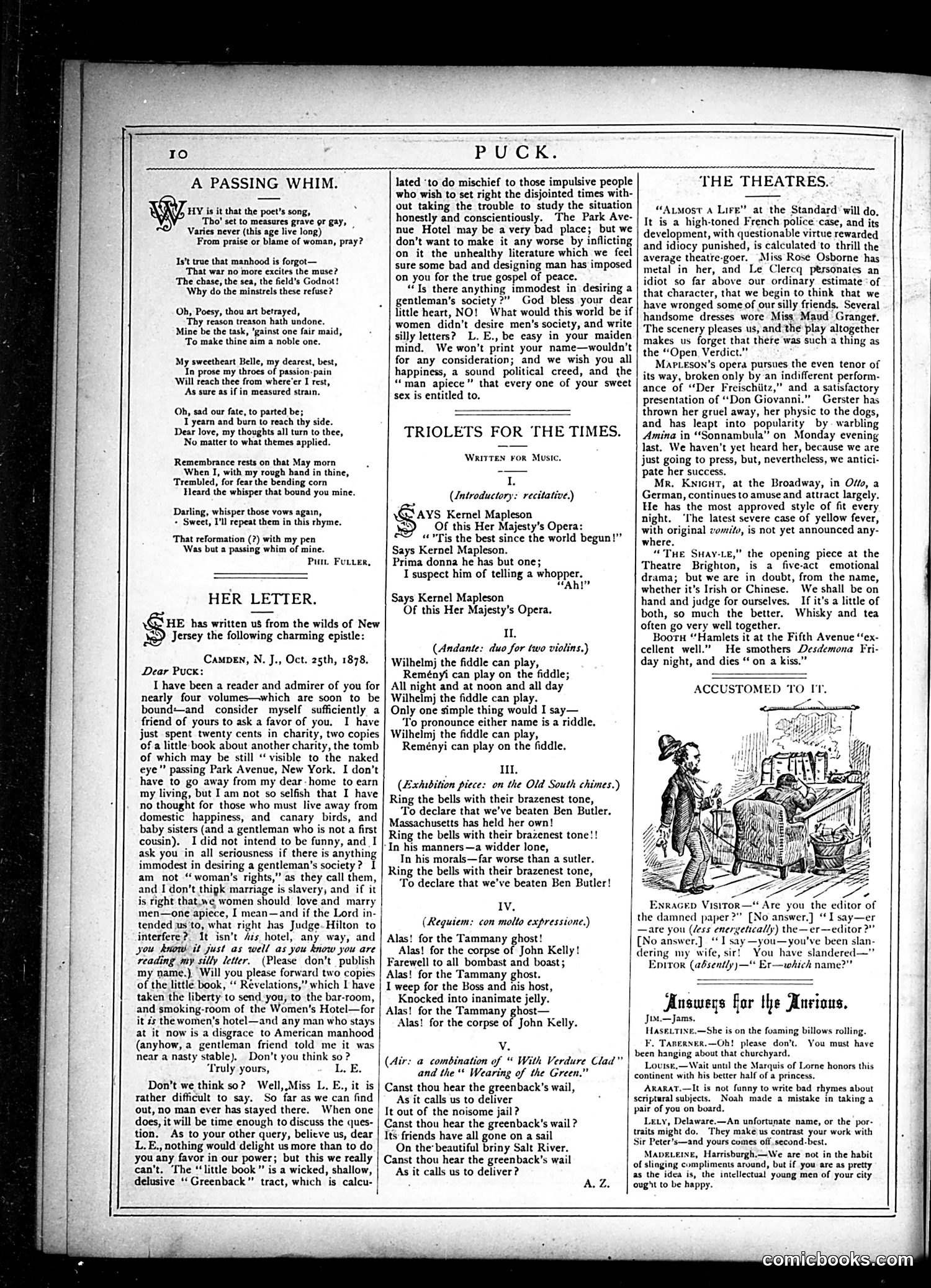
This cartoon depicts an "Engaged Visitor" at what appears to be a newspaper office, confronting an editor about the publication's editorial practices. The visitor expresses exasperation, asking sarcastically if the editor is responsible for "slandering" and other journalistic misconduct ("which makes?"). The cartoon satirizes yellow journalism practices of the 1890s era—specifically the tendency of newspapers to publish sensational, unethical content for profit. The visitor represents the public's frustration with media irresponsibility, while the editor's implied nonchalance ("accustomed to it") suggests newspapers routinely engaged in libel and slander without consequence. This reflects broader Progressive Era criticism of unaccountable press power and the absence of legal protections against defamation.
📄 Transcribed text from this page (OCR, searchable)
Machine-transcribed from the original scan — historical spelling and the odd misread are preserved.
Io PUCK. A PASSING WHIM. HY is it that the poet’s song, . Tho’ set to measures grave gr gay, Varies never (this age live long) : From praise or blame of woman, pray? Is't true that manhood is forgot— ‘That war no more excites the muse? ‘The chase, the sea, the field's Godnot! Why do the minstrels these refuse? Oh, Poesy, thou art betrayed, Thy reason treason hath undone. Mine be the task, ‘gainst one fair maid, ‘To make thine aim a noble one. My sweetheart Belle, my dearest, best, In prose my throes of passion-pain Will reach thee from where’er I rest, As sure as if in measured strain. Oh, sad our fate, to parted be; T yearn and burn to reach thy side. Dear love, my thoughts all turn to thee, No matter to what themes applied. Remembrance rests on that May morn ‘When I, with my rough hand in thine, ‘Trembled, for fear the bending corn Heard the whisper that bound you mine. Darling, whisper those vows again, + Sweet, I'll repeat them in this rhyme. ‘That reformation (?) with my pen ‘Was but a passing whim of mine. Punt. FULLER, HER LETTER. HE has written us from the wilds of New » Jersey the following charming epistle: Campen, N. J., Oct. 25th, 1878, Dear Puck: T have been a reader and admirer of you for nearly four volumes—which are soon to be boundand consider myself sufficiently a friend of yours to ask a favor of you. I have just spent twenty cents in charity, two copies of a little book about another charity, the tomb of which may be still ‘“ visible to the naked eye” passing Park Avenue, New York. I don't have to go away from my dear-home to earn my living, but I am not so selfish that I have no thought for those who must live away from domestic happiness, and canary birds, and baby sisters (and a gentleman who is not a first cousin). I did not intend to be funny, and I ask you in all seriousness if there is anything immodest in desiring a gentleman's society? I am_ not “ woman’s rights,” as they call them, and I don’t thipk marriage is slavery, and if it is right that.we women should love and marry men—one apiece, I mean—and if the Lord in- tended us to, what right has Judge. Hilton to interfere? It isn’t Ais hotel, any way, and you know. it just as well as you know you are reading my silly letter. (Please don’t publish my name.) Will you please forward two copies of the little book, ‘ Revelations,” which I have taken the liberty to send you, to the bar-room, and smoking-room of the Women’s Hotel—for it ¢s the women’s hotel—and any man who stays at it now is a disgrace to American manhood (anyhow, a gentleman friend told me it was hear a nasty stable). Don’t you think so ? ‘Truly yours, LE. | Don’t we think so? Well, Miss L. E., it is rather difficult to say. So far as we can find out, no man ever has stayed there. When one does, it will be time enough to discuss the ques- tion. As to your other query, believe us, dear L.E., nothing would delight us more than to do you any favor in our power; but this we really can't. The ‘little book” is a wicked, shallow, delusive ‘‘ Greenback” tract, which is calcu- | ( lated ‘to do mischief to those impulsive people who wish to set right the disjointed times with- out taking the trouble to study the situation honestly and conscientiously. The Park Ave- nue Hotel may be a very bad place; but we don’t want to make it any worse by inflicting on it the unhealthy literature which we feel sure some bad and designing man has imposed on you for the true gospel of peace. “Ts there anything immodest in desiring a gentleman's society?” God bless your dear little heart, NO! What would this world be if women didn’t desire men’s society, and write silly letters? L. E., be easy in your maiden mind, We won't print your name—wouldn’t for any consideration; and we wish you all happiness, a sound political creed, and the “man apiece” that every one of your sweet sex is entitled to. TRIOLETS FOR THE TIMES. WRITTEN FOR Music. 1. (Untroductory: recitative.) ES AYS Kemel Mapleson =) Of this Her Majesty's Opera: “*Tis the best since the world begun!” Says Kernel Mapleson. Prima donna he has but one; I suspect him of telling a whopper. “ARI” Says Kernel Mapleson Of this Her Majesty’s Opera. I. (Andante: duo for two violins.) Wilhelm) the fiddle can play, Reményi can play on the fiddle; All night and at noon and all day Wilhelmj the fiddle can play. Only one simple thing would I say— To pronounce either name is a riddle. Wilhelmj the fiddle can play, Reményi can play on the fiddle. Il. (Exhsbition piece: on the Old South chimes.) Ring the bells with their brazenest tone, To declare that we’ve beaten Ben Butler. Massachusetts has held her own! Ring the bells with their brazenest tone!! In his manners—a widder lone, In his morals—far worse than a sutler. Ring the bells with their brazenest tone, To declare that we’ve beaten Ben Butler! IV. (Requiem: con molto expressione.) Alas! for the Tammany ghost! Alas! for the corpse of John Kelly! Farewell to all bombast and boast; Alas! for the Tammany ghost. I weep for the Boss and nis host, Knocked into inanimate jelly. Alas! for the Tammany ghost— Alas! for the corpse of John Kelly. Vv. (Air: @ combination of “ With Verdure Clad” and the‘ Wearing of the Green.” Canst thou hear the greenback’s wail, As it calls us to deliver It out of the noisome jail? Canst thou hear the greenback’s wail ? Its friends have all gone on a sail On the beautiful briny Salt River. Canst thou hear the greenback’s wail As it calls us to deliver? A. Z, ‘THE THEATRES. “AtMost A Lire” at the Standard will do, It is a high-toned French police:case, and its development, with questionable virtue rewarded and idiocy punished, is calculated to thrill the average theatre-goer. Miss Rose Osborne has metal in her, and Le Clercq personates an idiot so far above our ordinary estimate °of that character, that we begin to think that we have wronged some of our silly friends. Several handsome dresses wore Miss: Maud Granget. The scenery pleases us, and-the play altogether makes us forget that there was such a thing as the “Open Verdict.” Mapteson’s opera pursues the even tenor of its way, broken only by an indifferent perform- ance of ‘Der Freischiitz,” and a satisfactory presentation of “Don Giovanni.” Gerster has thrown her gruel away, her physic to the dogs, and has leapt into popularity by. warbling Amina in “Sonnambula” on Monday evening last. We haven't yet heard her, because we are just going to press, but, nevertheless, we antici- pate her success, Mr. Kyicut, at the Broadway, in Ofto, a German, continues to amuse and attract largely, He has the most approved style of fit every night. ‘The latest severe case of yellow fever, with original zomito, is not yet announced any- where. “Tue Suay-Le," the opening piece at the Theatre Brighton, is a five-act emotional drama; but we are in doubt, from the name, whether it’s Irish or Chinese. We shall be on hand and judge for ourselves. If it’s a little of both, so much the better, Whisky and tea often go very well together. Bootn “Hamlets it at the Fifth Avenue “‘ex- cellent well.” He smothers Desdemona Fri- day night, and dies “on a kiss.” the damned paper?” [No answer.] “I say—er —are you (less energetically) the—er—editor 2” [No answer.] “I say —you—you've been slai dering my wife, sir! You have slandered— Enitor (absently)—" Et—which name?” F . Answers for the Anrious, Jut.—Jams. HASELTINE, F. Tanerner.—Oh! please don’t. been hanging about that churchyard, Lout Wait untl the Marquis of Lorne honors this continent with his better half of a princess, ARARAT.—It is not funny to write bad rhymes about scriptural subjects, Noah made a mistake in taking a pair of you on board. Lkuy, Delaware.—An unfortunate name, or the por- traits might do. They makevus contrast your work with Sir Peter's—and yours comes off second-best. Mapeceine, Harrisburgh.—We are not in the habit of slinging compliments around, but if you are as pretty as the idea is, the intellectual young men of your city oug't to be happy. She is on the foaming billows rolling. You must have COMIECDOOKS®