
Puck, 1878-10-16 · page 12 of 16
Puck — October 16, 1878 — page 12: what you’re looking at
What you’re looking at
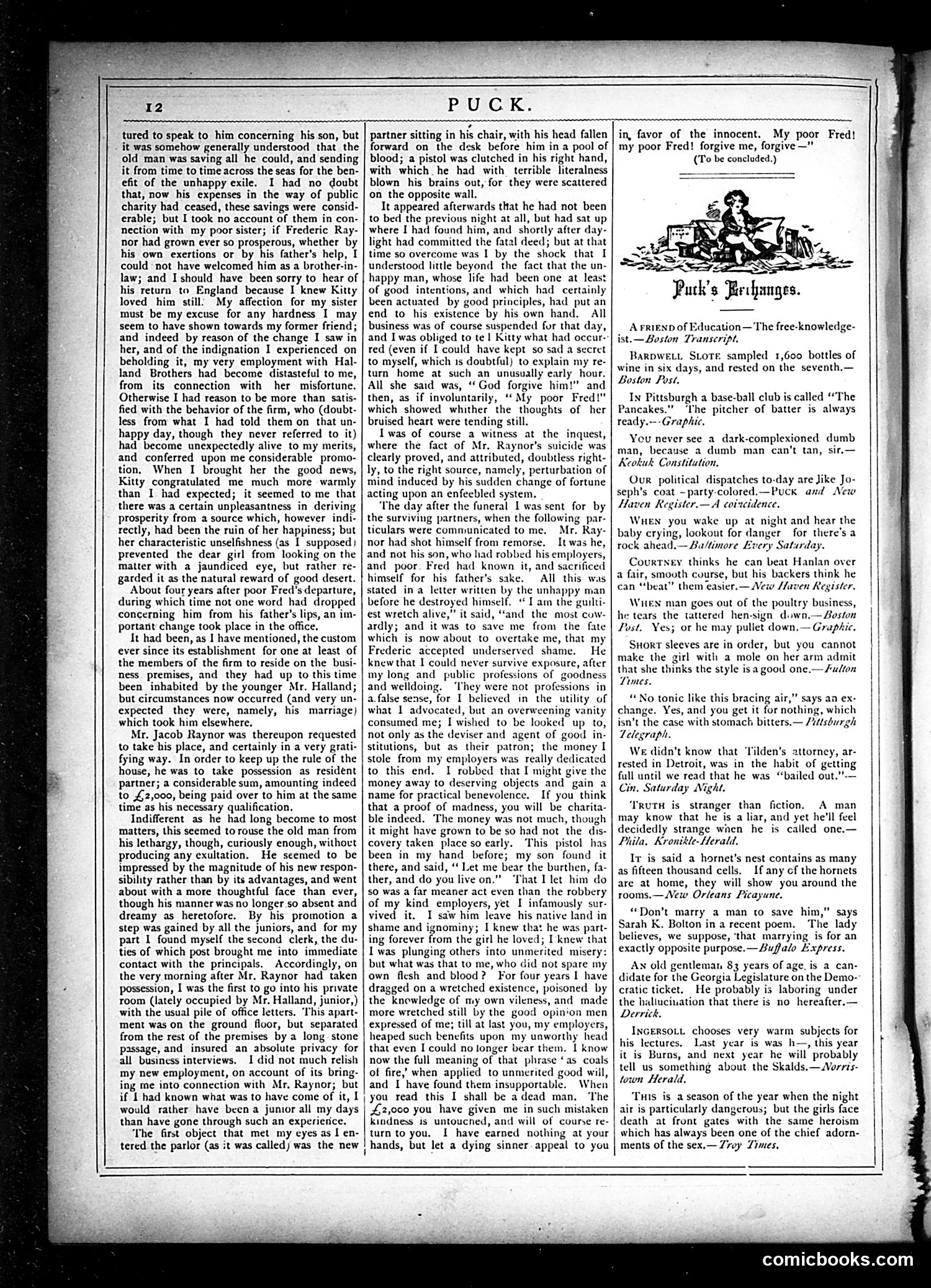
This page contains primarily **text content** rather than a prominent political cartoon. The main feature is "Puck's Briefs"—a humor column consisting of short jokes and satirical quips on contemporary topics. The visible jokes target: - Educational pretension ("A friend of Education") - Racial stereotypes (a "dark-complexioned dumb man" joke) - Political corruption and party politics - Marriage and domestic life - Various public figures and social types The column's tone is typical of Puck's approach: lighthearted mockery of American society, politicians, and current events. However, without seeing the primary cartoon illustration on this page (if one exists), I cannot identify specific political figures or events being satirized. The page appears to be primarily a humor miscellany rather than focused satire.
📄 Transcribed text from this page (OCR, searchable)
Machine-transcribed from the original scan — historical spelling and the odd misread are preserved.
12 tured to speak to him concerning his son, but it was somehow generally understood that the old man was saving all he could, and sending it from time to time across the seas for the ben- efit of the unhappy exile. I had no doubt that, now his expenses in the way of public charity had ceased, these savings were consid- erable; but I took no account of them in con- nection with my poor sister; if Frederic Ray- nor had grown ever so prosperous, whether by his own exertions or by his father’s help, I could not have welcomed him as a brother-in- law; and I should have been sorry to hear of his return to England because I knew Kitty loved him still: My affection for my sister must be my excuse for any hardness I may seem to have shown towards my former friend; and indeed by reason of the change I saw in her, and of the indignation I experienced on beholding it, my very employment with Hal- land Brothers had become distasteful to me, from its connection with her misfortune. Otherwise I had reason to be more than satis fied with the behavior of the firm, who (doubt- less from what I had told them on that un- happy day, though they never referred to it) had become unexpectedly alive to my merits, and conferred upon me considerable promo- tion, When I brought her the good news, Kitty congratulated me much more warmly than I had expected; it seemed to me that there was a certain unpleasantness in deriving prosperity from a source which, however indi- rectly, had been the ruin of her happiness; but her characteristic unselfishness (as I supposed} prevented the dear girl from looking on the matter with a jaundiced eye, but rather re- garded it as the natural reward of good desert. About four years after poor Fred's departure, during which time not one word had dropped concerning him from his father’s lips, an im- portant change took place in the office. It had been, as I have mentioned, the custom ever since its establishment for one at least of the members of the firm to reside on the busi- ness. premises, and they had up to this time been inhabited by the younger Mr. Halland; but circumstances now occurred (and very un- expected they were, namely, his marriage) which took him elsewhere, Mr. Jacob Raynor was thereupon requested to take his place, and certainly in a very grati- fying way. In order to keep up the rule of the house, he was to take possession as resident partner; a considerable sum, amounting indeed to £2,000, being paid over to him at the same time as his necessary qualification. Indifferent as he had long become to most matters, this seemed to rouse the old man from his lethargy, though, curiously enough, withoct producing any cxultation. He seemed to be impressed by the magnitude of his new respon- sibility rather than by its advantages, and went about with a more thoughtful face than ever, though his manner was no longer.so absent and dreamy as heretofore. By his promotion a step was gained by all the juniors, and for my part I found myself the second clerk, the du- ties of which post brought me into immediate contact with the principals. Accordingly, on the very morning after Mr. Raynor had taken possession, I was the first to go into his private room (lately occupied by Mr. Halland, junior,) with the usual pile of office letters. This apart- ment was on the ground floor, but separated from the rest of the premises by a long stone passage, and insured an absolute privacy for all business interviews. I did not much relish my new employment, on account of its bring- ing me into connection with Mr, Raynor; but if 1 had known what was to have come of it, I would rather have been a junior all my days than have gone through such an experietice. ‘The first object that met my cyes as I en- tered the parlor (as it was called) was the new partner sitting in his chair, with his head fallen forward on the desk before him in a pool of blood; a pistol was clutched in his right hand, with which he had with terrible literalness blown his brains out, for they were scattered on the opposite wall. It appeared afterwards that he had not been to bed the previous night at all, but had sat up where I had found him, and. shortly after day- light had committed the fatal deed; but at that time so overcome was I by the shock that I understood little beyond the fact that the un- happy man, whose life had been one at leas of good intentions, and which had certainly been actuated by good principles, had put an end to his existence by his own hand. All business was of course suspended for that day, and I was obliged to tel Kitty what had occur- red (even if I could have kept so sad a secret to myself, which 1s doubtful) to explain my re- turn home at such an unusually early hour. All she said was, “God forgive him!” and then, as if involuntarily, ‘My poor Fred!” which showed whither the thoughts of her bruised heart were tending still. Iwas of course a witness at the inquest, where the fact of Mr, Raynor's suicide was clearly proved, and attributed, doubtless right- ly, to the right source, namely, perturbation of mind induced by his sudden change of fortune acting upon an enfeebled system, ‘The day after the funeral 1 was sent for by the surviving partners, when the following par- ticulars were communicated to me, Mr. Ray- nor had shot himself from remorse. It was he, and not his son, who had robbed his employers, and poor. Fred had known it, and sacrificed himself for his father’s sake. All this was stated in a letter written by the unhappy man before he destroyed himself. “ I am the guilti- est wretch alive,” it said, “and the most cow- ardly; and it was to save me from the fate which is now about to overtake me, that my Frederic accepted underserved shame. He knew that I could never survive exposure, after my long and public professions of goodness and welldoing. ‘They were not professions in a.false sense, for I believed in the utility of what I advocated, but an overweening vanity consumed me; I wished to be looked up to, not only as the deviser and agent of good in- stitutions, but as their patron; the money I stole from my employers was really dedicated to this end. I robbed that I might give the money away to deserving objects and gain a name for practical benevolence. If you think that a proof of madness, you will be charita- ble indeed. The money was not much, though it might have grown to be so had not the dis- covery taken place so early. This pistol has been in my hand before; my son found it there, and said, ‘‘ Let me bear the burthen, fa- ther, and do you live on.” ‘That I let him do so was a far meaner act even than the robbery of my kind employers, yet I infamously sur- vived it. I saw him leave his native land in shame and ignominy; I knew tha: he was part- ing forever from the girl he loved; knew that I was plunging others into unmerited misery: but what was that to me, who did not spare my own ficsh and blood? For four years I have dragged on a wretched existence, poisoned by the knowledge of my own vileness, and made more wretched still by the good opinion men expressed of me; till at last you, my employers, heaped such benefits upon my unworthy head that even I could no longer bear them. I know now the full meaning of that phrase ‘as coals of fire” when applied to unmerited good will, and I have found them insupportable. When you read this I shall be adead man. The (£2,000 you have given me in such mistaken Kindness is untoucned, and will of course re- turn to you. 1 have earned nothing at your ; hands, but let a dying sinner appeal to you in, favor of the innocent. My poor Fred! my poor Fred! forgive me, forgive —” (To be concluded.) lucation—The free-knowledge- AFRIEND Of Transcript, ist.—Boston Barpwett SLoTE sampled 1,600 bottles of wine in six days, and rested on the seventh.— Boston Post, IN Pittsburgh a base-ball club is called “The Pancakes.” ‘The pitcher of batter is always ready.—-Graphic. You never see a dark-complexioned dumb man, because a dumb man can't tan, sir.— Keokuk Constitution, Our political dispatches to-day are Jike Jo- seph’s coat ~party-colored.—Puck and New Haven Register. A coincidence. Wuey you wake up at night and hear the baby crying, lookout for danger for there's a rock ahead. —Bul/timore Every Saturday. Courtey thinks he can beat Hanlan over a fair, smooth course, but his backers think he can “beat” them easier.— New Haven Register. man goes out of the poultry business, he tears the tattered hen-sign duwn,— Boston ust. Yes; or he may pullet down.— Graphic. Suort sleeves are in order, but you cannot make the girl with a mole on her arm admit that she thinks the style isa good one.—/udton Times. “No tonic like this bracing air,” says an ex: change. Yes, and you get it for nothing, which isn’t the case with stomach bitters.— Pittsburgh Telegraph. We didn’t know that Tilden’s attorney, ar- rested in Detroit, was in the habit of getting full until we read that he was “bailed out.”-— Cin, Saturday Night. ‘TrRutH is stranger than fiction, A man may know that he is a liar, and yet he'll feel decidedly strange when he is called one.— Phila, Kronikle-Herald, Ir is said a hornet’s nest contains as many as fifteen thousand cells. If any cf the hornets are at home, they will show you around the rooms.—New Orleans Picayune. “Don’t marry a man to save him,” says Sarah K. Bolton in a recent poem. The lady believes, we suppose, ‘that marrying is for an exactly opposite purpose.— Buffalo Express. Ay old gentleman 83 years of age, is a can- didate for the Georgia Legislature on the Demo- cratic ticket. He probably is laboring under the haltuciuation that there is no hereafter.— Derrick. INGERSOLL chooses very warm subjects for his lectures, Last year is was h—, this year it is Burns, and next year he will probably tell us something about the Skalds.—orris- town Herald. ‘Tuis is a season of the year when the night air is particularly dangerous; but the girls face death at front gates with the same heroism which has always been one of the chief adorn- ments of the sex. oy Times. comicbooks.com