
Puck, 1878-08-28 · page 6 of 16
Puck — August 28, 1878 — page 6: what you’re looking at
What you’re looking at
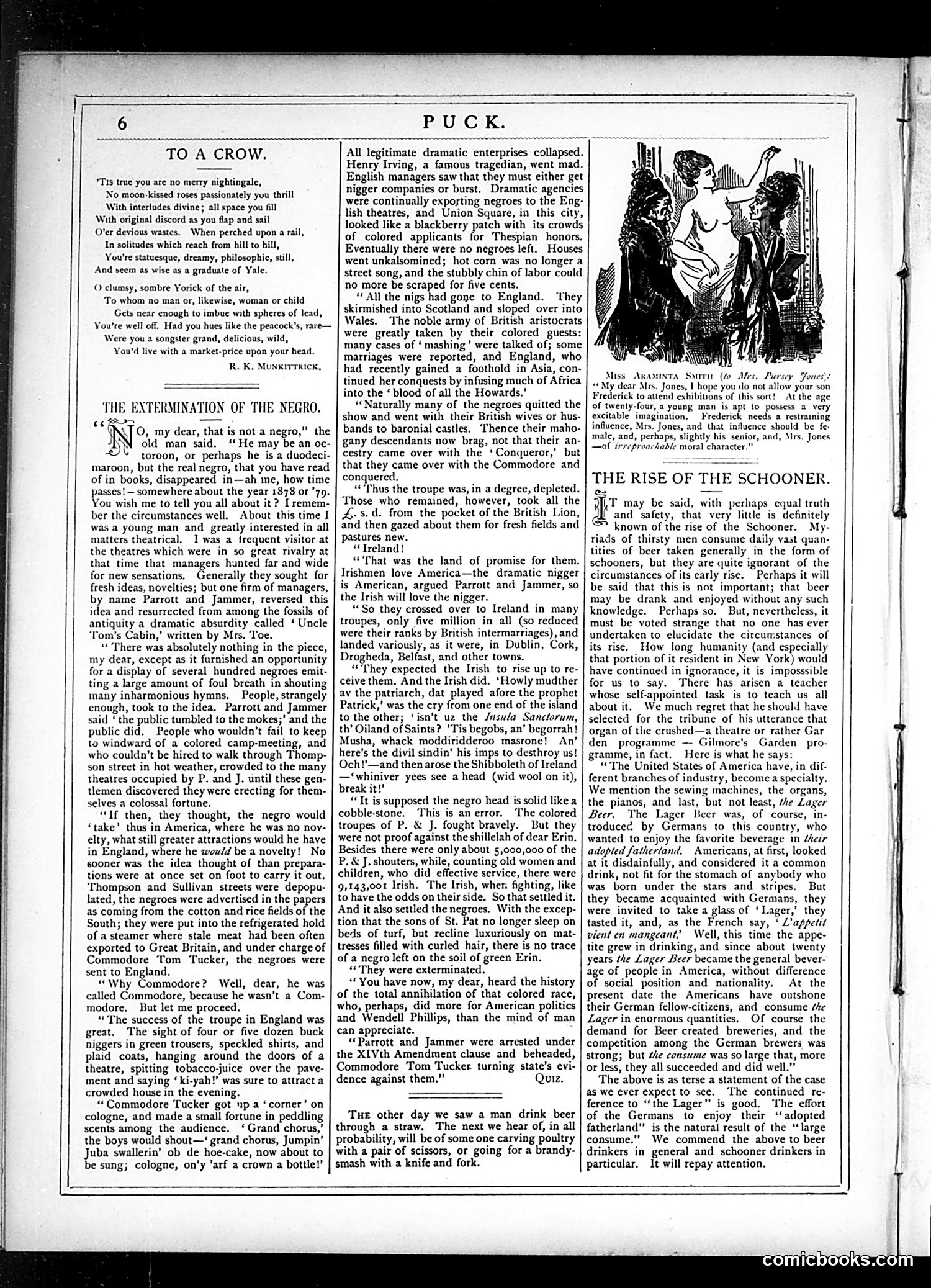
This page contains three distinct pieces: 1. **"To a Crow"** - A poem by R.K. Munkittrick mocking crows as common, unrefined creatures. 2. **"The Extermination of the Negro"** - A satirical dialogue criticizing racist attitudes. The text mocks arguments that African Americans should be removed from America, revealing their absurdity through exaggeration. It references theatrical managers' attempts to exclude Black performers and satirizes arguments about racial "purity." 3. **"The Rise of the Schooner"** - An article about the increasing popularity of a beer drink served in large glasses, humorously suggesting Americans adopted it from Germans without understanding its origins. The cartoon illustration shows figures in period dress, though specific identities aren't clearly labeled in the visible portion.
📄 Transcribed text from this page (OCR, searchable)
Machine-transcribed from the original scan — historical spelling and the odd misread are preserved.
TO A CROW. ‘Tis true you are no merry nightingale, No moon-kissed roses passionately yuu thrill With interludes divine; all space you fill With original discord as you flap and sail O'er devious wastes. When perched upon a rail, In solitudes which reach from hill to hill, You're statuesque, dreamy, philosophic, still, And seem as wise as a graduate of Yale. O clumsy, sombre Yorick of the air, ‘To whom no man or, likewise, woman or child Gets near enough to imbue with spheres of lead, You're well off. Had you hues like the peacock’s, rare— Were you a songster grand, delicious, wild, You'd live with a market-price upon your head. R. K. Munkirrrick, THE EXTERMINATION OF THE NEGRO. 2 = {NQ] O, my dear, that is not a negro,” the SKN old man said. ‘He may be an oc- “© toroon, or perhaps he is a duodeci- maroon, but the real negro, that you have read of in books, disappeared in—ah me, how time passes! — somewhere about the year 1878 or '79. You wish me to tell you all about it? [remem- ber the circumstances well, About this time I was a young man and greatly interested in all matters theatrical, I was a frequent visitor at the theatres which were in so great rivalry at that time that managers hunted far and wide for new sensations. Generally they sought for fresh ideas, novelties; but one firm of managers, by name Parrott and Jammer, reversed this idea and resurrected from among the fossils of antiquity a dramatic absurdity called ‘ Uncle ‘Tom's Cabin,’ written by Mrs. Toe. “There was absolutely nothing in the piece, my dear, except as it furnished an opportunity for a display of several hundred negroes emit- ting a large amount of foul breath in shouting many inharmonious hymns. People, strangely enough, took to the idea. Parrott and Jammer said ‘the public tumbled to the mokes;’ and the public did. People who wouldn't fail to keep to windward of a colored camp-meeting, and who couldn't be hired to walk through Thomp- son street in hot weather, crowded to the many theatres occupied by P. and J. until these gen- tlemen discovered they were erecting for them- selves a colossal fortune. “If then, they thought, the negro would “take’ thus in America, where he was no nov- elty, what still greater attractions would he have in England, where he wou/d be a novelty! No sooner was the idea thought of than prepara- tions were at once set on foot to carry it out, ‘Thompson and Sullivan streets were depopu- lated, the negroes were advertised in the papers as coming from the cotton and rice fields of the South; they were put into the refrigerated hold of a steamer where stale meat had been often exported to Great Britain, and under charge of Commodore ‘Tom Tucker, the negroes were sent to England. ““Why Commodore? Well, dear, he was called Commodore, because he wasn't a Com- modore. But let me proceed. “The success of the troupe in England was great. The sight of four or five dozen buck niggers in green trousers, speckled shirts, and plaid coats, hanging around the doors of a theatre, spitting tobacco-juice over the pave- ment and saying ‘ki-yah!’ was sure to attract a crowded house in the evening. “Commodore Tucker got up a ‘corner’ on cologne, and made a small fortune in peddling scents among the audience. ‘Grand chorus,’ the boys would shout—‘ grand chorus, Jumpin’ Juba swallerin’ ob de hoe-cake, now about to be sung; cologne, on'y ‘arf a crown a bottle!’ All legitimate dramatic enterprises collapsed. Henry Irving, a famous tragedian, went mad. English managers saw that they must either get nigger companies or burst. Dramatic agencies were continually exporting negroes to the Eng- lish theatres, and Union Square, in this city, looked like a blackberry patch with its crowds of colored applicants for Thespian honors. Eventually there were no negroes left. Houses went unkalsomined; hot corn was no longer a street song, and the stubbly chin of labor could no more be scraped for five cents. “All the nigs had gone to England. ‘They skirmished into Scotland and sloped over into Wales. The noble army of British aristocrats were greatly taken by their colored guests: many cases of ‘ mashing’ were talked of; some marriages were reported, and England, who had recently gained a foothold in Asia, con- tinued her conquests by infusing much of Africa into the ‘ blood of all the Howards.’ “Naturally many of the negroes quitted the show and went with their British wives or hus- bands to baronial castles. ‘Thence their maho- gany descendants now brag, not that their an- cestry came over with the ‘Conqueror,’ but that they came over with the Commodore and conquered. “ Thus the troupe was, in a degree, depleted. Those who remained, however, took all the 4-8. a, from the pocket of the British Lion, and then gazed about them for fresh fields and pastures new. “Treland! “That was the land of promise for them. Irishmen love America—the dramatic nigger is American, argued Parrott and Jammer, so the Irish will love the nigger. “So they crossed over to Ireland in many troupes, only five million in all (so reduced were their ranks by British intermarriages), and landed variously, as it were, in Dublin, Cork, Drogheda, Belfast, and other towns. “They expected the Irish to rise up to re- ceive them. And the Irish did. ‘Howly mudther av the patriarch, dat played afore the prophet Patrick,’ was the cry from one end of the island to the other; ‘isn’t uz the /vsula Sanctorum, th’ Oiland of Saints? "Tis begobs, an’ begorrah! Musha, whack moddiridderoo masrone! An’ here’s the divil sindin’ his imps to desthroy us! Och!’—and then arose the Shibboleth of Ireland —‘whiniver yees see a head (wid wool on it), break it!” “Tt is supposed the negro head is solid likea cobble-stone. This is an error. ‘The colored troupes of P. & J. fought bravely. But they were not proof against the shillelah of dear Erin, Besides there were only about 5,000,000 of the P.& J. shouters, while, counting old women and children, who did effective service, there were 9,143,001 Irish. The Irish, when fighting, like to have the odds on their side. So that settled it. And it also settled the negroes. With the excep- tion that the sons of St. Pat no longer sleep on beds of turf, but recline luxuriously on mat- tresses filled with curled hair, there is no trace of a negro left on the soil of green E “They were exterminated. “You have now, my dear, heard the history of the total annihilation of that colored race, who, perhaps, did more for American politics and Wendell Phillips, than the mind of man can appreciate. “Parrott and Jammer were arrested under the XI1Vth Amendment clause and beheaded, Commodore Tom Tucker turning state's evi- dence against them.” Quiz. Tue other day we saw a man drink beer through a straw. The next we hear of, in all probability, will be of some one carving poultry with a pair of scissors, or going for a brandy- smash with a knife and fork. Miss Akaminta Swurit (40 Mrs, Pursey Jonesse “My dear Mrs. Jones, | hope you do not allow your son Frederick to attend exhibitions of this sort! At the age of twenty-four, a young man is apt to possess a very excitable imagination, Frederick needs a restraining influence, Mrs. Jones, and that influence should be fe- male, and, perhaps, slightly his senior, and, Mrs, Jones —of irreproachable moral character.” THE RISE OF THE SCHOONER. ee ht, may be said, with perhaps equal truth and safety, that very little is definitely known of the rise of the Schooner. M tiads of thirsty men consume daily vast quan- tities of beer taken generally in the form of schooners, but they are quite ignorant of the circumstances of its early rise. Perhaps it will be said that this is not important; that beer may be drank and enjoyed without any such knowledge. Perhaps so. But, nevertheless, it must be voted strange that no one has ever undertaken to elucidate the circumstances of its rise. How long humanity (and especially that portion of it resident in New York) would have continued in ignorance, it is impossible for us to say. There has arisen a teacher whose self-appointed task is to teach us all about it. We much regret that he should have selected for the tribune of his utterance that organ of the crushed—a theatre or rather Gar den programme — Gilmore's Garden pro- gramme, in fact. Here is what he say: “The United States of America have, in dif- ferent branches of industry, become a specialty. We mention the sewing machines, the organs, the pianos, and last, but not least, He Lager Beer. The Lager Beer was, of course, in- troducec by Germans to this country, who wanted to enjoy the favorite beverage in /heir adopted fatherland, Americans, at first, looked at it disdainfully, and considered it a common drink, not fit for the stomach of anybody who was born under the stars and stripes. But they became acquainted with Germans, they were invited to take a glass of ‘Lager,’ they tasted it, and, as the French say, ‘ L’appetit vient en mangeant! Well, this time the appe- tite grew in drinking, and since about twenty years the Lager Beer became the general bever- age of people in America, without difference of social position and nationality. At the present date the Americans have outshone their German fellow-citizens, and consume ¢he Lager in enormous quantities. Of course the demand for Beer created breweries, and the competition among the German brewers was strong; but ¢he consume was so large that, more or less, they all succeeded and did well The above is as terse a statement of the case as we ever expect to sce. The continued re- ference to “the Lager” is good. ‘The effort of the Germans to enjoy their “adopted fatherland” is the natural result of the “large consume.” We commend the above to beer drinkers in general and schooner drinkers in particular. It will repay attention. A