
Puck, 1878-08-28 · page 10 of 16
Puck — August 28, 1878 — page 10: what you’re looking at
What you’re looking at
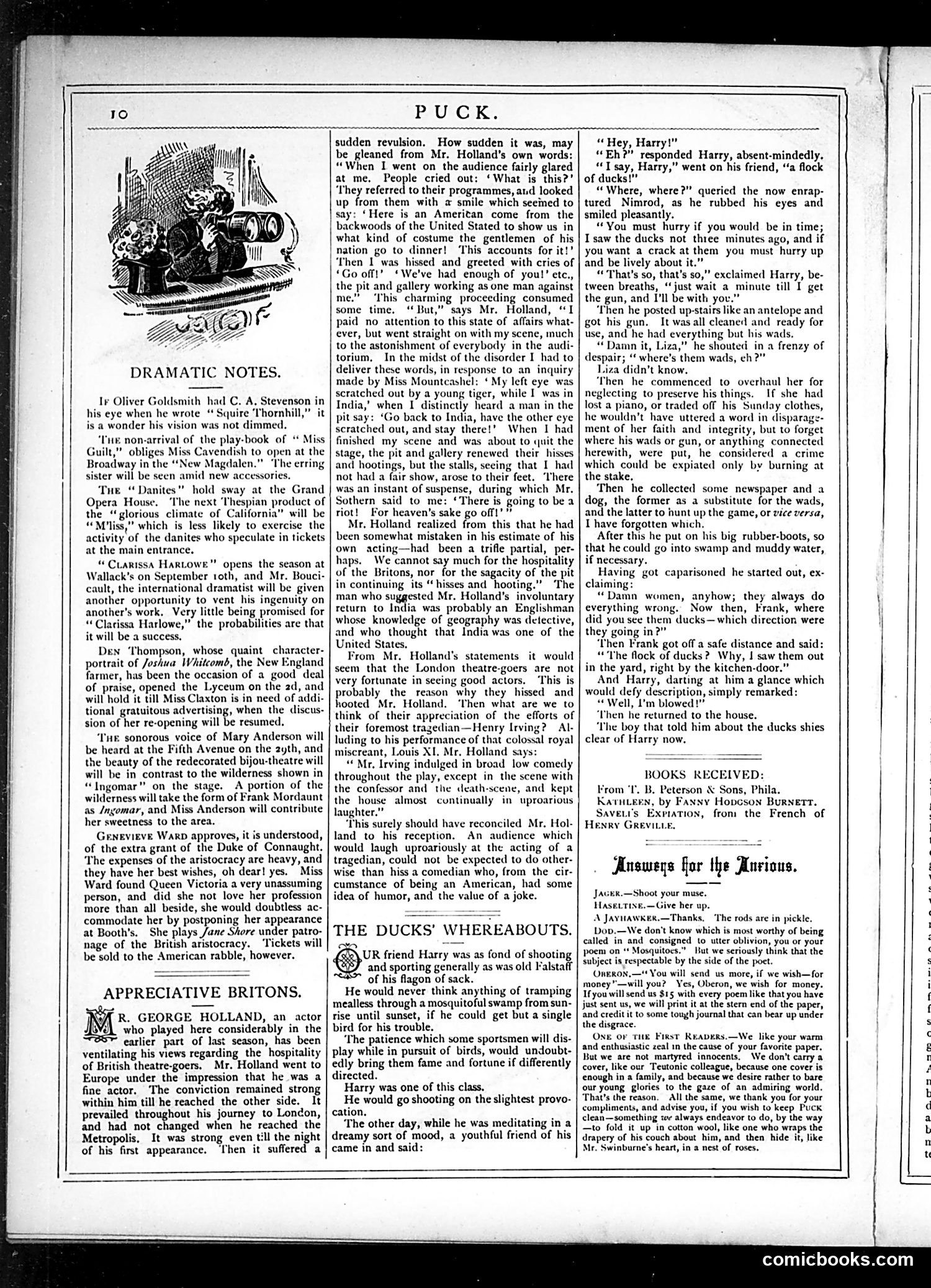
This page contains theatrical criticism rather than political satire. The main illustration shows a dramatic scene, likely from a play being reviewed. The "Dramatic Notes" section discusses recent theater productions, including Oliver Goldsmith's "She Stoops to Conquer" and a play featuring George Holland. The text criticizes Holland's performance in a play where he portrayed an American character, noting his poor geography knowledge (confusing India with the United States). "The Ducts' Whereabouts" appears to be a humorous short story about a character named Harry and his friend's obsession with duck hunting. The section includes dialogue about shooting ducks and contains social commentary on sporting culture. The page concludes with a "Books Received" section listing recently published works and an "Answers for the Anxious" advice column addressing reader inquiries.
📄 Transcribed text from this page (OCR, searchable)
Machine-transcribed from the original scan — historical spelling and the odd misread are preserved.
PUCK. DRAMATIC NOTES. Ir Oliver Goldsmith had C. A, Stevenson in his eye when he wrote “ Squire Thornhill,” it is a wonder his vision was not dimmed. : non-arrival of the play-book of “ Miss obliges Miss Cavendish to open at the Broadway in the “New Magdalen.” i sister will be seen amid new accessories. Tue “ Danites” hold sway at the Grand Opera Ho ‘The next ‘Thespian product of the “glorious climate of California” will be “Miss,” which is less likely to exercise the activity of the danites who speculate in tickets at the main entrance, “ CLARISSA HARLOWE” opens the season at Wallack’s on September roth, and Mr. Bouci- cault, the international dramatist will be given another opportunity to vent his ingenuity on another's work. Very little being promised for “Clarissa Harlowe,” the probabilities are that it will be a success, Den ‘Thompson, whose quaint character- portrait of Joshua Whitcomé, the New England farmer, has been the occasion of a good deal of praise, opened the Lyceum on the ad, and will hold it till Miss Claxton is in need of addi- tional gratuitous adlvertising, when the discus- sion of her re-opening will be resumed. ‘Ie sonorous voice of Mary Anderson will be heard at the Fifth Avenue on the 2yth, and the beauty of the redecorated bijou-theatre will will be in contrast to the wilderness shown in “Ingomar” on the stage. A portion of the wilderness will take the form of Frank Mordaunt as /ngomar, and Miss Anderson will contribute her sweetness to the area. Genevieve Warp approves, it is understood, of the extra grant of the Duke of Connaught. ‘The expenses of the aristocracy are heavy, and they have her best wishes, oh dear! yes. Miss Ward found Queen Victoria a very unassuming person, and did she not love her profession more than all beside, she would doubtless ac- commodate her by postponing her appearance at Booth's. She plays /ane Shore under patro- nage of the British aristocracy. ‘Tickets will be sold to the American rabble, however. APPRECIATIVE BRITONS. R. GEORGE HOLLAND, an_ actor J who played here considerably in the earlier part of last season, has been ventilating his views regarding the hospitality of British theatre-goers, Mr. Holland went to Europe under the impression that he was a fine actor, The conviction remained strong within him till he reached the other side. It prevailed throughout his journey to London, and had not changed when he reached the Metropolis, It was strong even till the night of his first appearance. ‘Then it suffer sudden revulsion, How sudden it was, may be gleaned from Mr. Holland’s own words: “When I went on the audience fairly glared at me, People cried out: ‘What is this?’ ‘They referred to their programmes, aud looked up from them with a smile which seemed to say: ‘Here is an Ameritan come from the backwoods of the United Stated to show us in what kind of costume the gentlemen of his nation go to dinner! ‘This accounts for it!’ ‘Then I was hissed and greeted with cries of “Go off!’ ‘We've had enough of you!’ ete., the pit and gallery working as one man against me.” ‘This charming proceeding consumed some time, ‘ But,” says Mr. Holland, “1 paid no attention to this state of affairs what- ever, but went straight on with my scene, much to the astonishment of everybody in the audi- torium, In the midst of the disorder I_ had to deliver these words, in response to an inquiry made by Miss Mounteashel: ‘My left eye was scratched out by a young tiger, while I was in India,’ when I distinctly heard a man in the pit say: ‘Go back to India, have the other eye scratched out, and stay there!’ When I had finished my scene and was about to quit the stage, the pit and gallery renewed their hisses and hootings, but the stalls, seeing that I had not had a fair show, arose to their feet. ‘There was an instant of suspense, during which Mr. Sothern said to me: ‘There is going to bea riot! For heaven's sake go off!" Mr. Holland realized from this that he had been somewhat mistaken in his estimate of his own acting—had been a trifle partial, per- haps. We cannot say much for the hospitality of the Britons, nor for the sagacity of the pit in continuing its ‘hisses and hooting.” The man who suggested Mr. Holland’s involuntary return to India was probably an Englishman whose knowledge of geography was detective, and who thought that India was one of the United States, From Mr. Holland's statements it would seem that the London theatre-goers are not very fortunate in seeing good actors. This is probably the reason why they hissed and hooted Mr, Holland. ‘Then what are we to think of their appreciation of the efforts of their foremost tragedian—Henry Irving? Al- luding to his performance of that colossal royal miscreant, Louis XI, Mr, Holland says: “Mr, Irving indulged in broad low comedy throughout the play, except in the scene with the confessor and the death-scene, and kept the house almost continually in uproarious laughter.” ‘This should have reconciled Mr. Hol- land to reception, An audience which would laugh uproariously at the acting of a tragedian, could not be expected to do other- wise than hiss a comedian who, from the cir- cumstance of being an American, had some idea of humor, and the value of a joke. THE DUCKS’ WHEREABOUTS. 2 UR friend Harry was as fond of shooting and sporting generally as was old Falstaff of his flagon of sack. He would never think anything of tramping mealless through a mosquitoful swamp from sun- rise until sunset, if he could get but a single bird for his trouble. ‘The patience which some sportsmen will dis- play while in pursuit of birds, would undoubt- edly bring them fame and fortune if differently directed. Harry was one of this class, He would go shooting on the slightest provo- cation, ‘The other day, while he was meditating in a dreamy sort of mood, a youthful friend of his came in and said: “Hey, Harry!” a Eh} responded Harry, absent-mindedly. “T say, Harry,” went on his friend, “a flock of ducks!"" “Where, where?” queried the now enrap- tured Nimrod, as he rubbed his eyes and smiled pleasantly. “You must hurry if you would be in time; I saw the ducks not three minutes ago, and if you want a crack at them you must hurry up and be lively about it.” “That's so, that’s so,” exclaimed Harry, be- tween breaths, “just wait a minute till I get the gun, and I'll be with you.” ‘Then he posted up-stairs like an antelope and got his gun. It was all cleaned and ready for use, and he had everything but his wads. “Damn it, Liza,” he shouted ina frenzy of despair; “ where’s them wads, eh?” Liza didn’t know. ‘Then he commenced to overhaul her for neglecting to preserve his things. If she had lost a piano, or traded off his Sunday clothes, he wouldn’t have uttered a word in disparage- ment of her faith and integrity, but to forget where his wads or gun, or anything connected herewith, were put, he considered a crime which could be expiated only by burning at the stake. Then he collected some newspaper and a dog, the former as a substitute for the wads, and the latter to hunt up the game, or vice versa, I have forgotten which. After this he put on his big rubber-boots, so that he could go into swamp and muddy water, if necessary. Having got caparisoned he started out, ex- claiming: “Damn women, anyhow; they always do everything wrong. Now then, Frank, where did you see them ducks—which direction were they going in?” ‘Then Frank got off a safe distance and said: “The flock of ducks? Why, | saw them out in the yard, right by the kitchen-door.” And Harry, darting at him a glance which would defy description, simply remarked: “Well, I'm blowed! hen he returned to the house, ‘The boy that told him about the ducks shies clear of Harry now. BOOKS RECEIVED: From ‘I’. B. Peterson & Sons, Phila. Katitery, by Fanyy Hopcson Burvetr. Savet's Exriation, from the French of Henry GREVILLE. naweqs for the Anrious, —Shoot your muse. ‘The rods are in pickle. Dov.—We don't know which is most worthy of being called in and consigned to utter oblivion, you or your poem on “ Mosquitoes.” ut we seriously think that the subject is respectable by the side of the poet. ow “You will send us more, if we wish—for money”—will you? Yes, Oberon, we wish for money. Ifyou will send us $15 with every poem like that you have just sent us, we will print it at the stern end of the paper, and credit it to some tough journal that can bear up under the disgrace. Oxe or THe First Reavers.—We like your warm and enthusiastic zeal in the cause of your favorite paper. But we are not martyred innocents, We don't carry a cover, like our Teutonic colleague, because one cover is enough in a family, and because we desire rather to bare our young glories to the gaze of an admiring world. ‘That's the reason. All the same, we thank you for your compliments, and advise you, if you wish to keep Puck clean—something toc always endeavor to do, by the way —to fold it up in cotton wool, like one who wraps the drapery of his couch about him, and then hide it, like Mr. Swinburne’s heart, in a nest of roses. On ——] comicbooks.com