
Puck, 1878-06-26 · page 7 of 16
Puck — June 26, 1878 — page 7: what you’re looking at
What you’re looking at
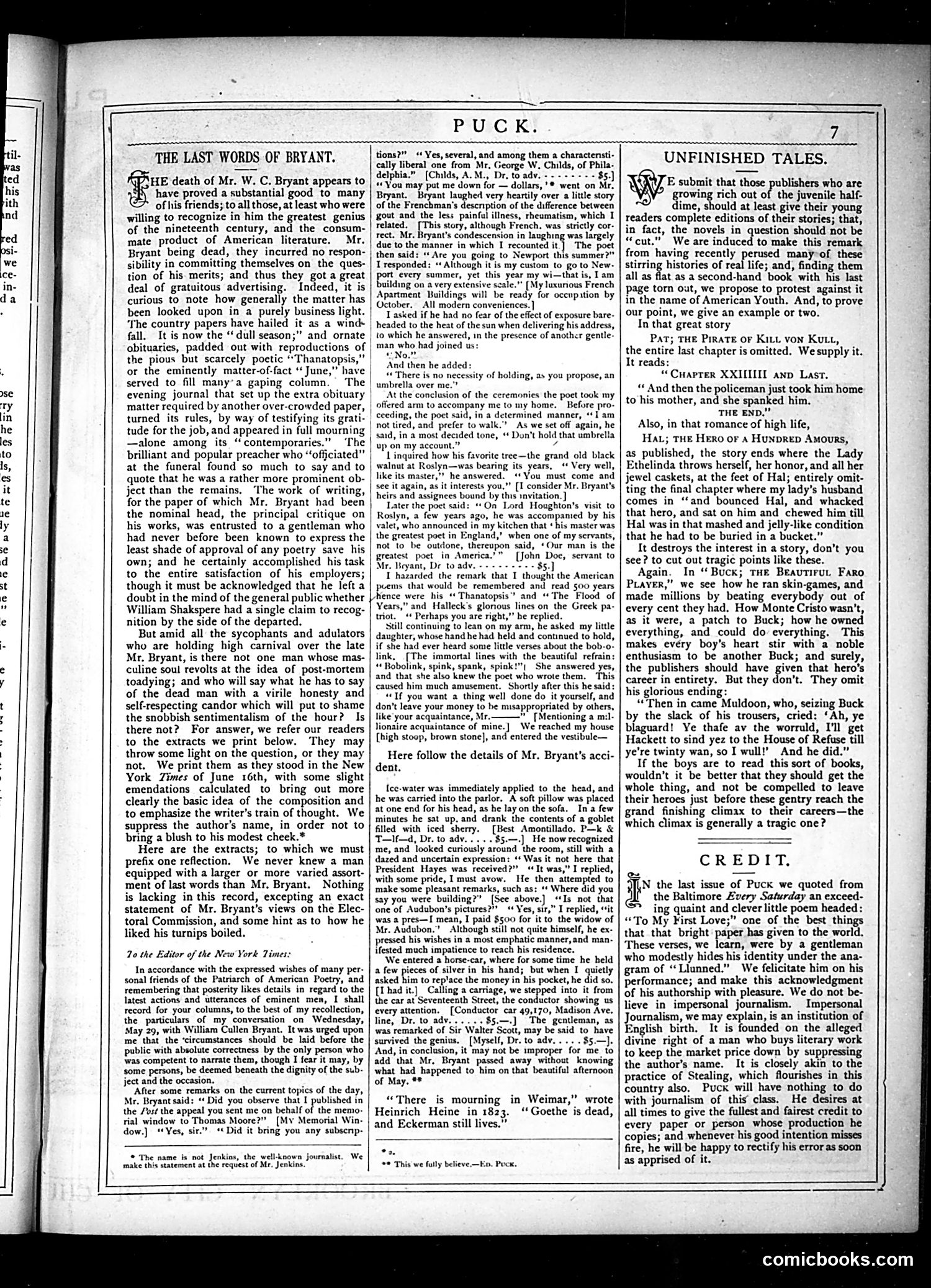
This page is primarily text-based editorial content rather than cartoons. It contains: 1. **"The Last Words of Bryant"** — an article about W.C. Bryant's death, noting his prominence as a nineteenth-century American poet and editor. The piece discusses his contributions to journalism and literature, then reprints various anecdotes and final remarks attributed to him. 2. **"Unfinished Tales"** — a brief section criticizing publishers for incomplete serialized novels, using examples like "The Death of Kill von Küll" to illustrate the problem of stories ending abruptly without proper conclusions. 3. **"Credit"** — a note about sourcing, mentioning the Baltimore *Every Saturday* publication. The page appears to be a literary and editorial section rather than satirical visual content, focusing on cultural commentary and literary criticism typical of Puck's content.
📄 Transcribed text from this page (OCR, searchable)
Machine-transcribed from the original scan — historical spelling and the odd misread are preserved.
PUCK. 7 THE LAST WORDS OF BRYANT. HE death of Mr. W. C. Bryant appears to have proved a substantial good to many of his friends; to all those, at least who were willing to recognize in him the greatest genius of the nineteenth century, and the consum- mate product of American literature. Mr. | rect. Mr. Bryant being dead, they incurred no respon- | sibility in committing themselves on the ques- tion of his. merits; and thus they got a great deal of gratuitous advertising. Indeed, it is curious to note how generally the matter has been looked upon in a purely business light. ‘The country papers have hailed it as a winds fall. It is now the “dull season;" and ornate obituaries, padded out with reproductions of the pious but scarcely poetic “Thanatopsis,” or the eminently matter-of-fact “June,” have served to fill many’a gaping column. ‘The evening journal that sct up the extra obituary matter required by another over-crowded paper, turned its rules, by way of testifying its grati- tude for the job, and appeared in full mourning —alone among its “contemporaries.” ‘The brilliant and popular preacher who “offjciated” | at the funeral found so much to say and to | quote that he was a rather more prominent ob- ject than the remains, ‘The work of writing, for the paper of which Mr. Bryant had been the nominal head, the principal critique on his works, was entrusted to a gentleman who had never before been known to express the least shade of approval of any poetry save his own; and he certainly accomplished his task to the entire satisfaction of his employers; though it must be acknowledged that he left a doubt in the mind of the general public whether William Shakspere had a single claim to recog- nition by the side of the departed. But amid all the sycophants and adulators who are holding high carnival over the late Mr. Bryant, is there not one man whose mas- culine soul revolts at the idea of post-mortem toadying; and who will say what he has to say of the dead man with a virile honesty and self-respecting candor which will put to shame the snobbish sentimentalism of the hour? Is there not? For answer, we refer our readers to the extracts we print below. They may throw some light on the question, or they may not. We print them as they stood in the New York Zimes of June 16th, with some slight emendations calculated to bring out more clearly the basic idea of the composition and to emphasize the writer's train of thought. We suppress the author’s name, in order not to bring a blush to his modest cheek.* Here are the extracts; to which we must prefix one reflection. We never knew a man equipped with a larger or more varied assort- ment of last words than Mr. Bryant. Nothing is lacking in this record, excepting an exact statement of Mr. Bryant's views on the Elec- toral Commission, and some hint as to how he liked his turnips boiled. 70 the Editor of the New York Times: In accordance with the expressed wishes of many per- sonal friends of the Patriarch of American Poetry, and remembering that posterity likes details in regard to the latest actions and utterances of eminent men, I shall record for your columns, to the best of my recollection, the particulars of my conversation on Wednesday, May 29, with William Cullen Bryant. It was urged upon me that the ‘circumstances should be laid before the public with absolute correctness by the only person who was competent to narrate them, though I fear it may, by some persons, be deemed beneath the dignity of the sub- ject and the occasion. ‘After some remarks on the current topics of the day, Mr. Bryant said: “ Did you observe that I published in the /oit the appeal you sent me on behalf of the memo- rial window to Thomas Moore?” (My Memorial Win- dow.} Yes, sir.” “Did it bring you any subsenp- © ‘The name is not Jenkins, the well-known journalist. We make this statement at ihe request of Mr. Jenkins. tions?” « Yes, several, and among them a charactensti- cally liberal one from Mr. George W. Childs, of Phila- delphia.” (Childs, A.M. Dr, to adv. ----+--- $5.) “You may put me down for — dollars, ’* went on Mr. Bryant. Bryant laughed very heartily over a little story of the Frenchman's description of the difference between gout and the less painful illness, rheumatism, which I related: [This tory, although French. was strictly cor- Bryant's condescension in laughing was largely nner in which I recounted it ] The poet then sai re you going to Newport this summer?” I responded: * Although it is my custom to go to New- port every summer, yet this year my wi—that is, I am building on a very extensive scale.” [My luxurious French Apartment Buildings will be ready for occupation by October. All modern conveniences. | T asked if he had no fear of the effect of exposure bare- headed to the heat of the sun when delivering his address, to which he answered, in the presence of another gentle man who had joined us: And then he added: “There is no necessity of holding, as you propose, an umbrella over me.”* At the conclusion of the ceremonies the poet took my offered arm to accompany me to my home. Before pro- ceeding, the poet said, in a determined manner, ‘1 am not tired, and prefer to walk.” As we set off again, he said, in a most decided tone, Don't hold that umbrella up on my account.” 7 L inquired how his favorite tree—the grand old black walnut at Roslyn—was bearing its years, “ Very well, like its master,” he answered. ‘* You must come and see it again, as it interests you,"" [I consider Mr. Bryant’s heirs and assignees bound by this invitation. ] Later the poct said: On Lord Houghton’s visit to Roslyn, a few years ago, he was accompanied by his valet, who announced in my kitchen that ‘ his master was the greatest poet in England,’ when one of my servants, not to be outdone, thereupon said, ‘Our man is the greatest poet_in America.’” [John Doe, servant to Mr. Bryant, De to adv, -- +++ -2-- $5. I hazarded the remark that I thought the American peems that would be remembered and read 500 years Hence were his “ Thanatopsis” and “The Flood of Years," and Halleck’s glorious lines on the Greek pa- triot. |“ Perhaps you are right,” he replied. Suill continuing to lean on my arm, he asked my little daughter, whose hand he had held and continued to hold, if she had ever heard some little verses about the bob-o- link, [The immortal lines with the beautiful refrain: “ Bobolink, spink, spank, spink!"| She answered yes, and that she also knew the poet who wrote them. This caused him much amusement. Shortly after this he said: “If you want a thing well done do it yourself, and don't leave your money to he misappropriated by others, like’ your acquaintance, Mr. ”” [Mentioning a m:l- lionaire acquaintance of mine.] We reached my house [high stoop, brown stone], and entered the vestibule— due to th Here follow the details of Mr. Bryant's acci- dent. {ce-water was immediately applied to the head, and he was carried into the parlor. A soft pillow was placed at one end for his head, as he lay on the sofa. Ina few minutes he sat up. and drank the contents of a goblet filled with iced sherry. [Best Amontillado. P—k & T—I—4, Dr. to adv. ....$5.—.] He now recognized me, and looked curiously around the room, still with a dazed and uncertain expression: ‘Was it not here that President Hayes was received?” It was,” I replied, with some pride, I must avow. He then attempted to make some pleasant remarks, such as: ‘¢ Where did you say you were building?” (See above.) Is not that one of Audubon’s pictures?” «+ Y I replied, “it was a pres—I mean, I paid $500 for it to the widow of Mr. Audubon.” Although still not quite himself, he ex- pressed his wishes in a most emphatic manner,and man- ifested much impatience to reach his residence. We entered a horse-car, where for some time he held a few pieces of silver in his hands but when I quietly asked him to replace the money in his pocket, he did so. [Thad it.] Calling a carriage, we stepped into it from the car at Seventeenth Street, the conductor showing us every attention. [Conductor car 49,170, Madison Ave. line, Dr. to ady. $5.—.] The gentleman, as was remarked of Sir Walter Scott, may be said to have survived the genius. (Myself, Dr. to adv. ‘And, in conclusion, it may not be improper for me to add ‘that Mr, Bryant passed away without knowing what had happened to him on that beautiful afternoon of May. #* “There is mourning in Weimar,” wrote Heinrich Heine in 1823. ‘‘ Goethe is dead, and Eckerman still lives.” ** This we fully believe. Ep. Poex. UNFINISHED TALES. E submit that those publishers who are growing tich out of the juvenile half- ime, should at least give their young readers complete editions of their stories; that, in fact, the novels in question should not be cut." We are induced to make this remark from having recently perused manyeof these stirring histories of real lifes and, finding them all as flat as a second-hand book with his last page torn out, we propose to protest against it in the name of American Youth. And, to prove our point, we give an example or two. In that great story Pat; THE Pirate oF Kitt von Kutt, the entire last chapter is omitted. We supply it. It reads: “Cuaprer XXIII anp Last, “And then the policeman just took him home to his mother, and she spanked him. THE END.” Also, in that romance of high life, Hav; THE HeRo or A HunpRED AMours, as published, the story ends where the Lady Ethelinda throws herself, her honor, and all her jewel caskets, at the feet of Hal; entirely omit- ting the final chapter where my lady's husband comes in ‘‘and bounced Hal, and whacked that hero, and sat on him and chewed him till Hal was in that mashed and jelly-like condition that he had to be buried in a bucket.” It destroys the interest in a story, don’t you see? to cut out tragic points like these. Again. In “ Buck; THE Beautirut Faro Prayer,” we see how he ran skin-games, and made millions by beating everybody out of every cent they had. How Monte Cristo wasn’t, as it were, a patch to Buck; how he owned everything, and could do everything. This makes evéry boy's heart stir with a noble enthusiasm to be another Buck; and surely, the publishers should have given that hero’s career in entirety. But they don’t. They omit his glorious ending: “Then in came Muldoon, who, seizing Buck by the slack of his trousers, cried: ‘Ah, ye blaguard! Ye thafe av the worruld, I'll get Hackett to sind yez to the House of Refuse till ye’re twinty wan, so I wull!’ And he did.” If the boys are to read this sort of books, wouldn't it be better that they should get the whole thing, and not be compelled to leave their heroes just before these gentry reach the grand finishing climax to their careers—the which climax is generally a tragic one? CREDIT, IP the last issue of Puck we quoted from the Baltimore Every Saturday an exceed- ing quaint and clever little poem headed: “To My Kirst Love;” one of the best things that that bright paper has given to the world, ‘These verses, we Icarn, were by a gentleman who modestly hides his identity under the ana- gram of “Liunned.” We felicitate him on his performance; and make this acknowledgment of his authorship with pleasure. We do not be- lieve in impersonal journalism. Impersonal Journalism, we may explain, is an institution of English birth. It is founded on the alleged divine right of a man who buys literary work to keep the market price down by suppressing the author’s name. It is closely akin to the practice of Stealing, which flourishes in this country also. Puck will have nothing to do with journalism of this class. He desires at all times to give the fullest and fairest credit to every paper or person whose production he copies; and whenever his good intention misses fire, he will be happy to rectify his error as soon as apprised of it. comicbooks.com