
Puck, 1878-06-26 · page 6 of 16
Puck — June 26, 1878 — page 6: what you’re looking at
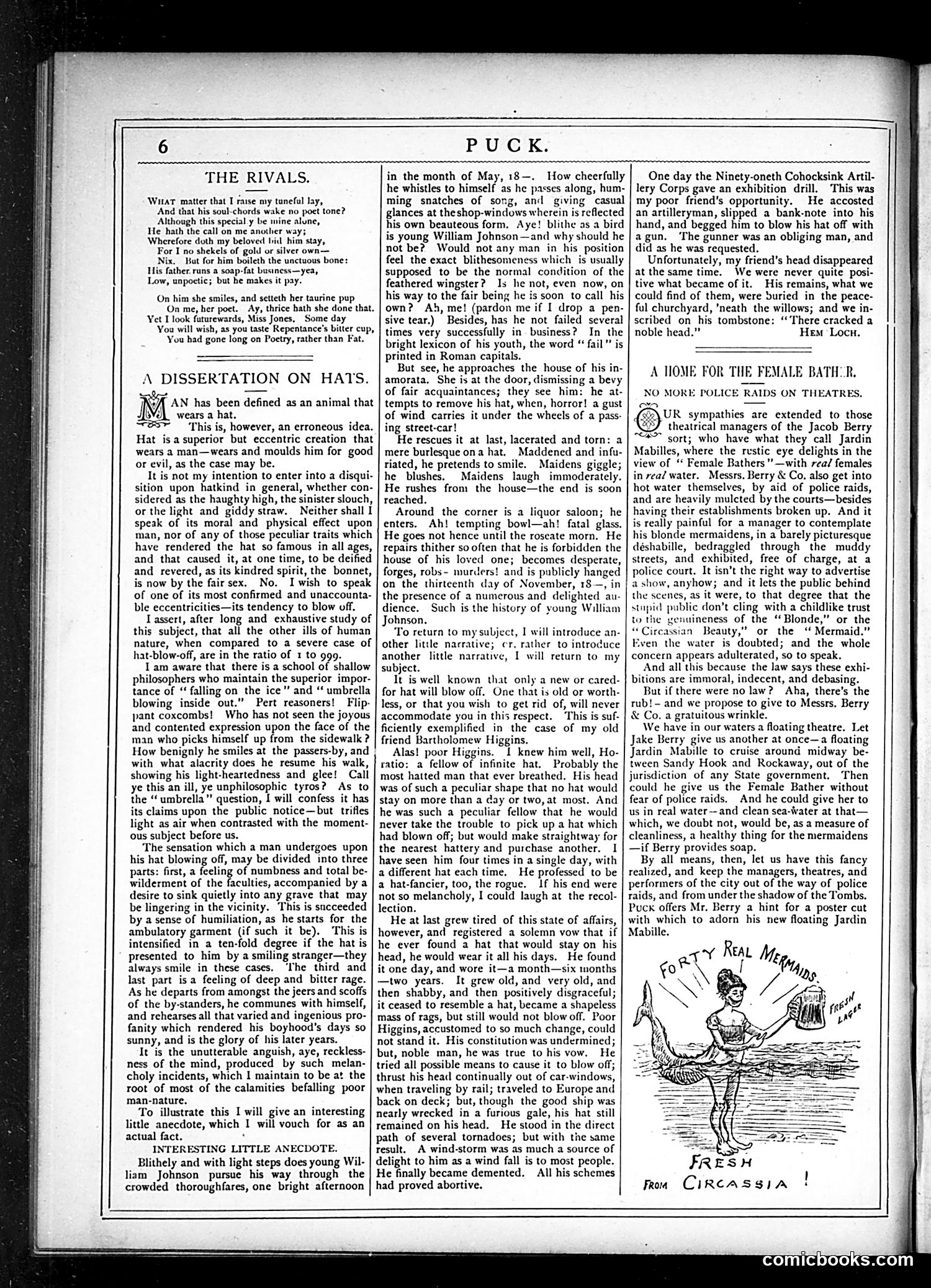
What you’re looking at
This page contains three distinct pieces: **"The Rivals"** (left column): A humorous poem about competing suitors vying for a woman's affection, with comedic boasting about their respective qualities. **"A Dissertation on Hats"** (center): A satirical essay mocking the absurdity of hat-wearing conventions and the ridiculous varieties men endure, using elaborate rhetorical language to mock pretentious philosophical discourse. **"A Home for the Female Bath"** (right): Commentary on police raids targeting theaters, defending theatrical managers (Jacob Berry's Mabilles) against morality-based closures. It advocates using police resources more productively than harassing entertainment venues. **"Forty Real Mermaids Fresh from Circassia!"** (bottom right): An illustrated advertisement or satirical reference, likely mocking sensationalist circus promotions. The page exemplifies Puck's satirical approach to social conventions and contemporary regulatory disputes.
📄 Transcribed text from this page (OCR, searchable)
Machine-transcribed from the original scan — historical spelling and the odd misread are preserved.
PUCK. THE RIVALS. Wuat matter that I faise my tuneful lay, And that his soul-chords wake no poet tone? Although this special y be mine alune, He hath the call on me another way; Wherefore doth my beloved bid him’stay, For I no shekels of gold or silver own— Nix. Hut for him boileth the unctuous bone: His father. runs a soap-fat business—yea, Low, unpoetic; but he makes it pay. On him she smiles, and setteth her taurine pup ‘On me, her poet. Ay, thrice hath she done that. Yet I look futurewards, Miss Jones, Some day You will wish, as you taste Repentance’s bitter cup, You had gone long on Poetry, rather than Fat. A DISSERTATION ON HATS. I y AN has been defined as an animal that Ve wears a hat. sSy ‘This is, however, an erroneous idea. Hat isa superior but eccentric creation that wears a man—wears and moulds him for good or evil, as the case may be. It is not my intention to enter into a disqui- sition upon hatkind in general, whether con- sidered as the haughty high, the sinister slouch, or the light and giddy straw. Neither shall I speak of its moral and physical effect upon man, nor of any of those peculiar traits which have rendered the hat so famous in all ages, and that caused it, at one time, to be deified and revered, as its kindred spirit, the bonnet, is now by the fair sex. No. I wish to speak of one of its most confirmed and unaccounta- ble eccentricities—its tendency to blow off. L assert, after long and exhaustive study of this subject, that all the other ills of human nature, when compared to a severe case of hat-blow-off, are in the ratio of 1 to 999. lam aware that there is a school of shallow philosophers who maintain the superior impor- tance of “ falling on the ice” and ‘ umbrella blowing inside out.” Pert reasoners! Flip- pant coxcombs! Who has not seen the joyous and contented expression upon the face of the man who picks himself up from the sidewalk ? How benignly he smiles at the passers-by, and with what alacrity does he resume his walk, showing his light-heartedness and glee! Call ye this an ill, ye unphilosophic tyros? As to the “ umbrella” question, I will confess it has its claims upon the public notice—but trifles light as air when contrasted with the moment- ous subject before us. ‘The sensation which a man undergoes upon his hat blowing off, may be divided into three parts: first, a feeling of numbness and total be- wilderment of the faculties, accompanied by a desire to sink quietly into any grave that may be lingering in the vicinity. This is succeeded by a sense of humiliation, as he starts for the ambulatory garment (if such it be). This is intensified in a ten-fold degree if the hat is presented to him by a smiling stranger—they always smile in these cases. ‘I'he third and last part isa feeling of deep and bitter rage. As he departs from amongst the jeers and scoffs of the by-standers, he communes with himself, and rehearses all that varied and ingenious pro- fanity which rendered his boyhood’s days so sunny, and is the glory of his later years. It is the unutterable anguish, aye, reckless- ness of the mind, produced by such melan- choly incidents, which I maintain to be at the root of most of the calamities befalling poor man-nature. To illustrate this I will give an interesting little anecdote, which I will vouch for as an actual fact. ‘ INTERESTING LITTLE ANECDOTE. Blithely and with light steps does young Wil- liam Johnson pursue his way through the crowded thoroughfares, one bright afternoon in the month of May, 18—. How cheerfully he whistles to himself as he passes along, hum- ming snatches of song, and giving casual glances at theshop-windows wherein is reflected his own beauteous form. Aye! blithe as a bird is young William Johnson—and why should he not be? Would not any man in his position feel the exact blithesomeness which is usually supposed to be the normal condition of the feathered wingster? Is he not, even now, on his way to the fair being he is soon to call his own? Ah, me! (pardon me if I drop a pen- sive tear.) Besides, has he not failed several times very successfully in business? In the bright lexicon of his youth, the word “ fail” is printed in Roman capitals. But see, he approaches the house of his in- amorata. She is at the door, dismissing a bevy of fair acquaintances; they see him: he at- tempts to remove his hat, when, horror! a gust of wind carries it under the wheels of a pass- ing street-car! He rescues it at last, lacerated and torn: a mere burlesque ona hat. Maddened and infu- riated, he pretends to smile. Maidens giggle; he blushes. Maidens laugh immoderately. He rushes from the house—the end is soon reached. Around the corner is a liquor saloon; he enters. Ah! tempting bowl—ah! fatal glass. He goes not hence until the roseate morn, He repairs thither so often that he is forbidden the house of his loved one; becomes desperate, forges, robs- murders! and is publicly hanged on the thirteenth day of November, 18—, in the presence of a numerous and delighted au- dience. Such is the history of young William Johnson. To return to my subject, I will introduce an- other little narrative; cr, rather to introduce another little narrative, I will return to my subject. It is well known that only a new or cared- for hat will blow off. One that is old or worth- less, or that you wish to get rid of, will never accommodate you in this respect. This is suf- ficiently exemplified in the case of my old friend Bartholomew Higgins. Alas! poor Higgins. 1 knew him well, Ho- ratio: a fellow of infinite hat. Probably the most hatted man that ever breathed, His head was of such a peculiar shape that no hat would stay on more than a day or two,at most. And he was such a peculiar fellow that he would never take the trouble to pick up a hat which had blown off; but would make straightway for the nearest hattery and purchase another. I have seen him four times in a single day, with a different hat each time. He professed to be a hat-fancier, too, the rogue. If his end were not so melancholy, I could laugh at the recol- lection. He at last grew tired of this state of affairs, however, and registered a solemn vow that if he ever found a hat that would stay on his head, he would wear it all his days. He found it one day, and wore it—a month—six months —two years. It grew old, and very old, and then shabby, and then positively disgraceful; it ceased to resemble a hat, became a shapeless mass of rags, but still would not blow off. Poor Higgins, accustomed to so much change, could not stand it. His constitution was undermined; but, noble man, he was true to his vow. He tried all possible means to cause it to blow off; thrust his head continually out of car-windows, when traveling by rail; traveled to Europe and back on deck; but, though the good ship was nearly wrecked in a furious gale, his hat still remained on his head. He stood in the direct path of several tornadoes; but with the same result. A wind-storm was as much a source of delight to him as a wind fall is to most people. He finally became demented. All his schemes had proved abortive. One day the Ninety-oneth Cohocksink Artil- lery Corps gave an exhibition drill. This was my poor friend’s opportunity. He accosted an artilleryman, slipped a bank-note into his hand, and begged him to blow his hat off with agun. ‘The gunner was an obliging man, and did as he was requested. Unfortunately, my friend’s head disappeared at the same time. We were never quite posi- tive what became of it. His remains, what we could find of them, were buried in the peace- ful churchyard, ‘neath the willows; and we in- scribed on his tombstone: ‘There cracked a noble head.” Hem Locu. A TIOME FOR THE FEMALE BATH:R. NO MORE POLICE RAIDS ON THEATRES, UR sympathies are extended to those theatrical managers of the Jacob Berry sort; who have what they call Jardin Mabilles, where the rustic eye delights in the view of ‘ Female Bathers "—with rea/ females in rea? water. Messrs. Berry & Co, also get into hot water themselves, by aid of police raids, and are heavily mulcted by the courts—besides having their establishments broken up. And it is really painful for a manager to contemplate his blonde mermaidens, in a barely picturesque déshabille, bedraggled through the muddy streets, and exhibited, free of charge, at a police court. It isn’t the right way to advertise a show, anyhow; and it lets the public behind the scenes, as it were, to that degree that the stupid public don’t cling with a childlike trust to the genuineness of the “Blonde,” or the “Circassian Beauty,” or the “ Mermaid.” Even the water is doubted; and the whole concern appears adulterated, so to speak. ‘And all this because the law says these exhi- bitions are immoral, indecent, and debasing. But if there were no law? Aha, there’s the rub!- and we propose to give to Messrs. Berry & Co. a gratuitous wrinkle. We have in our waters a floating theatre. Let Jake Berry give us another at once—a floating Jardin Mabille to cruise around midway be- tween Sandy Hook and Rockaway, out of the jurisdiction of any State government. Then could he give us the Female Bather without fear of police raids. And he could give her to us in real water—and clean sea-Water at that— which, we doubt not, would be, as a measure of cleanliness, a healthy thing for the mermaidens —if Berry provides soap. By all means, then, let us have this fancy realized, and keep the managers, theatres, and performers of the city out of the way of police raids, and from under the shadow of the Tombs. Puck offers Mr. Berry a hint for a poster cut with which to adorn his new floating Jardin Mabille. Doct CIRCASSIA Froia