
Puck, 1878-04-17 · page 6 of 16
Puck — April 17, 1878 — page 6: what you’re looking at
What you’re looking at
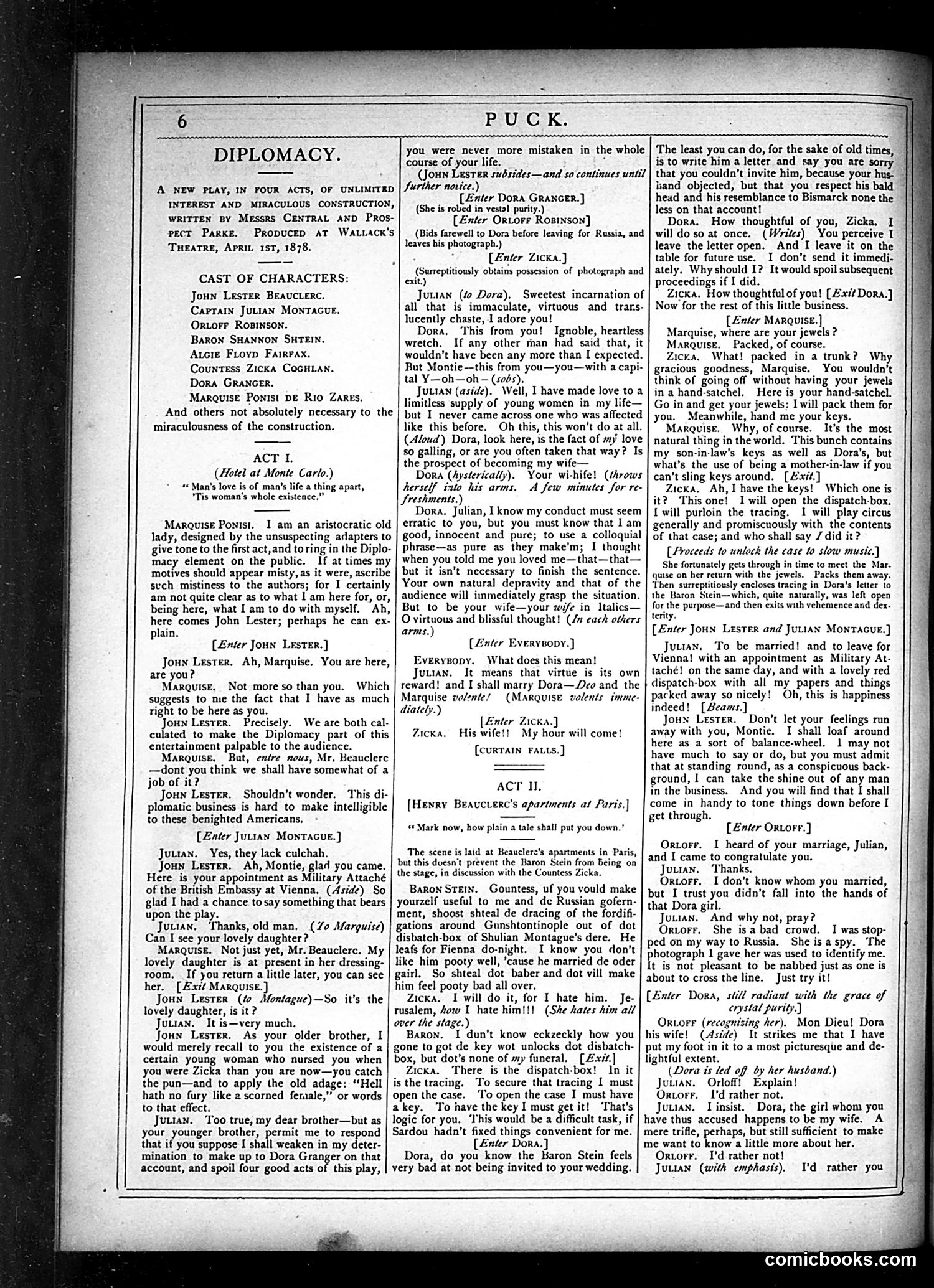
This page contains the script for "Diplomacy," a four-act satirical play produced at Wallace's Theatre on April 1st, 1878. The play satirizes diplomatic and aristocratic pretension through characters like Marquise Posini (an old aristocratic lady) and John Lester (an American). The satire targets the contrast between European aristocratic snobbery and American straightforwardness. References to "Military Attaché" positions, Russian affairs, and Constantinople suggest it mocks mid-Victorian diplomatic intrigue and the social climbing enabled by diplomatic appointments. The plot involving marriage, social standing, and aristocratic maneuvers critiques how nobility manipulated marriages and social position for political advantage. The humor derives from colliding American practicality against European pretension and absurd diplomatic machinations.
📄 Transcribed text from this page (OCR, searchable)
Machine-transcribed from the original scan — historical spelling and the odd misread are preserved.
PUCK. DIPLOMACY. A NEW PLAY, IN FOUR ACTS, OF UNLIMITED INTEREST AND MIRACULOUS CONSTRUCTION, WRITTEN BY Messrs CENTRAL AND PRos- PECT Parke. Propucep aT WALLACK'S THEATRE, APRIL IST, 1878. CAST OF CHARACTERS: Joun Lester BEAUCLERC. Caprain JULIAN MONTAGUE. Ortorr Rosinson. Baron SHANNON SHTEIN. Acie Froyp Fairrax. Countess Zicka COGHLAN. Dora GRANGER. Marquise Ponist pe Rio Zares. And others not absolutely necessary to the miraculousness of the construction. ACT I. (Hotel at Monte Carlo.) “« Man's love is of man’s life a thing apart, 'Tis woman's whole existence.” Marquise Ponist. I am an aristocratic old lady, designed by the unsuspecting adapters to give tone to the first act, and toring in the Diplo- macy element on the public. If at times my motives should appear misty, as it were, ascribe such mistiness to the authors; for I certainly am not quite clear as to what I am here for, or, being here, what I am to do with myself. ‘A here comes John Lester; perhaps he can ex: plain. (Enter Joun Lester.) Joun Lester. Ah, Marquise. You are here, are you? Marquise, Not moreso than you. Which suggests to me the fact that I have as much right to be here as you. Joun Lester. Precisely. We are both cal- culated to make the Diplomacy part of this entertainment palpable to the audience. Marquise. But, entre nous, Mr. Beauclerc —dont you think we shall have somewhat of a job of it? Joun Lester. Shouldn't wonder. This di- plomatic business is hard to make intelligible to these benighted Americans. [Enter Juutan Montacue.] Juttan. Yes, they lack culchah. Joun Lester. Ah, Montie, glad you came. Here is your appointment as Military Attaché of the British Embassy at Vienna. (Aside) So glad I had a chance tosay something that bears upon the play. Juttan, ‘Thanks, old man. Can I see your lovely daughter ? Marquise. Not just yet, Mr. Beauclerc. My lovely daughter is at present in her dressing- room. If you return a little later, you can see her. [Axt¢ Marquise.] Joun Lester (¢0 Montague)—So it's the lovely daughter, is it? Juttan. It is—very much. Joun Lester. As your older brother, I would merely recall to you the existence of a certain young woman who nursed you when you were Zicka than you are now—you catch the pun—and to apply the old adage: “Hell hath no fury like 2 scorned feraale,” or words to that effect. Jutian. Too true, my dear brother—but as your younger brother, permit me to respond that if you suppose I shall weaken in my deter- mination to make up to Dora Granger on that account, and spoil four good acts of this play, (Lo Marguise) you were never more mistaken in the whole course of your life. £ (Joun Lester subsides—and so continues until further novice.) [Enter Dora Grancer.] (She is robed in vestal purity.) (2nter Orvorr Rosinson) (Bids farewell to Dora before leaving for Russia, and leaves his photograph.) : [Enter Zicka.] (Surreptitiously obtains possession of photograph and exit.) Juttan (40 Dora). Sweetest incarnation of all that is immaculate, virtuous and trars- lucently chaste, 1 adore you! Dora. ‘This from you! Ignoble, heartless wretch, If any other man had said that, it wouldn't have been any more than I expected. But Montie—this from you—you—with a capi- tal Y—oh—oh — (sobs). JuLtan (aside). Well, I have made love to a limitless supply of young women in my life— but I never came across one who was affected like this before. Oh this, this won't do at all. (Aloud) Dora, look here, is the fact of my! love so galling, or are you often taken that way? Is the prospect of becoming my wii Dora (Aysterically). Your wi-hife! (throws herself into his arms. A few minutes for re- freshments.) Dora. Julian, I know my conduct must seem erratic to you, but you must know that I am good, innocent and pure; to use a colloquial phrase—as pure as they make'm; I thought when you told me you loved me—that—that— but it isn’t necessary to finish the sentence. Your own natural depravity and that of the audience will immediately grasp the situation. But to be your wife—your wife in Italics— Ovirtuous and blissful thought! (/2 each others arms.) [Enter Evervuovy.] Everysopy. What does this mean! Jutian. It means that virtue is its own reward! and I shall marry Dora—Deo and the Marquise volente! (MaRQuise volents imme- diately.) [Enter Zicka.] His wife!!| My hour will come! [curtain Fatts.] Zicka, ACT II, (Henry Beauccerc's apartments at Paris “ Mark now, how plain a tale shall put you down.’ The scene is laid at Beauclerc’s apartments in Paris, but this doesn’t prevent the Baron Stein from Being on the stage, in discussion with the Countess Zicka. Baron STEIN. Gountess, uf you vould make yourzelf useful to me and de Russian gofern- ment, shoost shteal de dracing of the fordifi- gations around Gunshtontinople out of dot disbatch-box of Shulian Montague’s dere. He leafs for Fienna do-night. I know you don’t like him pooty well, ‘cause he married de oder gairl. So shteal dot baber and dot vill make him feel pooty bad all over. Zicxa. I will do it, for I hate him. Je- rusalem, Aow I hate him!!! (She hates him all over the stage.) Baron. I dun't know eckzeckly how you gone to got de key wot unlocks dot disbatch- box, but dot’s none of my funeral. [£-xit.] Zicka. There is the dispatch-box! In it is the tracing. To secure that tracing I must open the case. ‘To open the case I must have akey. ‘To have the key I must get it! That's logic for you. ‘I'his would be a difficult task, if Sardou hadn't fixed things convenient for me. [Enter Dora.] Dora, do you know the Maron Stein feels very bad at not being invited to your wedding. The least you can do, for the sake of old times, is to write him a letter and say you are sorry that you couldn’t invite him, because your hus- hand objected, but that you respect his bald 1) head and his resemblance to Bismarck none the less on that account! Dora. How thoughtful of you, Zicka. I will do so at once. (Writes) You perceive 1 leave the letter open. And I leave it on the table for future use. I don’t send it immedi- ately. Why should I? It would spoil subsequent proceedings if I did. Zicka. How thoughtful of you! [xi Dora.] Now for the rest of this little business. [Enter Marquise.] Marquise, where are your jewels ? Marquise. Packed, of course. Zicv.a, What! packed in a trunk? Why gracious goodness, Marquise. You wouldn't think of going off without having your jewels in a hand-satchel. Here is your hand-satchel. Go in and get your jewels: I will pack them for you. Meanwhile, hand me your keys. Marquise. Why, of course. It’s the most natural thing in the world. This bunch contains my son-in-law's keys as well as Dora’s, but what's the use of being a mother-in-law if you can’t sling keys around. [/'xit.] Zicka, Ah,I have the keys! Which one is it? This one! I will open the dispatch-box. [will purloin the tracing. 1 will play circus generally and promiscuously with the contents of that case; and who shall say / did it? [Proceeds to unlock the case to slow music] She fortunately gets through in time to meet the Mar- quise on her return with the jewels. Packs them away. Then surreptitiously encloses tracing in Dora's letter to the Baron Stein—which, quite naturally, was left open for the purpose—and then exits with vehemence and dex- terity. [Enter Joun Lester and Jutian Montacve.] Juttan. To be married! and to leave for Vienna! with an appointment as Military At- taché! on the same day, and with a lovely red dispatch-box with all my papers and things packed away so nicely! Oh, this is happiness indeed! [Beams.] Joun Lester. Don’t let your feelings run away with you, Montie, I shall loaf around here as a sort of balance-wheel. 1 may not have much to say or do, but you must admit that at standing round, as a conspicuous back- ground, I can take the shine out of any man in the business. And you will find that { shall come in handy to tone things down before I get through. (Enter Orvorr.] Ortorr. I heard of your marriage, Julian, and I came to congratulate you. Jutian. Thanks. Ortorr. I don’t know whom you married, but I trust you didn’t fall into the hands of that Dora girl. Jutian. And why not, pray? Ortorr. She isa bad crowd. I was stop- ped on my way to Russia. She isaspy. The photograph 1 gave her was used to identify me. It is not pleasant to be nabbed just as one is about to cross the line. Just try it! [Enter Dora, still radiant with the grace of crystal purity.) Or.orr (recognising her). Mon Dieu! Dora his wife! (Aside) It strikes me that I have put my foot in it to a most picturesque and de- lightful extent. (Dora is led off by her husband.) Jutta, Orloff! Explain! Ortorr. I'd rather not. Juuan. Linsist. Dora, the girl whom you have thus accused happens to be my wife. A mere trifle, perhaps, but still sufficient to make me want to know a little more about her. Or.orr. I'd rather not! JULIAN (with emphasis). Yd rather you comicbooks.com