
Puck, 1877-11-14 · page 7 of 16
Puck — November 14, 1877 — page 7: what you’re looking at
What you’re looking at
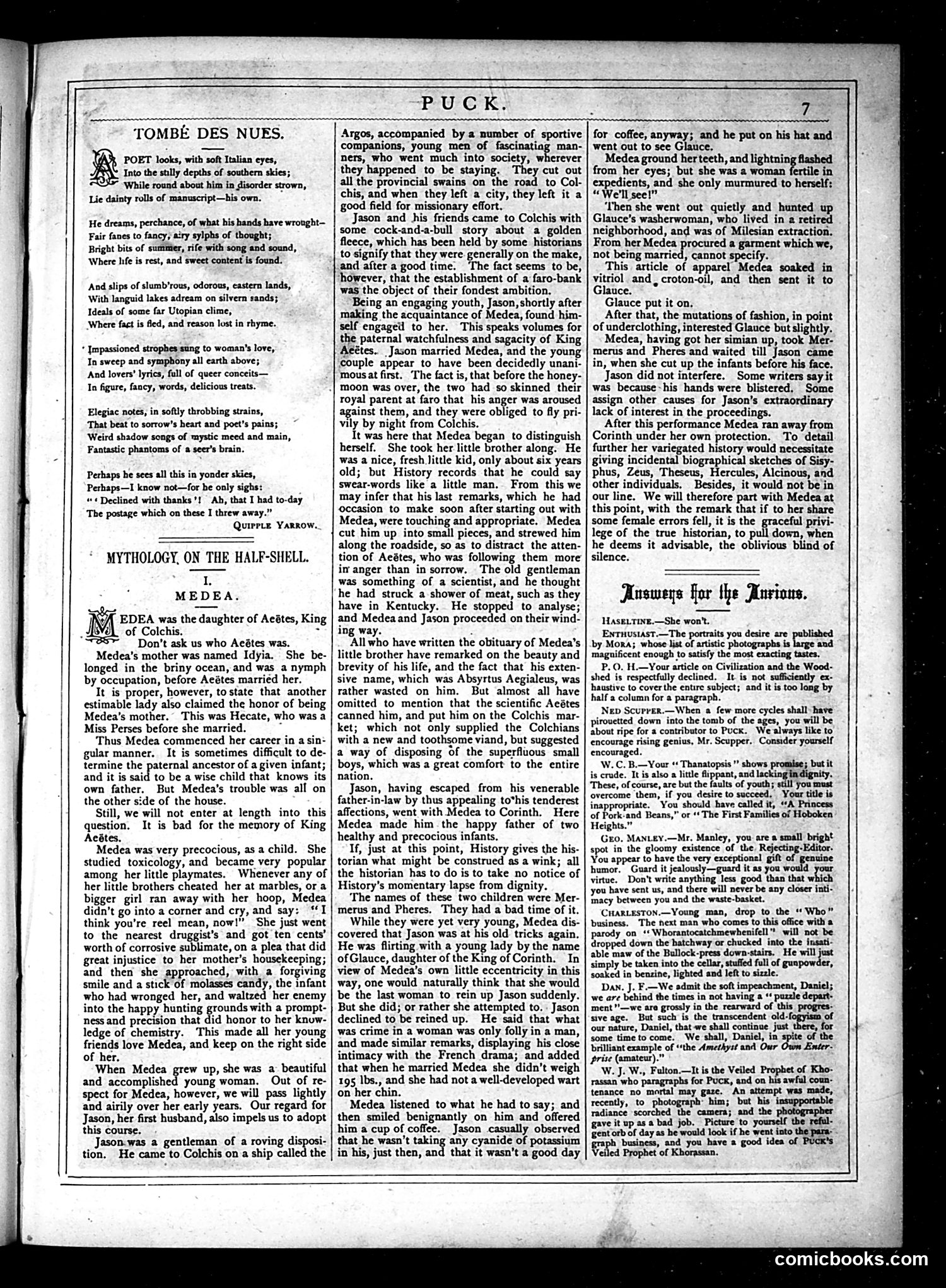
This page contains a literary/mythological essay titled "Mythology on the Half-Shell: Medea" rather than political satire. The article retells the classical Greek myth of Medea, daughter of King Aeetes, focusing on her relationship with Jason and their eventual marriage. The piece adopts a humorous, irreverent tone typical of Puck, treating the ancient legend as entertainment for contemporary readers. It includes details about Medea's precocious childhood behavior and her romantic entanglement with Jason. The bottom section features "Answers for the Furious"—reader responses addressing various letters about content from previous issues. This appears to be standard magazine correspondence rather than satirical commentary on specific political or social figures.
📄 Transcribed text from this page (OCR, searchable)
Machine-transcribed from the original scan — historical spelling and the odd misread are preserved.
PUCK. TOMBE DES NUES, POET looks, with soft Italian eyes, Into the stilly depths of southern skies; ‘While round about him in disorder strown, Lie dainty rolls of manuscript—his own. He dreams, perchance, of what his hands have wrought— Fair fanes to fancy, airy sylphs of thought; Bright bits of sumitier, rife with song and sound, ‘Where hfe is rest, and sweet content is found. ‘And slips of slumb'rous, odorous, eastern lands, With languid lakes adream on silvern sands; Ideals of some far Utopian clime, Where fact is fled, and reason lost in rhyme. + Impassioned strophes sting to woman's love, In sweep and symphony all earth above; ‘And lovers’ lyrics, fall of queer conceits— In figure, fancy, words, delicious treats. Elegiac notes, in softly throbbing strains, ‘That beat to sorrow's heart and poet's pains; Weird shadow songs of mystic meed and main, Fantastic phantoms of a seer's brain. Perhaps he sees all this in yonder skies, Perhaps—I know not—for he only sighs: ««¢ Declined with thanks *! Ah, that I had to-day ‘The postage which on these I threw away.” Quirrte Yarrow. MYTHOLOGY, ON THE HALF-SHELL. Ll MEDEA. Re) EDEA was the daughter of Aeétes, Kin; . of Colchis. : Don’t ask us who Aeétes was. Medea’s mother was named Idyia. She be- longed in the briny ocean, and was a nymph by occupation, before Aeétes married her. It is proper, however, to state that another estimable lady also claimed the honor of being Medea’s mother.” This was Hecate, who was a Miss Perses before she married. 7 Thus Medea commenced her career in a sin= gular manner. It is sometimes difficult to de- termine the paternal ancestor of a given infant; and it is said to be a wise child that knows its own father. But Medea’s trouble was all on the other side of the house. Still, we will not enter at length into this question. It is bad for the memory of King Acates, ‘Medea was very precocious, as a child. She studied toxicology, and became very popular among her little playmates. Whenever any of her little brothers cheated her at marbles, or a bigger girl ran away with her hoop, Medea didn’t go into a corner and cry, and say: ‘1 think you're reel mean, now!” She just went to the nearest druggist’s and got ten cents’ worth of corrosive sublimate, on a plea that did great injustice to her mother’s housekeeping; and then she approached, with a forgiving smile and a stick of molasses candy, the infant who had wronged her, and waltzed her enemy into the happy hunting grounds with a prompt- ness and precision that did honor to her know- ledge of chemistry. This made all her young friends love Medea, and keep on the right side of her, When Medea grew up, she was a: beautiful and accomplished young woman. Out of re- spect for Medea, however, we will pass lightly and airily over her early years. Our regard for Jason, her first husband, also impels us to adopt this course, Jason.was a gentleman of a roving disposi: tion. He came to Colchis on a ship called the Argos, accompanied by a number of sportive companions, young men of fascinating man- ners, who went much into society, ae they happened to be staying. They cut out all the provincial swains on the road to Col- chis, and when they left a city, they left it a good field for missionary effort. Jason and his friends came to Colchis with some cock-and-a-bull story about a golden fleece, which has been held by some historians to signify that they were. generally on the make, and after a good time. ‘The fact seems to be, however, that the establishment of a faro-bank was the object of their fondest ambition. Being an engaging youth, Jason, shortly after making the acquaintance of Medea, found him- self engaged to her. This speaks volumes for the paternal watchfulness and sagacity of King Acétes.._ Jason married Medea, and the young couple appear to have been decidedly unani- mousat first. ‘The fact is, that before the honey- .| moon was over, the two had so skinned their royal parent at faro that his anger was aroused against them, and they were obliged to fly pri- vily by night from Colchis. It was here that Medea began to distinguish herself. She took her little brother along. He was a nice, fresh Jittle kid, only about six years old; but History records that he could say swear-words like a little man. From this we may infer that his last remarks, which he had occasion to make soon after starting out with Medea, were touching and appropriate. Medea cut him up into small pieces, and strewed him along the roadside, so as to distract the atten- tion of Aeates, who was following them more im anger than in sorrow. The old gentleman was something of a scientist, and he thought he had struck a shower of meat, such as they have in Kentucky. He stopped to analyse; and Medeaand Jason proceeded on their wind- ing way. : All who have written the obituary of Medea’s little brother have remarked on the beauty and brevity of his life, and the fact that his exten- sive name, which was Absyrtus Aegialeus, was rather wasted on him. But almost all have omitted to mention that the scientific Acétes canned him, and put him on the Colchis mar- ket; which not only supplied the Colchians with a new and toothsome viand, but suggested a way of disposing of the superfluous small boys, which was a great comfort to the entire nation. Jason, having escaped from his venerable father-in-law by thus appealing to*his tenderest affections, went with Medea to Corinth. Here Medea made him the happy father of two healthy and precocious infants. If, just at this point, History gives the his- torian what might be construed as a wink; all the historian has to do is to take no notice of History's momentary lapse from dignity. ‘The names of these two children were Mer- merus and Pheres. They had a bad time of it While they were yet very young, Medea di covered that Jason was at his old tricks again. He was flirting with a young lady by the name of Glauce, daughter of the King of Corinth. In view of Medea’s own little eccentricity in this way, one would naturally think that she would be the last woman to rein up Jason suddenly. But she did; or rather she attempted to. . Jason declined to be reined up. He said that what was crime in a woman was only folly in a man, and made similar remarks, displaying his close intimacy with the French drama; and added that when he married Medea she didn’t weigh 195 lbs., and she had not a well-developed wart on her chin. Medea listened to what he had to say; and then smiled benignantly on him and offered him a cup of coffee. Jason casually observed that he wasn’t taking any cyanide of potassium in his, just then, and that it wasn’t a good day for coffee, anyway; and he put on his hat and went out to see Glauce, Medea ground herteeth, and lightning flashed from her eyes; but she was a woman fertile in expedients, and she only murmured to herself: “We'll see!” ‘Then she went out quietly and hunted up Glauce’s washerwoman, who lived in a retired neighborhood, and was of Milesian extraction. From her Medea procured a garment which we, not being married, cannot specify. This article of apparel Medea soaked in vitriol and, croton-oil, and then sent it to Glauce. Glauce put it on, After that, the mutations of fashion, in point of underclothing, interested Glauce but slightly. Medea, having got her simian up, took Mer- merus and Pheres and waited till Jason came in, when she cut up the infants before his face. Jason did not interfere. Some writers say it was because -his hands were blistered, Some assign other causes for Jason’s extraordinary lack of interest in the proceedings. After this performance Medea ran away from Corinth under her own protection. To detail further her variegated history would necessitate giving incidental biographical sketches of Sisy- phus, Zeus, Theseus, Hercules, Alcinous, and other individuals. Besides, it would not be in our line. We will therefore part with Medea at this point, with the remark that if to her share some female errors fell, it is the graceful privi- lege of the true historian, to pull down, when pe deems it advisable, the oblivious blind of silence. Answeys for the Anrions. HASELTINE.—She won't. Entnustast.—The portraits you desire are published by Mora; whose list of artistic photographs is ter ‘and magnificent enough to satisfy the most exacting tastes. P.O. H.—Your article on Civilization and the Wood- shed is respectfully declined. It. is not sufficiently ex- haustive to cover the entire subject; and it is too long by half a column for a paragraph. Neb Scurrer.—When a few more cycles shall have pirouetted down into the tomb of the ages, you will be about ripe for a contributor to Puck. We always like to encourage rising genius, Mr. Scupper. Consider yourself encouraged. W. C. B.—Your “ Thanatopsis ” shows promise; but it is crude. It's also lite fippant, and lacking in dignity. These, of course, are but the faults of youth; still you must overcome them, if you desire to succeed. Your title is inappropriate. You should have called it, “A Princess of Pork-and Beans,” or « The First Families of Hoboken Heights.” Gro. MANLEY.—Mr. Manley, you are a small bright spot in the gloomy existence of the Rejecting Ealtor. You appear to have the very exceptional gift ine humor. Guard it ealously—guard it as you would your virtue. Don't write anything less good than that w you have sent us, and there will never be any cléser inti- macy between you and the waste-basket. Citar.eston.—Young man, drop to the ‘ Who” business. The hext man who comes to this office with a ly on ¢ Whorantocatchmewhenifell”’ will not be dropped down the batchway or chucked into tke insati- able maw of the Bullock-press down-stairs. He will j simply be taken into the cellar, stuffed full of gunpowder, soaked in benzine, lighted and left to sizzle. Dan. J. F.—We admit the soft impeachment, Daniel; we are behind the times in not having a “¢ puzzle depart- ment "—we are grossly in the rearward of this progres- sive age. But such is the transcendent old-f¢ of our nature, Daniel, that-we shall continue just for fome time to come. | We shall, Danlel, in spite of the brilliant example of ‘the Amethyst and Our Own Enter- prise (amateur).” W. J. W., Fulton.—It is the Veiled Prophet of Kho- rassan who paragraphs for PUCK, and on his awful coun- tenance no mortal may gaze. An attempt was made, recently, to photograph: him; but his’ insupportable radiance ‘scorched the camera; and the photographer gave it up as a bad job. Picture to yourself the refal- gent orb of day as he would look if he went into the para~ graph business, and you have a good idea of PUCK'S Galea Prophet of Khorassan. comicbooks.com