
Puck, 1877-05 · page 6 of 16
Puck — May 1877 — page 6: what you’re looking at
What you’re looking at
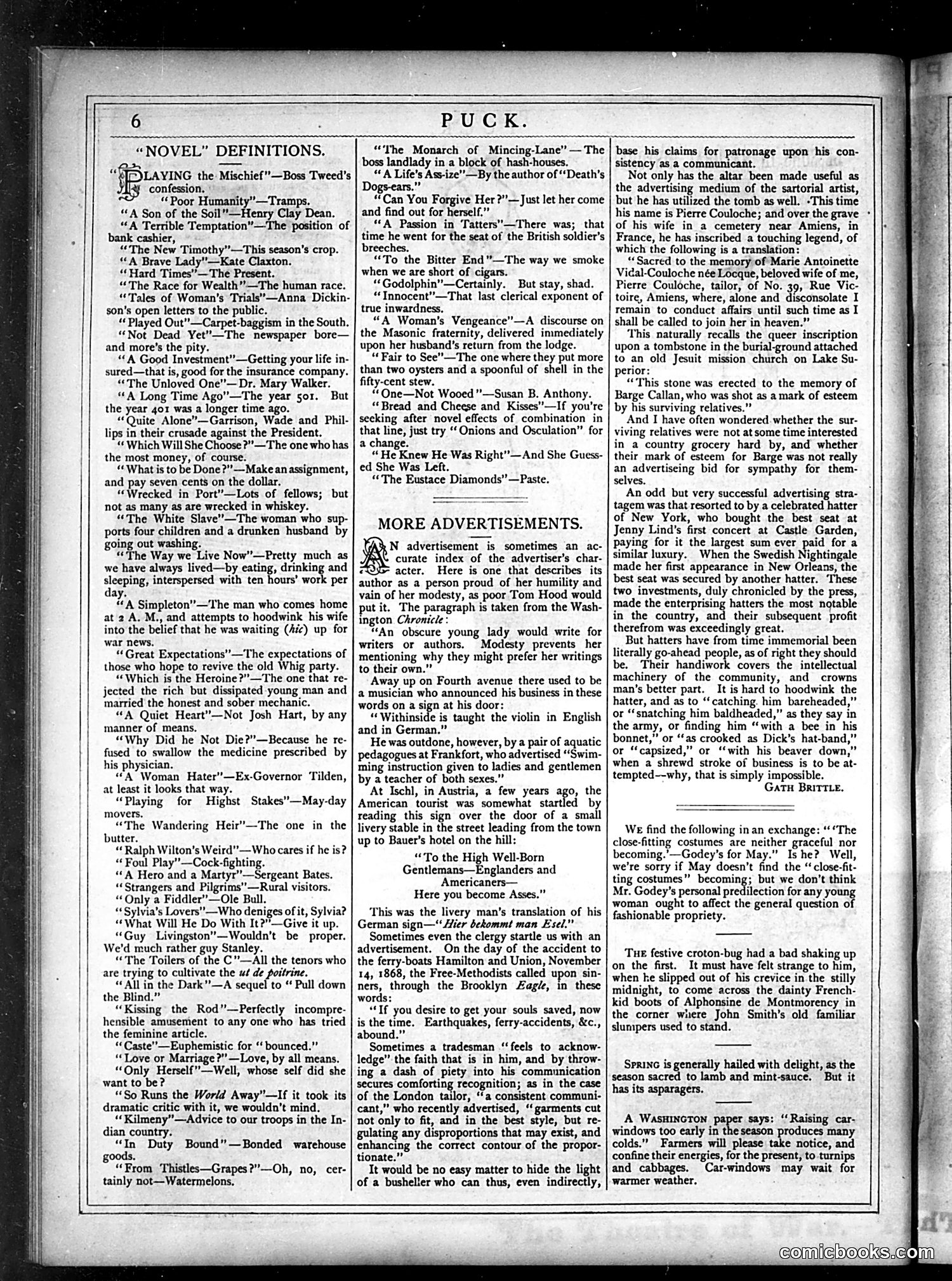
This page from Puck contains primarily **text content rather than cartoons**: two columns of "Novel Definitions" (satirical definitions of book titles) and "More Advertisements" (humorous fake ads). The "Novel Definitions" section parodies contemporary book titles through witty redefinitions—for example, redefining "Poor Humanity" and "A Son of the Soil" with sarcastic commentary. These mock popular literature of the era. The "More Advertisements" section contains absurdist humor advertising fictional products and services, including humorous translations of German signs and satirical commentary on American businessmen and tourism. Without visible illustrations on this page, the satire relies entirely on **wordplay and ironic commentary** rather than visual caricature. The humor targets contemporary popular culture, literature, and social pretensions of readers familiar with the books and situations referenced.
📄 Transcribed text from this page (OCR, searchable)
Machine-transcribed from the original scan — historical spelling and the odd misread are preserved.
6 PUCK. “NOVEL” DEFINITIONS. “i LAYING the: Mischief" Boss Tweed’s confession, “Poor Humanity”—Tramps. “A Son of the Soil’'—Henry Clay Dean. “A Terrible Temptation”—The position of cashier, “The New Timothy”—This season's crop. “A Brave Lady"—Kate Claxton. ‘Hard Times”—The Present. “The Race for Wealth”—The human race. “Tales of Woman's Trials’—Anna Dickin- son's open letters to the public. “Played Out"—Carpet-baggism in the South. “Not Dead Yet"”—The newspaper bore— and more's the pity. “A Good Investment”—Getting your life in- sured—that is, good for the insurance company. “The Unloved One"—Dr. Mary Walker. “A Long Time Ago”—The year sor. the year 401 was a longer time ago. “Quite Alone”—Garrison, Wade and Phil- lips in their crusade against the President. «Which Will She Choose ?”—The one who has the most money, of course. ««Whiat is to be Done?”"—Make an assignment, and pay seven cents on the dollar. “Wrecked in Port”—Lots of fellows; but not as many as are wrecked in whiskey. “The White Slave’—The woman who sup- ports four children and a drunken husband by going out washing. “The Way we Live Now’—Pretty much as we have always lived—by eating, drinking and sleeping, interspersed with ten hours’ work per d But lay. “A Simpleton”—The man who comes home at 2 A. M., and attempts to hoodwink his wife into the belief that he was waiting (Ac) up for war news. ‘Great Expectations’”’—The expectations of those who hope to revive the old Whig party. “Which is the Heroine ?”—The one that re- jected the rich but dissipated young man and married the honest and sober mechanic. “A Quiet Heart’—Not Josh Hart, by any manner of means. “Why Did he Not Die?”—Because he re- fused to swallow the medicine prescribed by his physician. «A Woman Hater’—Ex-Governor Tilden, at least it looks that way. “Playing for Highst Stakes""—May-day movers. “The Wandering Heir’—The one in the butter. “ Ralph Wilton’s Weird"”—Who cares if he is? “Foul Play”—Cock-fighting. ‘A Hero and a Martyr’—Sergeant Bates. “Strangers and Pilgrims’—Rural visitors. “Only a Fiddler”—Ole Bull. “Sylvia’s Lovers""—Who deniges of it, Sylvia? “What Will He Do With It?”—Give it up. “Guy Livingston”—Wouldn’t be proper. We'd much rather guy Stanley. “The Toilers of the C”—All the tenors who are trying to cultivate the ut de poitrine. “All in the Dark”"—A sequel to “ Pull down the Blind.” “Kissing the Rod”—Perfectly incompre- hensible amusement to any one who has tried the feminine article. “«Caste’—Euphemistic for ‘‘ bounced.” “Love or Marriage?” —Love, by all means. “Only Herself”—Well, whose self did she want to be? “So Runs the World Away”—If it took its dramatic critic with it, we wouldn't mind. “Kilmeny”—Adyvice to our troops in the In- dian country. “In Duty Bound”—Bonded warehouse goods. “From Thistles—Grapes?’—Oh, no, cer- tainly not—Watermelons. “The Monarch of Mincing-Lane” — The boss landlady in a block of hash-houses. “A Life's Ass-ize”’—By the author of ‘‘Death’s ” “Can You Forgive Her ?”—Just let her come and find out for herself.” ‘A Passion in Tatters’—There was; that time he went for the seat of the British soldier’s breeches. “To the Bitter End"—The way we smoke when we are short of cigars. “Godolphin”—Certainly. But stay, shad. “Innocent”—That last clerical exponent of true inwardness, “A Woman's Vengeance”—A discourse on the Masonic fraternity, delivered immediately upon her husband's return from the lodge. “Fair to See”—The one where they put more than two oysters and a spoonful of shell in the fifty-cent stew. “ One—Not Wooed"—Susan B. Anthony. “Bread and Cheese and Kisses”—If you're secking after novel effects of combination in that line, just try “Onions and Osculation” for a change. “ He Knew He Was Right"—And She Guess- ed She Was Left. “The Eustace Diamonds” —Paste. MORE ADVERTISEMENTS. N advertisement is sometimes an ac- curate index of the advertiser's char- rs acter. Here is one that describes its author as a person proud of her humility and vain of her modesty, as poor Tom Hood would put it. The paragraph is taken from the Wash- ington Chronicle: “An obscure young lady would write for writers or authors. Modesty prevents her mentioning why they might prefer her writings to their own.” Away up on Fourth avenue there used to be a musician who announced his business in these words on a sign at his door: “Withinside is taught the violin in English and in German.” He was outdone, however, by a pair of aquatic pedagogues at Frankfort, who advertised “Swim- ming instruction given to ladies and gentlemen by a teacher of both sexes.” ‘At Ischl, in Austria, a few years ago, the American tourist was somewhat startled b reading this sign over the door of a small livery stable in the street leading from the town up to Bauer’s hotel on the hill: “To the High Well-Born Gentlemans—Englanders and Americaners— Here you become Asses.”" ‘This was the livery man’s translation of his German sign—‘ Hier bekommt man Essel.” Sometimes even the clergy startle us with an advertisement. On the day of the accident to the ferry-boats Hamilton and Union, November 14, 1868, the Free-Methodists called upon sin- ners, through the Brooklyn Zagée, in these words: “If you desire to get your souls saved, now is the time. Earthquakes, ferry-accidents, &c., abound.” Sometimes a tradesman ‘‘feels to acknow- ledge’ the faith that is in him, and by throw- ing a dash of piety into his communication secures comforting recognition; as in the case of the London tailor, ‘a consistent communi- cant,” who recently advertised, ‘garments cut not only to fit, and in the best style, but re- gulating any disproportions that may exist, and enhancing the correct contour of the propor- tionate.”” It would be no easy matter to hide the light of a busheller who can thus, even indirectly, base his claims for patronage upon his con- sistency as a communicant. Not only has the altar been made useful as the advertising medium of the sartorial artist, but he has utilized the tomb as well. -This time his name is Pierre Couloche; and over the grave * of his wife in a cemetery near Amiens, in France, he has inscribed a touching legend, of which the following is a translation: ‘ “Sacred to the memory of’ Marie Antoinette Vidal-Couloche née Locque, beloved wife of me, Pierre Couldche, tailor, of No. 39, Rue Vic- toire, Amiens, where, alone and disconsolate I remain to conduct affairs until such time as I shall be called to join her in heaven.” ‘This naturally recalls the queer inscription upon a tombstone in the burial-ground attached to an old Jesuit mission church on Lake Su- perior: “This stone was erected to the memory of Barge Callan, who was shot as a mark of esteem by his surviving relatives.” And I have often wondered. whether the sur- viving relatives were not at some time interested in a country grocery hard by, and whether their mark of esteem for Barge was not really an advertiseing bid for sympathy for them- selves. An odd but very successful advertising stra- tagem was that resorted to by a celebrated hatter of New York, who bought the best seat at Jenny Lind’s first concert at Castle Garden, paying for it the largest sum ever paid for a similar luxury. When the Swedish Nightingale made her first appearance in New Orleans, the best seat was secured by another hatter. ‘These two investments, duly chronicled by the press, made the enterprising hatters the most notable in the country, and their subsequent profit therefrom was exceedingly great. But hatters have from time immemorial been literally go-ahead people, as of right they should be. Their handiwork covers the intellectual machinery of the community, and crowns man’s better part. It is hard to hoodwink the hatter, and as to “catching. him bareheaded,” or ‘snatching him baldheaded,” as they say in the army, or finding him “with a bee in his bonnet,” or ‘‘as crooked as Dick’s hat-band,” or “capsized,” or ‘with his beaver down,” when a shrewd stroke of business is to be at- tempted--why, that is simply impossible. Gat BritTLe. We find the following in an exchange: “‘The close-fitting costumes are neither graceful nor becoming.’—Godey’s for May.” Is he? Well, we're sorry if May doesn’t find the “close-fit- ting costumes” becoming; but we don’t think Mr. Godey’s personal predilection for any young woman ought to affect the general question of fashionable propriety. Tue festive croton-bug had a bad shaking up on the first. It must have felt strange to him, when ke slipped out of his crevice in the stilly midnight, to come across the dainty French- kid boots of Alphonsine de Montmorency in the corner where John Smith’s old familiar slumpers used to stand. Sprinc is generally hailed with delight, as the season sacred to lamb and mint-sauce. But it has its asparagers. A WasuIncTon paper says: ‘Raising car- windows too early in the season produces many colds.” Farmers will please take notice, and confine their energies, for the present, to turnips and cabbages. Car-windows may wait for warmer weather, comichooks.ceym