
Puck, 1877-05 · page 2 of 16
Puck — May 1877 — page 2: what you’re looking at
What you’re looking at
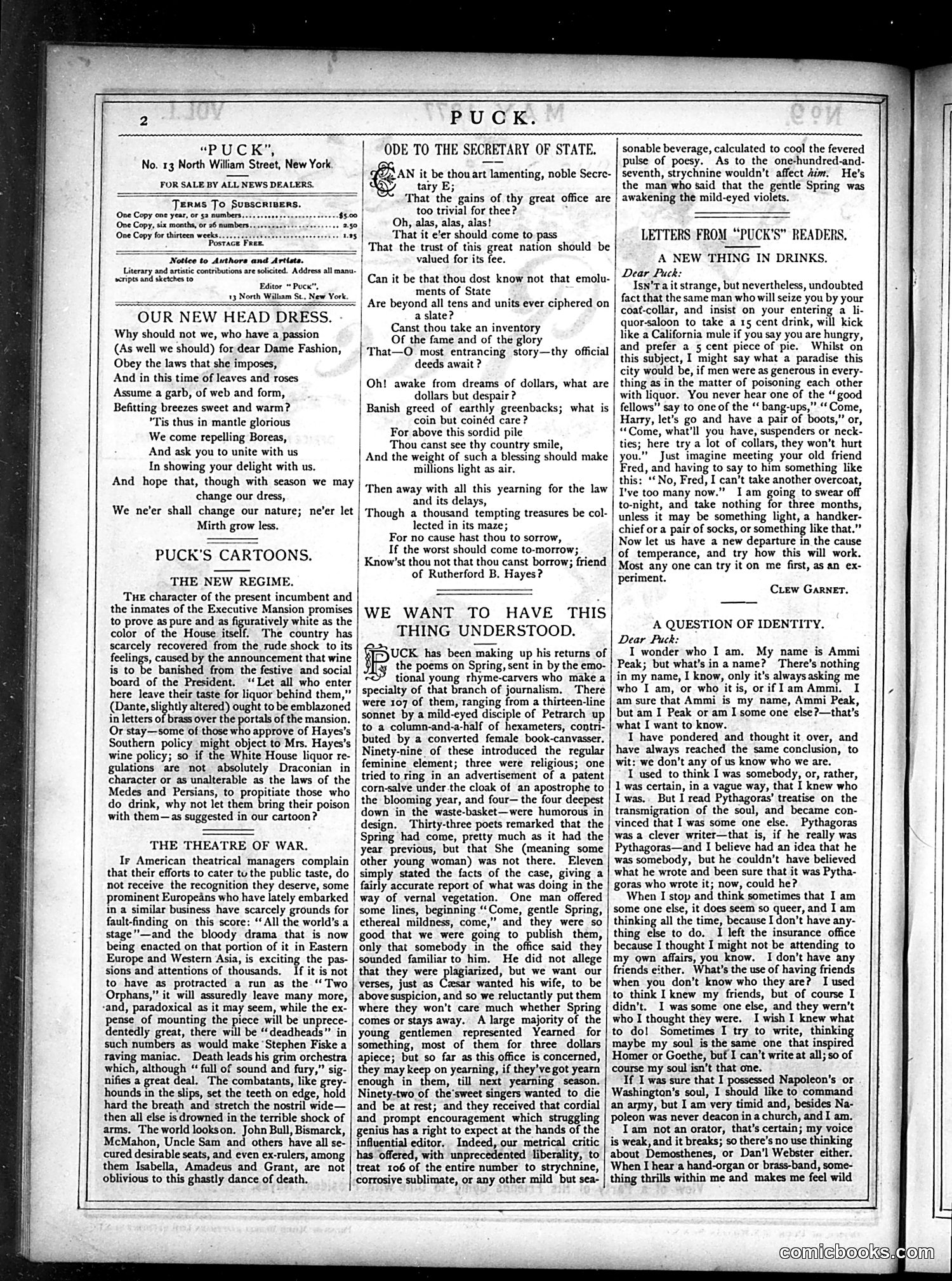
This page consists primarily of **text content rather than cartoons**: an "Ode to the Secretary of State," satirical commentary on theatrical war depictions, and reader letters. The main editorial piece ("The Theatre of War") critiques American theatrical managers for staging European war dramas while the actual conflict unfolds abroad. It appears to satirize productions capitalizing on current events—referencing performers like John Bull, Bismarck, and Uncle Sam as character types rather than specific individuals. The "Letters from Puck's Readers" section includes a humorous piece about a new economical drink (a 15-cent beverage with pie) and a philosophical letter titled "A Question of Identity" exploring personal identity and reincarnation beliefs. **No significant political cartoons are visible** on this particular page, which focuses on written satire and reader correspondence typical of Puck's format.
📄 Transcribed text from this page (OCR, searchable)
Machine-transcribed from the original scan — historical spelling and the odd misread are preserved.
PUCK. “PUCK”, No. 13 North William Street, New York FOR SALE BY ALL NEWS DEALERS. Terms To Susscriners. Ove Copy one year, or 52 numbers. One Copy, six months, or 26 numbers. One Copy for thirteen weeks Notice to Authors and Artists. Literary and artistic contributions are solicited. Address all manu- scripts and sketches to Editor “ Puck”, 13 North Willa St. New York. OUR NEW HEAD DRESS. Why should not we, who have a passion (As well we should) for dear Dame Fashion, Obey the laws that she imposes, And in this time of leaves and roses Assume a garb, of web and form, Befitting breezes sweet and warm? "Tis thus in mantle glorious We come repelling Boreas, And ask you to unite with us In showing your delight with us. And hope that, though with season we may change our dress, We ne’er shall change our nature; ne'er let | Mirth grow less. PUCK’S CARTOONS. THE NEW REGIME, Tue character of the present incumbent and the inmates of the Executive Mansion promises to prove as pure and as figuratively white as the color of the House itself. The country has scarcely recovered from the rude shock to its feelings, caused by the announcement that wine is to be banished from the festive and social board of the President. “Let all who enter here leave their taste for liquor behind them,” (Dante, slightly altered) ought to be emblazoned in letters of brass over the portals of the mansion. Or stay—some of those who approve of Hayes’s Southern policy might object to Mrs. Hayes’s wine policy; so if the White House liquor re- gulations are not absolutely Draconian in character or as unalterable as the laws of the Medes and Persians, to propitiate those who do drink, why not let them bring their poison with them—as suggested in our cartoon? THE THEATRE OF WAR. Ir American theatrical managers complain that their efforts to cater tu the public taste, do not receive the recognition they deserve, some prominent Europeans who have lately embarked in a similar business have scarcely grounds for fault-finding on this score: ‘All the world’s a stage”—and the bloody drama that is now being enacted on that portion of it in Eastern Europe and Western Asia, is exciting the pas- sions and attentions of thousands. If it is not to have as protracted a run as the ‘Two Orphans,” it will assuredly leave many more, -and, paradoxical as it may seem, while the ex- pense of mounting the piece will be unprece- dentedly great, there will be “deadheads” in such numbers as would make ‘Stephen Fiske a raving maniac. Death leads his grim orchestra which, although “ full of sound and fury,” sig- nifies a great deal. The combatants, like grey- hounds in the slips, set the teeth on edge, hold hard the breath and stretch the nostril wide— then all else is drowned in the terrible shock of arms. The world lookson. John Bull, Bismarck, McMahon, Uncle Sam and others have all se- cured desirable seats, and even ex-rulers, among them Isabella, Amadeus and Grant, are not oblivious to this ghastly dance of death. ODE TO THE SECRETARY OF STATE. 24. AN it be thouart lamenting, noble Secre- tary E; ‘That the gains of thy great office are | too trivial for thee? Oh, alas, alas, alas! That it e’er should come to pass | That the trust of this great nation should be valued for its fee. Can it be that thou dost know not that emolu- | ments of State Are beyond all tens and units ever ciphered on a slate? Canst thou take an inventory Of the fame and of the glory That—O most entrancing story—thy official deeds await ? Oh! awake from dreams of dollars, what are dollars but despair ? Banish greed of earthly greenbacks; what is coin but coinéd care? For above this sordid pile Thou canst see thy country smile, And the weight of such a blessing should make millions light as air. ‘Then away with all this yearning for the law and its delays, Though a thousand tempting treasures be col- lected in its maze; For no cause hast thou to sorrow, If the worst should come to-morrow; Know’st thou not that thou canst borrow; friend of Rutherford B. Hayes? WE WANT TO HAVE THIS THING UNDERSTOOD. Ij UCK has been making up his returns of [ay the poems on Spring, sent in by the emo- tional young rhyme-carvers who make a specialty of that branch of journalism. ‘There were 107 of them, ranging from a thirteen-line sonnet by a mild-eyed disciple of Petrarch up to a column-and-a-half of hexameters, contri- buted by a converted female book-canvasser. Ninety-nine, of these introduced the regular feminine element; three were religious; one tried to ring in an advertisement of a patent cornsalve under the cloak of an apostrophe to the blooming year, and four— the four deepest down in the waste-basket—were humorous in design. Thirty-three poets remarked that the Spring had come, pretty much as it had the year previous, but that She (meaning some other young woman) was not there. Eleven simply stated the facts of the case, giving a fairly accurate report of what was doing in the way of vernal vegetation. One man offered some lines, beginning “Come, gentle Spring, ethereal mildness, come,” and they were so good that we were going to publish them, only that somebody in the office said they sounded familiar to him. He did not allege that they were plagiarized, but we want our verses, just as Caesar wanted his wife, to be above suspicion, and so we reluctantly put them where they won't care much whether Spring comes or stays away. A large majority of the young gentlemen represented Yearned for something, most of them for three dollars apiece; but so far as this office is concerned, they may keep. on yearning, if they've got yearn enough in them, till next yearning season. Ninety-two of the'sweet singers wanted to die and be at rest; and they received that cordial and prompt encouragement which struggling genius has a right to expect at the hands of the influential editor. Indeed, our metrical critic has ‘offered, with unprecedented ‘liberality, to treat 106 of the entire number to strychnine, corrosive sublimate, or any other mild but sea- sonable beverage, calculated to cool the fevered pulse of poesy. As to the one-hundred-and- seventh, strychnine wouldn’t affect Aim. He’s the man who said that the gentle Spring was awakening the mild-eyed violets. LETTERS FROM “PUCK’S” READERS. A NEW THING IN DRINKS. Dear Puck: Isn'ta it strange, but nevertheless, undoubted fact that the same man who will seize you by your coat-collar, and insist on your entering a li- quor-saloon to take a 15 cent drink, will kick like a California mule if you say you are hungry, and prefer a § cent piece of pie. Whilst on this subject, 1 might say what a paradise this city would be, if men were as generous in every- thing as in the matter of poisoning each other with liquor. You never hear one of the “good fellows” say to one of the ‘‘ bang-ups,” ‘Come, Harry, let’s go and have a pair of boots,” or, | Come, what'll you have, suspenders or neck- | ties; here try a lot of collars, they won’t hurt ou.” Just imagine meeting your old friend red, and having to say to him something like | this: ‘No, Fred, I can’t take another overcoat, | I've too many now.” I am going to swear off to-night, and take nothing for three months, unless it may be something light, a handker- | chief or a pair of socks, or something like that.” Now let us have a new departure in the cause of temperance, and try how this will work. Most any one can try it on me first, as an ex- periment. Crew Garnet. A QUESTION OF IDENTITY. Dear Puck: I wonder who I am. My name is Ammi Peak; but what's ina name? There’s nothing in my name, I know, only it’s always asking me who I am, or who itis, or iffamAmmi. I am sure that Ammi is my name, Ammi Peak, but am I Peak or am I some one else?—that’s what I want to know. I have pondered and thought it over, and have always reached the same conclusion, to wit: we don’t any of us know who we are. I used to think I was somebody, or, rather, 1 was certain, in a vague way, that I knew who I was.. But I read Pythagoras’ treatise on the transmigration of the soul, and became con- vinced that I was some one else. Pythagoras was a clever writer—that is, if he really was Pythagoras—and I believe had an idea that he was somebody, but he couldn’t have believed what he wrote and been sure that it was Pytha- goras who wrote it; now, could he? When I stop and think sometimes that I am some one else, it does seem so queer, and I am thinking all the time, because I don’t have any- thing else to do. I left the insurance office because I thought I might not be attending to my own affairs, you know. I don’t have any friends either. What's the use of having friends when you don’t know who they are? I used to think I knew my friends, but of course I didn’t. I was some one else, and they wern’t who I thought they were. I wish I knew what to do! Sometimes I try to write, thinkin, maybe my soul is the same one that inspire Homer or Goethe, buf I can’t write at all; so of course my soul isn’t that one. If I was sure that I possessed Napoleon's or Washingtan’s soul, I should like to command an army, but I am very timid and, besides Na- poleon was never deacon in a church, andI am. Tam not an orator, that’s certain; my voice is weak, and it breaks; so there’s no use thinking about Demosthenes, or Dan'l Webster either. When I hear’a hand-organ or brass-band, some- thing thrills within me and makes me feel wild comichooks,