
Puck, 1877-05 · page 3 of 16
Puck — May 1877 — page 3: what you’re looking at
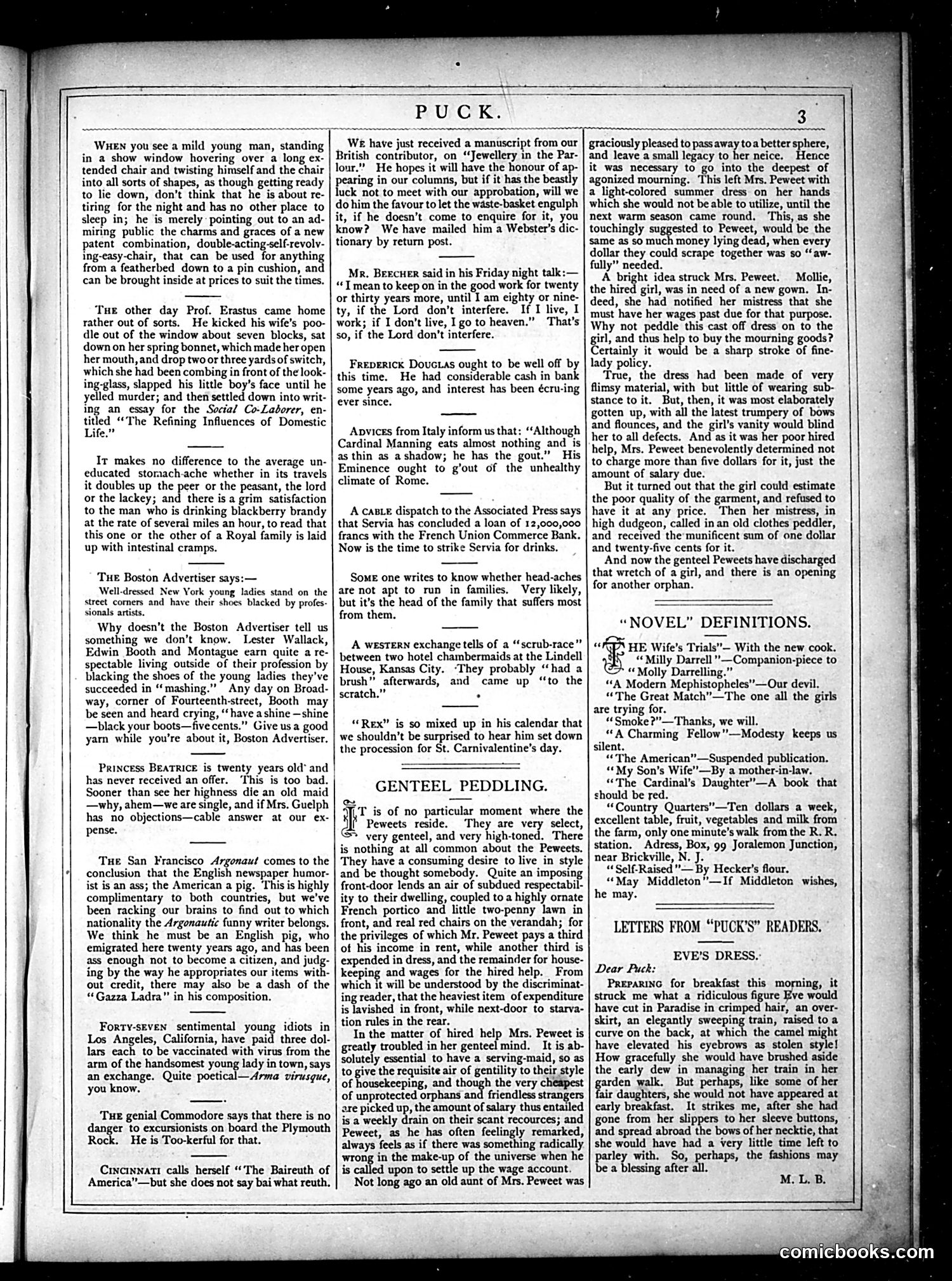
What you’re looking at
This page is primarily **text-based content rather than political cartoons**. It consists of humor columns, social commentary, and reader letters rather than illustrated satire. The content includes: - **Humorous observations** about urban life (New York fashion, Boston advertising) - **Social satire** targeting wealthy young people, their pretensions, and fashionable concerns - **"Novel Definitions"** section mocking current literary trends and book titles - **Reader letter** about women's fashion, specifically criticizing elaborate hairstyles and dress The satire targets **American consumer culture and vanity**, particularly among the wealthy and fashionable classes. References to expensive clothing, absurd hairstyles, and materialistic concerns suggest Puck was critiquing the excess and superficiality of Gilded Age society. The tone is lighthearted rather than politically confrontational.
📄 Transcribed text from this page (OCR, searchable)
Machine-transcribed from the original scan — historical spelling and the odd misread are preserved.
WHEN you see a mild young man, standing in a show window hovering over a long ex- tended chair and twisting himself and the chair into all sorts of shapes, as though getting ready to lie down, don’t think that he is about re- tiring for the night and has no other place to sleep in; he is merely: pointing out to an ad- miring public the charms and graces of a new patent combination, double-acting-self-revolv- ing-easy-chair, that can be used for anythin; from a featherbed down to a pin cushion, an can be brought inside at prices to suit the times. Tue other day Prof. Erastus came home rather out of sorts. He kicked his wife’s poo- dle out of the window about seven blocks, sat down on her spring bonnet, which made her open her mouth, and drop two or three yards of switch, which she had been combing in front of the look- ing-glass, slapped his little boy’s face until he yelled murder; and then settled down into writ- ing an essay for the Social Co-Laborer, en- sided “The Refining Influences of Domestic ‘ife.” Ir makes no difference to the average un- educated storaach-ache whether in its travels it doubles up the peer or the peasant, the lord or the lackey; and there is a grim satisfaction to the man who is drinking blackberry brandy at the rate of several miles an hour, to read that this one or the other of a Royal family is laid up with intestinal cramps. Tue Boston Advertiser says:— Well-dressed New York young ladies stand on the street corners and have their shoes blacked by profes- sionals artists. Why doesn’t the Boston Advertiser tell us something we don’t know. Lester Wallack, Edwin Booth and Montague earn quite a re- spectable living outside of their profession by blacking the shoes of the young ladies they’ve succeeded in “mashing.” Any day on Broad- way, corner of Fourteenth-street, Booth may be seen and heard crying, ‘have ashine —shine —black your boots—five cents.” Give us a good yarn while you're about it, Boston Advertiser. Princess BEATRICE is twenty years old’ and has never received an offer. Sooner than see her highness die an old maid —why, ahem—we are single, and if Mrs. Guelph has no objections—cable answer at our ex- pense. Tue San Francisco Argonaut comes to the conclusion that the English newspaper humor- ist is an ass; the American a pig. This is highly complimentary to both countries, but we've been racking our brains to find out to which nationality the Argonautic funny writer belongs. We think he must be an English pig, who emigrated here twenty years ago, and has been ass enough not to become a citizen, and judg- ing by the way he appropriates our items with- out credit, there may also be a dash of the “Gazza Ladra” in his composition. Forty-seven sentimental young idiots in Los Angeles, California, have paid three dol- lars each to be vaccinated with virus from the arm of the handsomest young lady in town, says an exchange. Quite poetical—Arma virusgue, you know, Tue genial Commodore says that there is no cane: r to excursionists on board the Plymouth Rock. He is Too-kerful for that. Cincinnati calls herself “The Baireuth of America”—but she does not say bai what reuth, This is too bad. | ~~ 3 We have just received a manuscript from our British contributor, on ‘Jewellery in the Par- lour.”” He hopes it will have the honour of ay pearing in our columns, but if it has the beastly luck not to meet with our approbation, will we do him the favour to let the waste-basket engulph it, if he doesn’t come to enquire for it, you know? We have mailed him a Webster's dic- tionary by return post. Mr. Beecuer said in his Friday night talk:— “T mean to keep on in the good work for twenty or thirty years more, until I am eighty or nine- ty, if the Lord don’t interfere. If I live, I work; if I don’t live, I go to heaven.” That’s so, if the Lord don’t interfere. FREDERICK DouGLas ought to be well off by this time. He had considerable cash in bank some years ago, and interest has been écru-ing ever since. Apvices from Italy inform us that: ‘Although Cardinal Manning eats almost nothing and is as thin as a shadow; he has the gout.” His Eminence ought to g’out of the unhealthy climate of Rome. A CaBLE dispatch to the Associated Press says that Servia has concluded a loan of 12,000,000 francs with the French Union Commerce Bank. Now is the time to strike Servia for drinks. Some one writes to know whether head-aches are not apt to run in families. Very likely, but it’s the head of the family that suffers most from them. A western exchange tells of a “‘scrub-race”’ between two hotel chambermaids at the Lindell House, Kansas City. ‘They probably “had a brush” afterwards, and came up “to the scratch.” : “Rex” is so mixed up in his calendar that we shouldn’t be surprised to hear him set down the procession for St. Carnivalentine’s day. GENTEEL PEDDLING. Peweets reside. They are very select, very genteel, and very high-toned. There is nothing at all common about the Peweets. They have a consuming desire to live in style and be thought somebody. Quite an imposing front-door lends an air of subdued respectabil- ity to their dwelling, coupled to a highly ornate French portico and little two-penny lawn in front, and real red chairs on the verandah; for the privileges of which Mr. Peweet pays a third ot his income in rent, while another third is expended in dress, and the remainder for house- keeping and wages for the hired help. From which it will be understood by the discriminat- ing reader, that the heaviest item of expenditure is lavished in front, while next-door to starva- tion rules in the rear. In the matter of hired help Mrs. Peweet is greatly troubled in her genteel mind. It is ab- solutely essential to have a serving-maid, so as to give the requisite air of gentility to their style of housekeeping, and though the very cheapest of unprotected orphans and friendless strangers are picked up, the amount of salary thus entailed is a weekly drain on their scant recources; and Peweet, as he has often feelingly remarked, always feels as if there was something radically wrong in the make-up of the universe when he is upon to settle up the wage account. Not long ago an old aunt of Mrs. Peweet was I is of no particular moment where the I graciously pleased to pass away toa better sphere, and leave a small legacy to her neice. Hence it was necessary to go into the deepest of agonized mourning. This left Mrs. Peweet with a light-colored summer dress on her hands which she would not be able to utilize, until the next warm season came round. This, as she touchingly suggested to Peweet, would be the same as so much money lying dead, when every dollar they could scrape together was so “‘aw- fully” needed. A bright idea struck Mrs. Peweet. Mollie, the hired girl, was in need of a new gown. In- deed, she had notified her mistress that she must have her wages past due for that purpose. Why not peddle this cast off dress on to the irl, and thus help to buy the mourning goods? ‘ertainly it would be a sharp stroke of fine- lady policy. True, the dress had been made of very flimsy material, with but little of wearing sub- stance to it. But, then, it was most elaborately gotten up, with all the latest trumpery of bows and flounces, and the girl’s vanity would blind her to all defects. And as it was her poor hired help, Mrs. Peweet benevolently determined not to charge more than five dollars for it, just the amount of salary due. But it turned out that the girl could estimate the poor quality of the garment, and refused to have it at any price. Then her mistress, in high dudgeon, called in an old clothes peddler, and received the'munificent sum of one dollar and twenty-five cents for it. And now the genteel Peweets have discharged that wretch of a girl, and there is an opening for another orphan. “NOVEL” DEFINITIONS. fe HE Wife's Trials”— With the new cook. “Milly Darrell "—Companion-piece to “Molly Darrelling.”” “A Modern Mephistopheles”—Our devil. “The Great Match”—The one all the girls '—Thanks, we will. “A Charming Fellow”—Modesty keeps us silent. “The American”—Suspended publication. “My Son’s Wife”—By a mother-in-law. “The Cardinal's Daughter’—A book that should be red. “Country Quarters’—Ten dollars a week, excellent table, fruit, vegetables and milk from the farm, only one minute’s walk from the R. R. station. Adress, Box, 99 Joralemon Junction, near Brickville, N. J. “ Self-Raised "— By Hecker’s flour. “May Middleton”—If Middleton wishes, he may. LETTERS FROM “PUCK’S” READERS. EVE'S DRESS. Dear Puck: PreparinG for breakfast this morning, it struck me what a ridiculous figure Eve would have cut in Paradise in crimped hair, an over- skirt, an elegantly sweeping train) raised to a curve on the back, at which the camel might have elevated his eyebrows as stolen style! How gracefully she would have brushed aside the early dew in managing her train in her gua walk. But perhaps, like some of her ir daughters, she would not have appeared at early breakfast. It strikes me, after she had gone from her slippers to her sleeve buttons, and spread abroad the bows of her necktie, that she would have had a very little time left to parley with. So, perhaps, the fashions may be a blessing after all. te comicbooks.com