
Life, 1927-06-09 · page 31 of 39
Life — June 9, 1927 — page 31: what you’re looking at
What you’re looking at
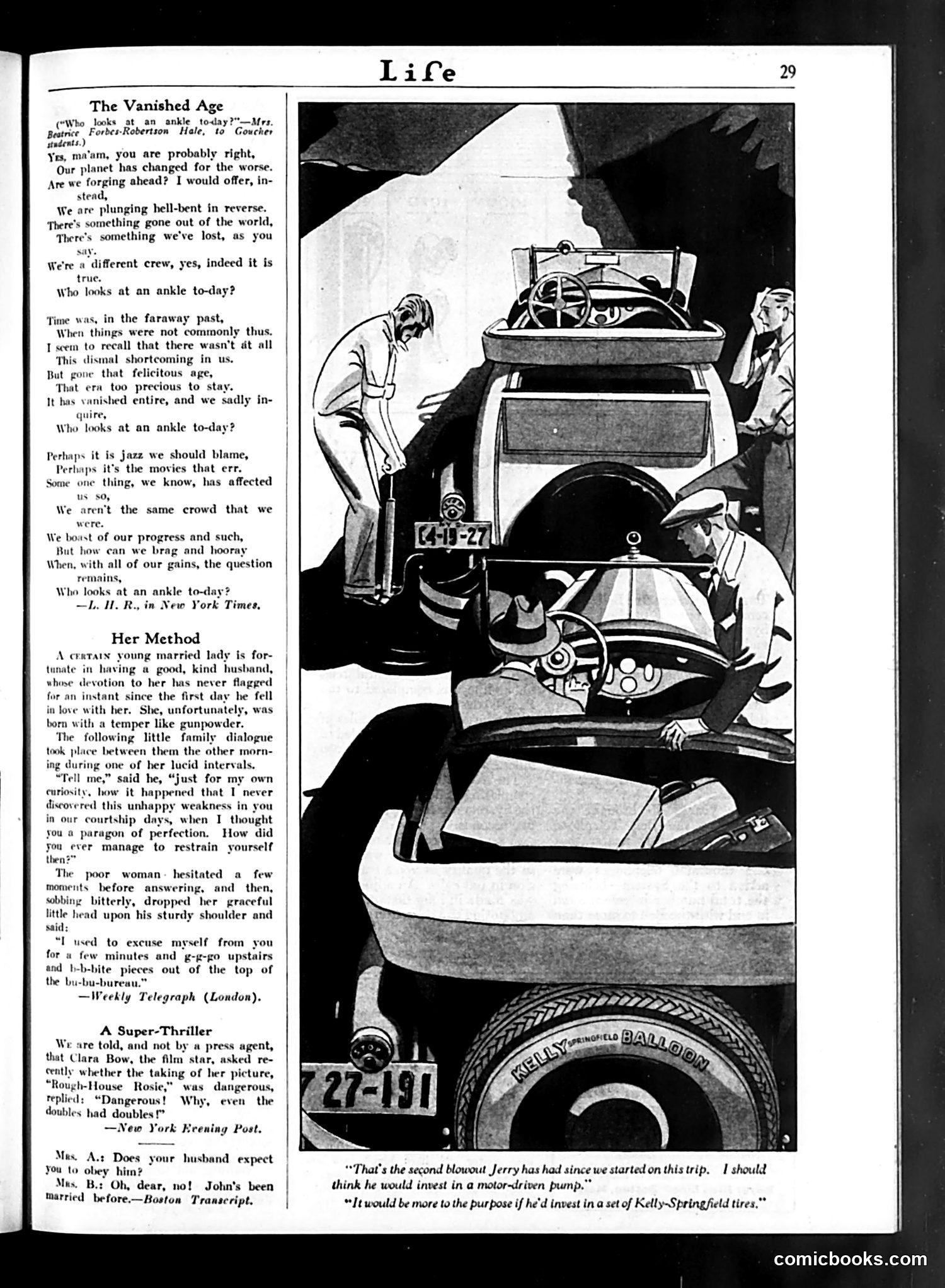
This page contains three distinct humorous pieces reflecting 1920s social anxieties: **"The Vanished Age"** is a nostalgic poem lamenting that modern men no longer appreciate women's ankles—a reference to the shocking fashion change of the era when women's hemlines rose dramatically, revealing legs previously hidden. The poem blames "jazz" and "movies" for corrupting society's morals and attention spans. The satire mocks both the older generation's prudish nostalgia and modern youth culture. **"Her Method"** is a domestic humor piece about a short-tempered wife who, when asked how she restrained herself during courtship, admits she'd bite the bureau instead—suggesting women hide their true temperaments from suitors. **The bottom cartoon** features two cars with blown tires, with the caption joking about investing in a motor-driven pump versus better tires—light automobile humor reflecting the novelty of motoring. Together, these pieces reflect period preoccupations: changing sexual mores, gender relations, and modern technology's role in society.
📄 Transcribed text from this page (OCR, searchable)
Machine-transcribed from the original scan — historical spelling and the odd misread are preserved.
The Vanished Age (“Who looks at an ankle today?"—Mrs. Beatrice Forbes-Robertson Hale, to Goucher stadents.) Yrs, ma’am, you are probably right, Our planet has changed for the worse. ‘Are we forging ahead? I would offer, in- stead, We are plunging hell-bent in reverse. ‘There's something gone out of the world, There’s something we've lost, as you say. We're « different crew, yes, indeed it is true. Who looks at an ankle to-day? ‘Time was, in the faraway past, When things were not commonly thus. I scem to recall that there wasn't dt all This dismal shortcoming in us. But gone that feli That era too pre It has vanished entire, and we sadly i quire, Who looks at an ankle to-day? Perhaps it is jazz we should blame, erhaps it's the movies that err. Some one thing, we know, has affected us 80, We aren't the same crowd that we were. We boast of our progress and such, But how can we brag and hooray When, with all of our gains, the question remains, Who looks at an ankle to-day? —L. H.R., in New York Times, Her Method A crntaty young married lady is for- tunate in having a good, kind husband, whose devotion to her has never flagged for an instant since the first day he fell in love with her, She, unfortunately, was born with a temper like gunpowder. The following little family dialogue took place between them the other morn- ing during one of her lucid intervals. “Tell me,” said he, “just for my own curiosity, how it happened that T never discovered this unhappy weakness in you in our courtship days, when I thought you a paragon of perfection. How did you ever manage to restrain yourself then?” The poor woman: hesitated a few moments before answering, and then, sobbing bitterly, dropped her graceful little head upon his sturdy shoulder and said: “I used to ex for a few minu and b-b-bite pieces out of the top of the bu-bu-bureau.” —Weekly Telegraph (London). A Super-Thriller We are told, and not by a press agent, that Clara Bow, the film star, asked re- cently whether the taking of her picture, “Rough-House Rosie,” was dangerous, replied: “Dangerous! Why, even the doubles had doubles!” —New York Evening Post, Mes. At Does your husband expect You to obey him? Mus, B.: Oh, dear, no! John's been married before.—Boston Transcript “That's the second blowout Jerry has had since we started on this trip. 1 should think he would invest in a motor-driven pump.” “It would be more to the purpose if he'd invest in a set of Kelly-Springfield tires,” comicbooks.com