
Life, 1927-06-09 · page 18 of 39
Life — June 9, 1927 — page 18: what you’re looking at
What you’re looking at
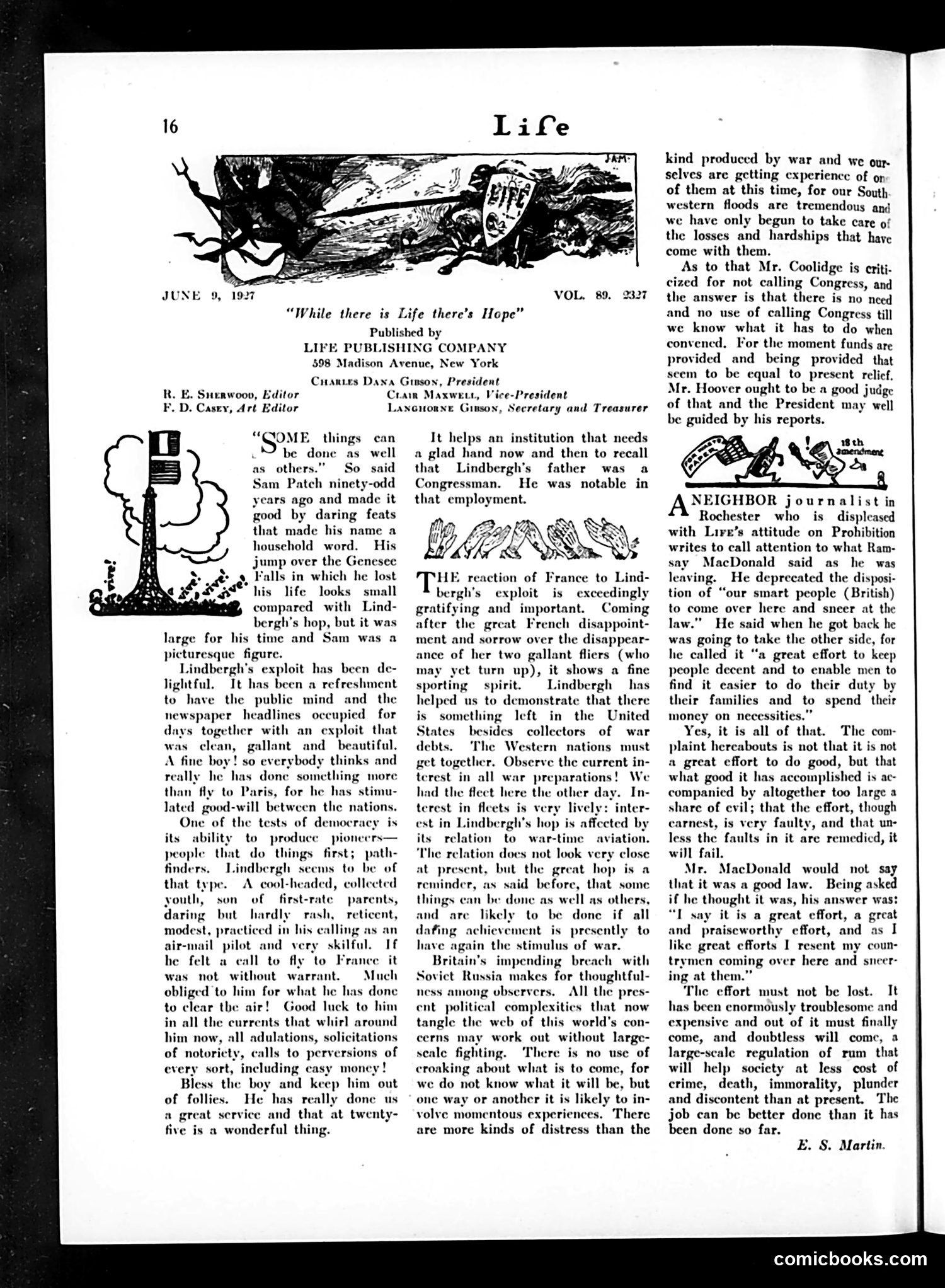
This page contains editorial commentary rather than political cartoons. The main illustration shows a figure jumping over what appears to be Genesee Falls, referencing Charles Lindbergh's father (a congressman) and likely Sam Patch, a legendary daredevil of the 1820s known for jumping waterfalls. The text discusses Lindbergh's transatlantic flight exploit and France's reaction to it. The editorial praises Lindbergh as a democratic hero—an ordinary person achieving extraordinary feats—while critiquing American political response and praising his demonstration that achievement remains possible beyond war's destruction. A sidebar addresses Prohibition enforcement efforts, expressing skepticism about their effectiveness. The overall tone celebrates individual accomplishment and questions government overreach.
📄 Transcribed text from this page (OCR, searchable)
Machine-transcribed from the original scan — historical spelling and the odd misread are preserved.
JUNE 9, 1927 VOL. 89. 2327 “While there is Life there’s Hope” Published by LIFE PUBLISHING COMPANY 598 Madison Avenue, New York Cuantes Dana Ginson, President R. E. Suerwoov, Editor F. D. Casey, Art Editor “QOME_ things can ‘ be done as well as others.” So said Sam Patch ninety-odd years ago and made it good by daring feats that made his name a household word. His yw jump over the Genesec S: 4@° 9, Falls in which he lost A GAe his life looks small > eg compared with Lind- bergh’s hop, but it was large for his time and Sam was a uresque figure. Lindbergh's exploit has been de- lightful. It has been a refreshment to have the public mind and the newspaper headlines occupied for days together with an exploit that was clean, gallant and beautiful. A fine boy! so everybody thinks and really he has done something more than fly to Paris, for he has stimu- lated good-will between the nations. One of the tests of democracy is its ability to produce pioncers— people that do things first; path- finders. Lindbergh seems to be o that type. A cool-headed, collected youth, son of fi daring but hardly sh, reticent, modest, practiced in his calling as an air-mail pilot and very skilful. If he felt. a call to fly to France it was not without warrant. © Much obliged to him for what he has done to clear the air! Good luck to him in all the currents that whirl around him now, all adulations, solic of notoriety, calls to perversions of every sort, including casy moncy! Bless the boy and keep him out of follies. He has really done us a great service and that at twenty- five is a wonderful thing. Crain Maxwett, Vice-President Laxcuorxe Ginson, Secretary and Treasurer It helps an institution that needs a glad hand now and then to recall that Lindbergh's father was a Congressman. He was notable in that employment. HE reaction of France to Lind- berg! exploit is exceedingly gratifying and important. Coming after the great French disappoint- ment and sorrow over the disappear- ance of her two gallant fliers (who may yet turn up), it shows a fine sporting — spirit. Lindbergh has helped us to demonstrate that there is something left in the United States besides collectors of war debts. The Western nations must get together. Observe the current in- terest in all war preparations! We had the flect here the other d. terest in fleets is very est in Lindbergh's hop is affc i ation to war-time ion does not look very c! at present, but the great hop is a reminde i that some things ¢: and are likely to be done if all dafing achievement is presently to ec again the stimulus of war. in’s impending breach with Sovict Russia makes for thoughtful- ness among observers. All the pres- ent. political complexities that now tangle the web of this world’s con- cerns may work out without large- seale fighting. There is no use of croaking about what is to come, for we do not know what it will be, but one way or another it is likely to in- volve momentous experiences, There are more kinds of distress than the kind produced by war and we our. selves are getting experience of on of them at this time, for our South western floods are tremendous and we have only begun to take care of the losses and hardships that have come with them. As to that Mr. Coolidge is criti- cized for not calling Congress, and the answer is that there is no need and no use of calling Congress till we know what it has to do when convened. For the moment funds are provided and being provided that seem to be equal to present relief, Mr. Hoover ought to be a good judge of that and the President may well be guided by his reports. NEIGHBOR journalist in Rochester who is displeased with Live’s attitude on Prohibition writes to call attention to what Ram- say MacDonald said as he was leaving. He deprecated the disposi- tion of “our smart people (British) to come over here and sneer at the law.” He said when he got back he was going to take the other side, for he called it “a great effort to keep people decent and to enable men to find it easier to do their duty by their families and to spend their money on necessities.” Yes, it is all of that. The com- plaint hereabouts is not that it is not a great effort to do good, but that what good it has accomplished is ac- companied by altogether too large a share of evil; that the effort, though carnest, is very faulty, and that un- less the faults in it are remedied, it will fail. Mr. MacDonald would not say that it was a good law. Being asked if he thought it was, his answer was: “ZL say it is a great effort, a great and praiseworthy effort, and as I like great efforts I resent my coun- trymen coming over here and sneer- ing at them.” The cffort must not be lost. It has been enormously troublesome and expensive and out of it must finally come, and doubtless will come, a large-scale regulation of rum that will help society at less cost of crime, death, immorality, plunder and discontent than at present. The job can be better done than it has been done so far. E. S. Martin. comicbooks.com