
Life, 1927-02-17 · page 33 of 34
Life — February 17, 1927 — page 33: what you’re looking at
What you’re looking at
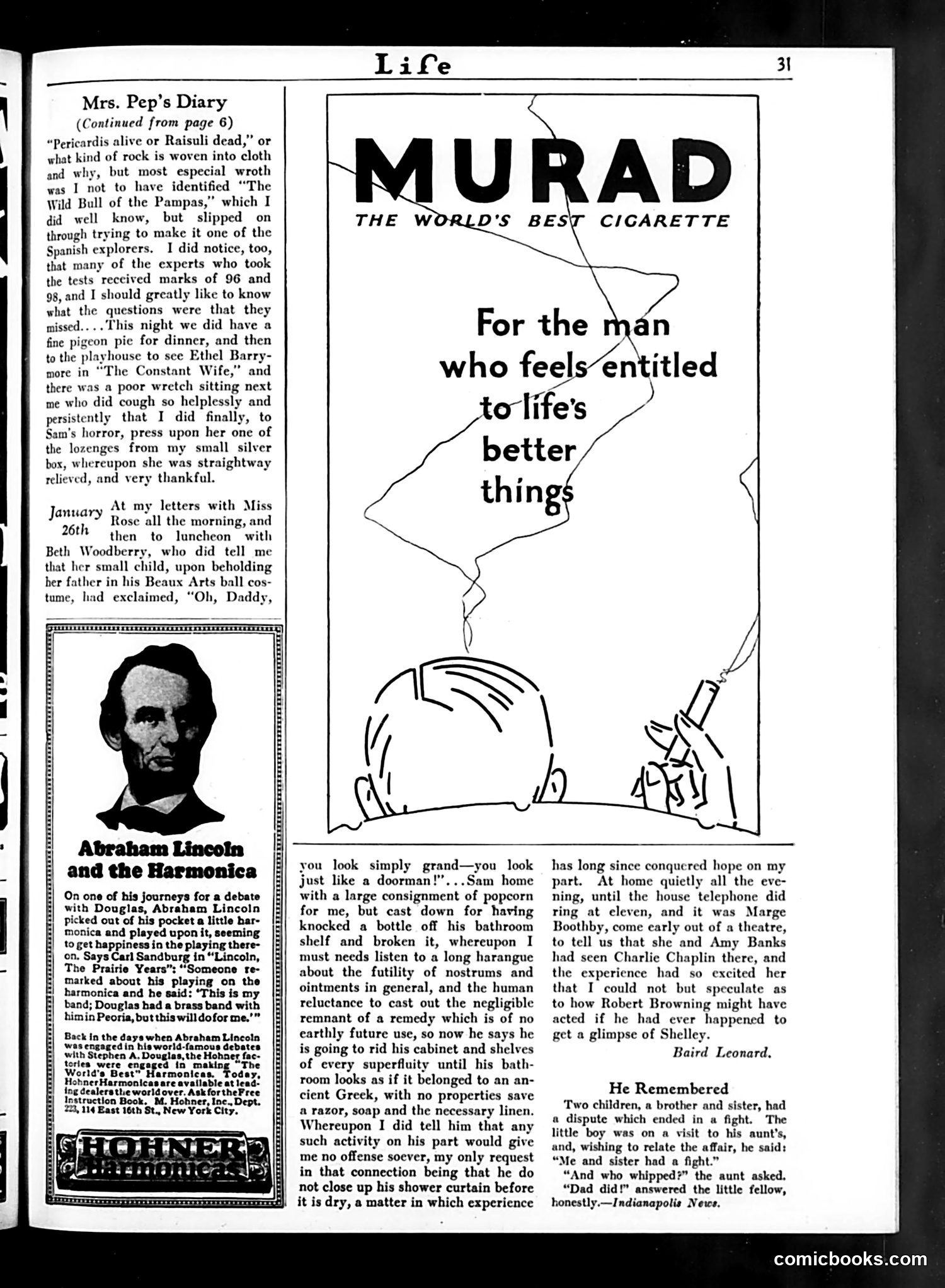
This page contains **Mrs. Pep's Diary**, a humor column documenting mundane domestic life. The satire lies in treating trivial daily events—a cough remedy, broken bathroom bottles, arguments about clutter—with the gravitas of significant literature. References to Ethel Barrymore (actress) and Charlie Chaplin (actor) suggest aspirational cultural awareness among the middle class. A **Murad cigarette advertisement** occupies the right side, targeting affluent men with the tagline "for the man who feels entitled to life's better things"—ironic given the adjacent content about everyday struggles. The lower section includes a **historical anecdote about Abraham Lincoln**, noting he played harmonica during debates. This appears promotional for Hohner harmonicas. Small humor items ("He Remembered," a child's joke) fill remaining space. The overall effect satirizes the gap between pretension and reality in American middle-class life circa the 1920s.
📄 Transcribed text from this page (OCR, searchable)
Machine-transcribed from the original scan — historical spelling and the odd misread are preserved.
Mrs. Pep’s Diary (Continued from page 6) “Pericardis alive or Raisuli dead,” or what kind of rock is woven into cloth and why, but most especial wroth was I not to have identified “The Wild Bull of the Pampas,” which I did well know, but slipped on through trying to make it one of the Spanish explorers. 1 did notice, too, that many of the experts who took the tests received marks of 96 and 98, and I should greatly like to know what the questions were that they missed.... This night we did have a fine pigeon pie for dinner, and then to the playhouse to sce Ethel Barry- more in “The Constant V * and there was a poor wretch sitting next me who did cough so helplessly and persistently that I did finally, to Sam's horror, press upon her one of the lozenges from my small silver box, whereupon she was straightway relieved, and very thankful. At my letters with Miss January Rose all the morning, and 26th then to luncheon with Beth Woodberry, who did tell me that her small child, upon beholding her father in his Beaux Arts ball cos- tume, had exclaimed, “Oh, Daddy, and the Harmonica On one of his journeys for a debate with Douglas, Abraham Lincoln picked out of his pocket a little har- monica and played upon it, seeming to get happiness in the playing there- on, Says Carl Sandburg in “Lincoln, The Prairie Years”: “Someone re- marked about his playing on the harmonica and he said: ‘This is my band; Douglas had a brass band with him in Peoria, but this will dofor me.’” Back in the days when Abraham Lincoln For the who feels“en itled to life's ) better over. fortheFree Book. M. Hohner, Inc. Dept. 223, 114 East 16th St., New York City. you look simply grand—you look just like a doorman!”...Sam home with a large consignment of popcorn for me, but cast down for having knocked a bottle off his bathroom shelf and broken it, whereupon I must needs listen to a long harangue about the futility of nostrums and ointments in general, and the human reluctance to cast out the negligible remnant of a remedy which is of no earthly future use, so now he says he is going to rid his cabinet and shelves of every superfluity until his bath- room looks as if it belonged to an an- cient Greek, with no properties save a razor, soap and the necessary linen. Whereupon I did tell him that any such activity on his part would give me no offense soever, my only request in that connection being that he do not close up his shower curtain before it is dry, a matter in which experience has long since conquered hope on my part. At home quietly all the eve- ning, until the house telephone did ring at eleven, and it was Marge Boothby, come early out of a theatre, to tell us that she and Amy Banks had seen Charlie Chaplin there, and the experience had so excited her that I could not but speculate as to how Robert Browning might have acted if he had ever happened to get a glimpse of Shelley. Baird Leonard, He Remembered Two children, a brother and sister, had a dispute which ended in a fight. The little boy was on a visit to his aunt's, and, wishing to relate the affair, he said: “Me and sister had a fight.” “And who whipped?” the aunt asked. “Dad did!” answered the little fellow, honestly.—Indianapolis News. comicbooks.com