
Life, 1921-03-17 · page 18 of 40
Life — March 17, 1921 — page 18: what you’re looking at
What you’re looking at
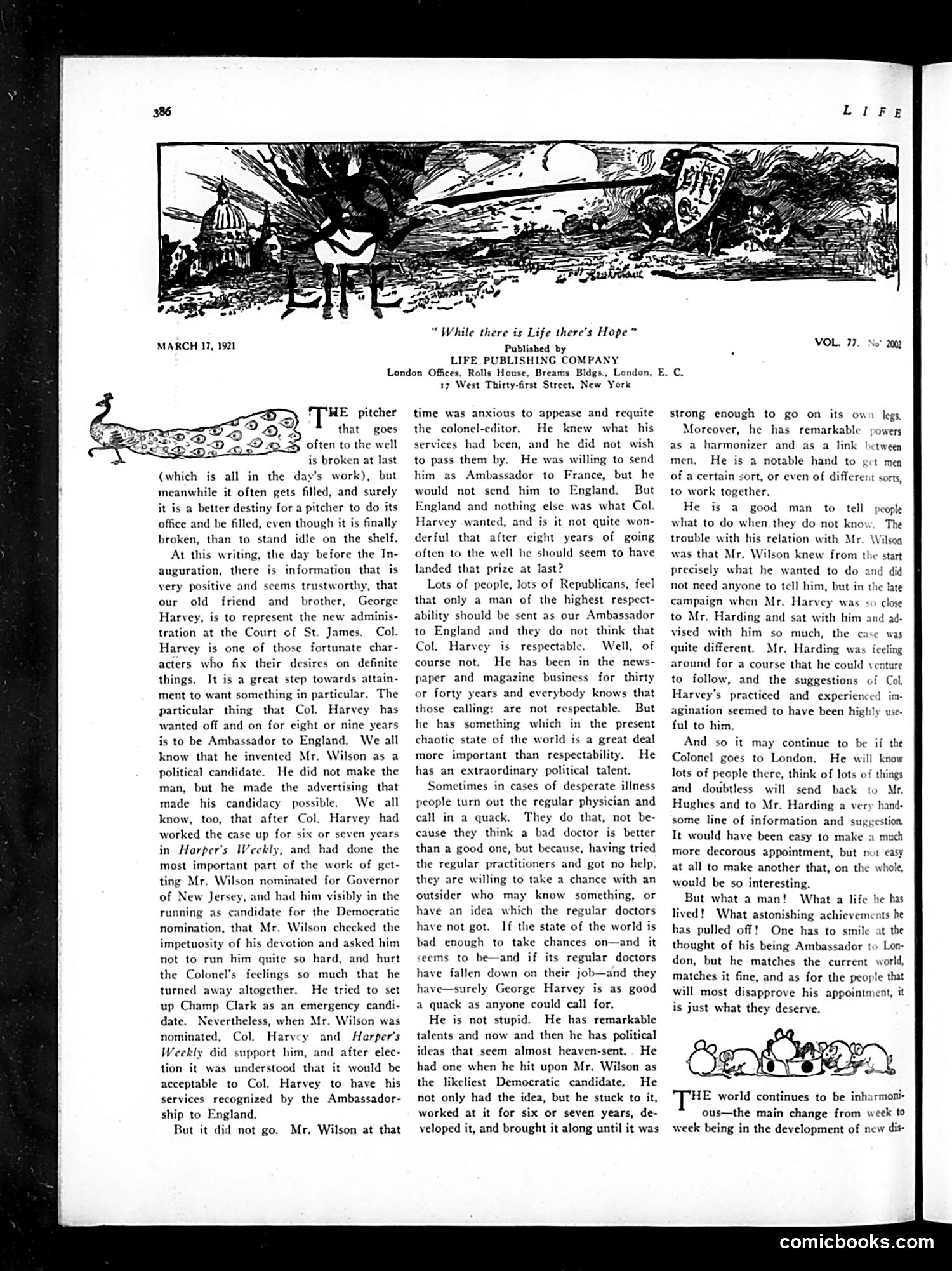
This is satirical commentary (not a cartoon) defending Colonel George Harvey's appointment as U.S. Ambassador to England under the new Harding administration. **The figures:** Colonel George Harvey—newspaper editor and political operative who had promoted Woodrow Wilson's early career but later fell out with him. The text discusses Wilson's earlier refusal to appoint Harvey ambassador to France or England. **The satire's point:** Life argues that while Harvey lacks "respectability" (a dig at his newspaper business), he possesses valuable "political talent." The extended metaphor compares him to a quack doctor—unconventional but potentially useful when regular physicians have failed. The opening proverb ("While there is Life there's Hope") suggests optimism despite Harvey's controversial nature. **Context:** This reflects post-WWI political realignment and the transition from Wilson to Harding, with Life defending an unconventional but strategically connected choice for a prestigious diplomatic post.
📄 Transcribed text from this page (OCR, searchable)
Machine-transcribed from the original scan — historical spelling and the odd misread are preserved.
MARCH 17, 1921 London Offices, HE pitcher that goes often to the well is broken at last (which is all in the day’s work), but meanwhile it often gets filled, and surely it is a better destiny fora pitcher to do its office and be filled, even though it is finally broken, than to stand idle on the shelf. At this writing, the day before the In- auguration, there is information that is very positive and scems trustworthy, that our old friend and brother, George Harvey, is to represent the new adminis- tration at the Court of St. James. Col. Harvey is one of those fortunate char- acters who fix their desires on definite things. It is a great step towards attain- ment to want something in particular, The particular thing that Col. Harvey has wanted off and on for eight or nine years is to be Ambassador to England. We all know that he invented Mr. Wilson as a political candidate. He did not make the man, but he made the advertising that made his candidacy possible. We all know, too, that after Col. Harvey had worked the case up for six or seven years in Harper's Weekly, and had done the most important part of the work of get- ting Mr. Wilson nominated for Governor of New Jersey, and had him visibly in the running as candidate for the Democratic nomination, that Mr. Wilson checked the impetuosity of his devotion and asked him not to run him quite so hard, and hurt the Colonel's feelings so much that he turned away altogether. He tried to set up Champ Clark as an emergency candi- date. Nevertheless, when Mr. Wilson was nominated, Col. Harvey and Harper's Weekly did support him, and after elec- tion it was understood that it would be acceptable to Col. Harvey to have his services recognized by the Ambassador- ship to England. But it did not go. Mr. Wilson at that “While there is Life there’s Hope” Published by LIFE PUBLISHING COMPANY 17 West Thirty-first Street, New York time was anxious to appease and requite the colonel-editor. He knew what his services had been, and he did not wish to pass them by. He was willing to send him as Ambassador to France, but he would not send him to England. But England and nothing else was what Col. Harvey wanted, and is it not quite won- derful that after eight years of going often to the well he should seem to have landed that prize at last? Lots of people, lots of Republicans, feel that only a man of the highest respect- ability should be sent as our Ambassador to England and they do not think that Col. Harvey is respectable. Well, of course not. He has been in the news- paper and magazine business for thirty or forty years and everybody knows that those calling: are not respectable. But he has something which in the present chaotic state of the world is a great deal more important than respectability. He has an extraordinary political talent. Sometimes in cases of desperate illness people turn out the regular physician and call in a quack. They do that, not be- cause they think a bad doctor is better than a good one, but because, having tried the regular practitioners and got no help, they are willing to take a chance with an outsider who may know something, or have an idea which the regular doctors have not got. If the state of the world is bad enough to take chances on—and it seems to be—and if its regular doctors have fallen down on their job—and they have—surely George Harvey is as good a quack as anyone could call for. He is not stupid. He has remarkable talents and now and then he has political ideas that seem almost heaven-sent. He had one when he hit upon Mr. Wilson as the likeliest Democratic candidate. He not only had the idea, but he stuck to it, worked at it for six or seven years, de- veloped it, and brought it along until it was Rolls House, Breams Bldgs, London, E, C, strong enough to go on its own Moreover, he has remarkable as a harmonizer and as a link men, legs. powers ctween He is a notable hand to get men of a certain sort, or even of different sorts, to work together, He is a good man to tell what to do when they do not kno’ people The trouble with his relation with Mr. \Vilsoa was that Mr. Wilson knew from the start precisely what he wanted to do and did not need anyone to tell him, but in the late campaign when Mr. Harvey was so close to Mr. Harding and sat with him and ad- vised with him so much, the case was quite different. Mr. Harding was feeling around for a course that he could venture to follow, and the suggestions of Col Harvey's practiced and experienced im- agination seemed to have been highly use- ful to him. And so it may continue to be if the Colonel goes to London. He will know lots of people there, think of lots of things and doubtless will send back to Mr. Hughes and to Mr. Harding a very hand- some line of information and suggestion. It would have been easy to make a much more decorous appointment, but not easy at all to make another that, on the whole, would be so interesting. But what a man! What a life he has lived! What astonishing achievements he has pulled off! One has to smile at the thought of his being Ambassador to Lon- don, but he matches the current world, matches it fine, and as for the people that will most disapprove his appointment, it is just what they deserve. HE world continues to be inharmoni- ous—the main change from week to week being in the development of new dis- comicbooks.com