
Life, 1921-03-17 · page 19 of 40
Life — March 17, 1921 — page 19: what you’re looking at
What you’re looking at
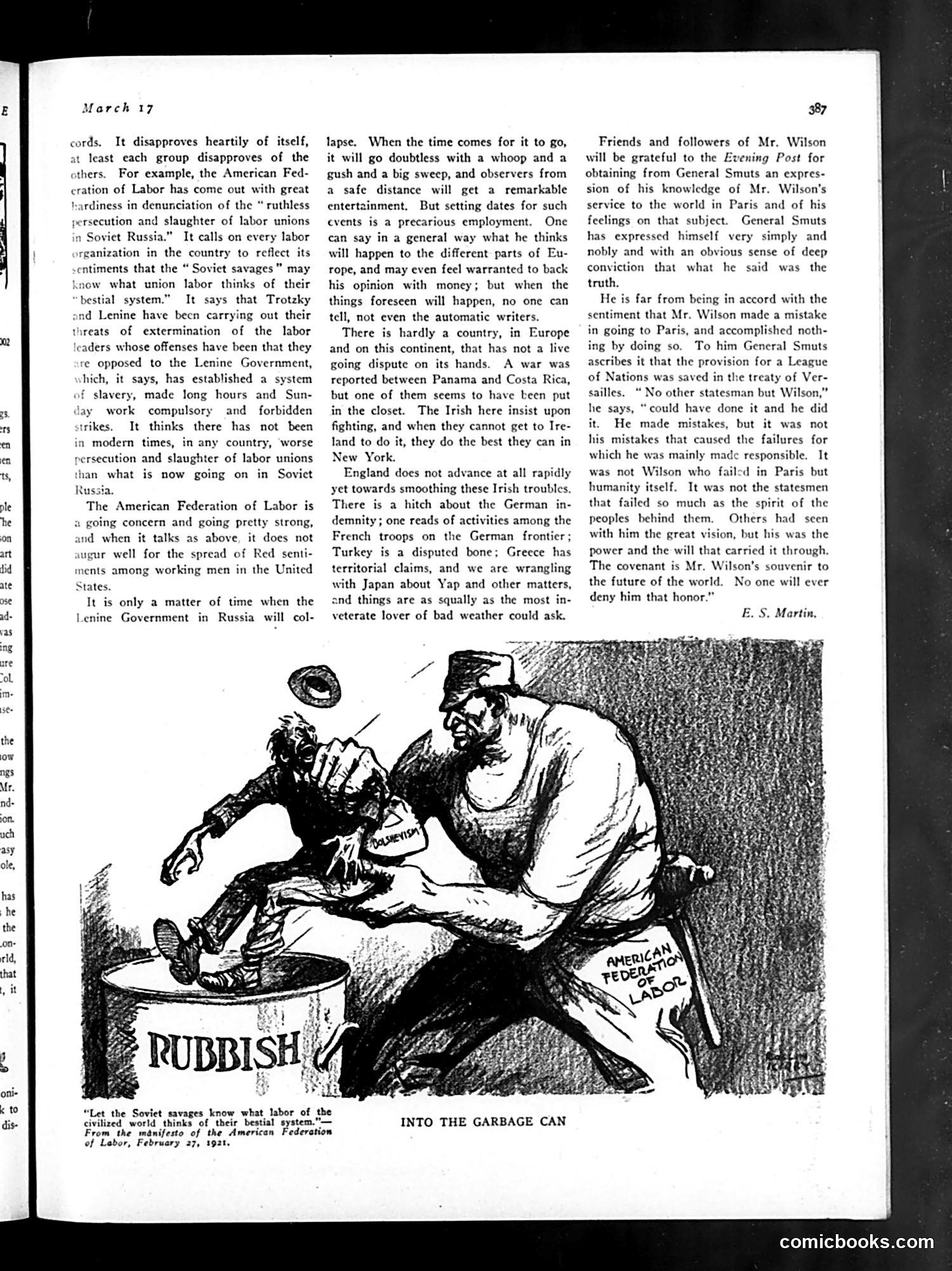
This cartoon satirizes the American Federation of Labor's denunciation of Soviet Russia (published February 27, 1921). The image depicts a large figure labeled "American Federation of Labor" dumping a small, caricatured Bolshevik figure into a garbage can labeled "RUBBISH." **Context:** Post-WWI America feared communist expansion. The AFL publicly condemned Soviet treatment of labor unions and the Bolshevik leadership (Lenin and Trotsky), despite the irony that labor movements theoretically aligned with communist ideology. **The satire's point:** The cartoon mocks this contradiction—American labor unions, which should theoretically sympathize with communist workers' movements, instead reject Soviet communism as barbaric ("bestial system," per the quoted AFL manifesto). The garbage-can disposal suggests the AFL views Bolshevism as literal trash. The accompanying article dismisses predictions the Soviet government will soon collapse, while documenting global unrest (Ireland, Germany, Turkey, Greece).
📄 Transcribed text from this page (OCR, searchable)
Machine-transcribed from the original scan — historical spelling and the odd misread are preserved.
March 17 cords. It disapproves heartily of itself, at least each group disapproves of the others. For example, the American Fed- cration of Labor has come out with great hardiness in denunciation of the “ ruthless persecution and slaughter of labor unions Soviet Russia.” It calls on every labor rganization in the country to reflect its sentiments that the “ Soviet savages” may what union labor thinks of their “bestial system.” It says that Trotzky and Lenine have becn carrying out their threats of extermination of the labor ‘caders whose offenses have been that they re opposed to the Lenine Government, hich, it says, has established a system f slavery, made long hours and Sun- day work compulsory and forbidden trikes. It thinks there has not been in modern times, in any country, worse persecution and slaughter of labor unions than what is now going on in Soviet Russia. The American Federation of Labor is a going concern and going pretty strong, and when it talks as above, it does not know augur well for the spread of Red senti- ments among working men in the United States. It is only a matter of time when the Lenine Government in Russia will col- “Let the Soviet savages know what labor of the civilized world thinks of their bestial system.”— From the manifesto of the American Federation of Labor, February 27, 1921. lapse. When the time comes for it to go, it will go doubtless with a whoop and a gush and a big sweep, and observers from a safe distance will get a remarkable entertainment, But setting dates for such cvents is a precarious employment. One can say in a general way what he thinks will happen to the different parts of Eu- rope, and may even feel warranted to back his opinion with money; but when the things foreseen will happen, no one can tell, not even the automatic writers. There is hardly a country, in Europe and on this continent, that has not a live going dispute on its hands. A war was reported between Panama and Costa Rica, but one of them seems to have been put in the closet. The Irish here insist upon fighting, and when they cannot get to Ire- land to do it, they do the best they can in New York. England does not advance at all rapidly yet towards smoothing these Irish troubles. There is a hitch about the German in- demnity ; one reads of activities among the French troops on the German frontier; Turkey is a disputed bone; Greece has territorial claims, and we are wrangling with Japan about Yap and other matters, and things are as squally as the most in- veterate lover of bad weather could ask. INTO THE GARBAGE CAN 387 Friends and followers of Mr. Wilson will be grateful to the Evening Post for obtaining from General Smuts an expres- sion of his knowledge of Mr. Wilson's service to the world in Paris and of his feelings on that subject. General Smuts has expressed himself very simply and nobly and with an obvious sense of deep conviction that what he the truth. He is far from being in accord with the sentiment that Mr. Wilson made a mistake in going to Paris, and accomplished noth- ing by doing so. To him General Smuts ascribes it that the provision for a League of Nations was saved in the treaty of Ver- sailles. “No other statesman but Wilson,” he says, “could have done it and he did it. He made mistakes, but it was not his mistakes that caused the failures for which he was mainly made responsible. It was not Wilson who failed in Paris but humanity itself. It was not the statesmen that failed so much as the spirit of the peoples behind them. Others had seen with him the great vision, but his was the power and the will that carried it through. The covenant is Mr. Wilson’s souvenir to the future of the world. deny him that honor.” said was No one will ever E. S. Martin. comicbooks.com