
Life, 1921-03-17 · page 17 of 40
Life — March 17, 1921 — page 17: what you’re looking at
What you’re looking at
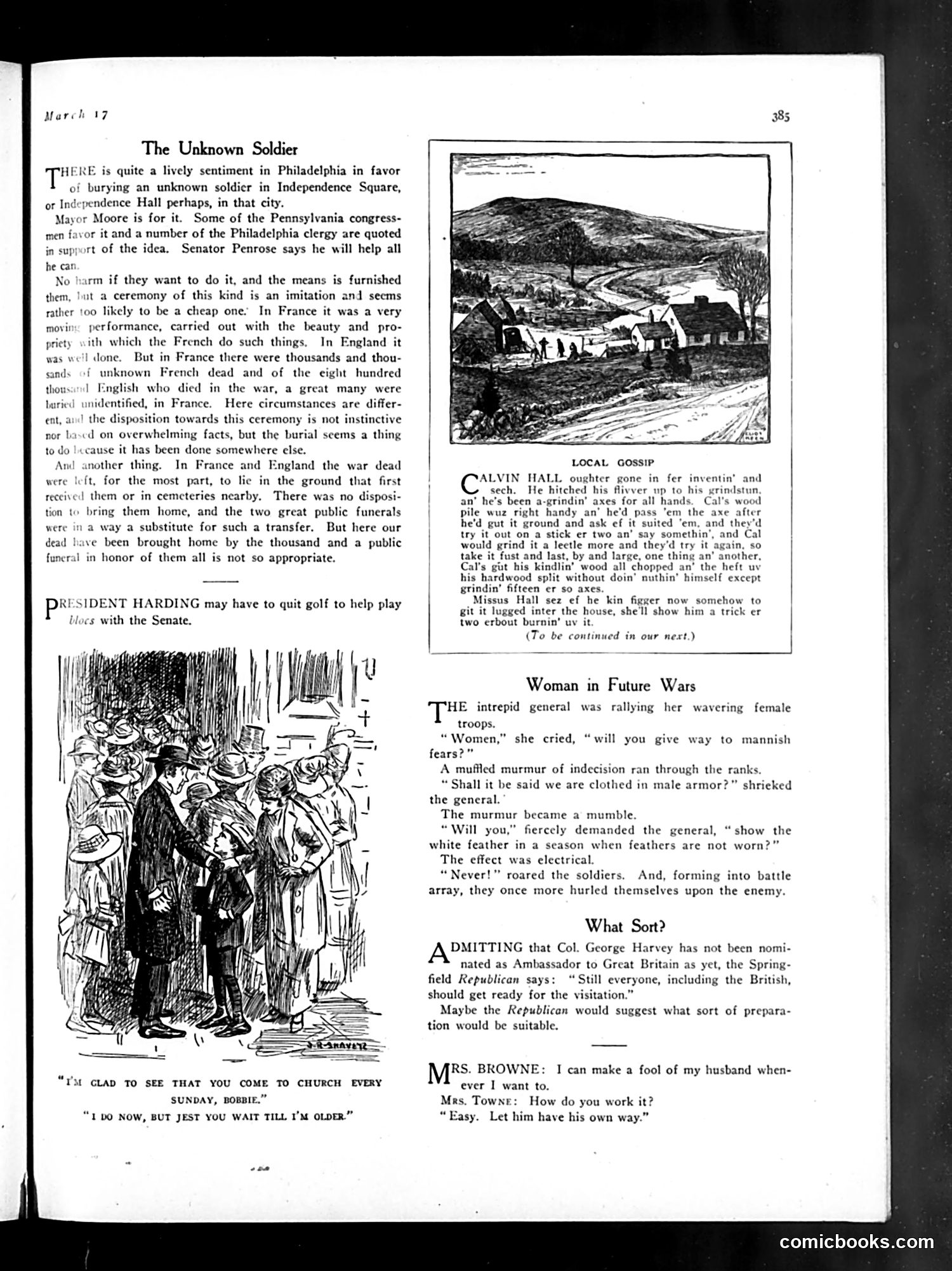
This page contains three distinct satirical pieces from the early 1920s: **"The Unknown Soldier"** critiques Philadelphia's proposal to bury an unknown WWI soldier. The author argues it's an imitative, cheap ceremony—whereas France and England buried unknowns out of necessity (thousands of unidentified dead), America is simply copying them despite having already brought most war dead home. The satire targets empty civic pageantry done merely because "it has been done somewhere else." **"President Harding may have to quit golf"** mocks President Harding's golfing habits while Congress needs him to resolve legislative disagreements ("play blocs with the Senate"). **"Woman in Future Wars"** is satirical dialogue imagining female soldiers. A female general rallies wavering women troops with absurd rhetoric about "mannish fears" and "white feathers"—mocking both contemporary anxieties about women's roles and the overwrought military oratory of the era. The bottom items are light domestic humor about marriage and church attendance, typical of the magazine's satirical tone.
📄 Transcribed text from this page (OCR, searchable)
Machine-transcribed from the original scan — historical spelling and the odd misread are preserved.
March 17 The Unknown Soldier HERE is quite a lively sentiment in Philadelphia in favor of burying an unknown soldier in Independence Square, or Independence Hall perhaps, in that city. Mayor Moore is for it. Some of the Pennsylvania congress- men favor it and a number of the Philadelphia clergy are quoted in support of the idea. Senator Penrose says he will help all he can No harm if they want to do it, and the means is furnished them, !ut a ceremony of this kind is an imitation and secms rather 100 likely to be a cheap one. In France it was a very movin performance, carried out with the beauty and pro- priety with which the French do such things. In England it was well done. But in France there were thousands and thou- sands of unknown French dead and of the eight hundred thousand English who died in the war, a great many were luried unidentified, in France. Here circumstances are differ- ent, and the disposition towards this ceremony is not instinctive nor Laced on overwhelming facts, but the burial seems a thing to do !xcause it has been done somewhere else. And another thing. In France and England the war dead were left, for the most part, to lie in the ground that first received them or in cemeteries nearby, There was no disposi- tion to bring them home, and the two great public funerals were in a way a substitute for such a transfer. But here our dead have been brought home by the thousand and a public funeral in honor of them all is not so appropriate. RESIDENT HARDING may have to quit golf to help play blocs with the Senate. “YM GLAD To SEE THAT YOU COME TO CHURCH EVERY SUNDAY, BOBBIE.” “1 pO NOW, BUT JEST YOU WAIT TILL I'M OLDER” LOCAL GossIP ALVIN HALL oughter gone in fer inventin’ and sech. He hitched his flivver up to his grindstun. an’ he’s been a-grindin’ axes for all hands. Cal's wood pile wuz right handy an’ he'd pass ‘em the axe after he'd gut it ground and ask ef it suited ‘em, and they'd try it out on a stick er two an’ say somethin’, and Cal would grind it a leetle more and they'd try it again, so take it fust and last, by and large, one thing an’ another, Cal’s gut his kindlin’ wood all chopped an’ the heft uv his hardwood split without doin’ nuthin’ himself except grindin’ fifteen er so axes. Missus Hall sez ef he kin figger now somehow to git it lugged inter the house, she'll show him a trick er two erbout burnin’ uv it. (To be continued in our next.) Woman in Future Wars THE intrepid general was rallying her wavering female troops. “Women,” she cried, “will you give way to mannish fears?” A muffled murmur of indecision ran through the ranks. “ Shall it be said we are clothed in male armor?” shrieked the general. The murmur became a mumble. “Will you,” fiercely demanded the general, “show the white feather in a season when feathers are not worn?” The effect was electrical. “Never!” roared the soldiers. And, forming into battle array, they once more hurled themselves upon the enemy. What Sort? DMITTING that Col. George Harvey has not been nomi- nated as Ambassador to Great Britain as yet, the Spring- field Republican says: “Still everyone, including the British, should get ready for the visitation.” Maybe the Republican would suggest what sort of prepara- tion would be suitable. RS. BROWNE: ever I want to. Mrs. Towne: How do you work it? “Easy. Let him have his own way.” I can make a fool of my husband when- comicbooks.com