
Life, 1905-09-21 · page 10 of 26
Life — September 21, 1905 — page 10: what you’re looking at
What you’re looking at
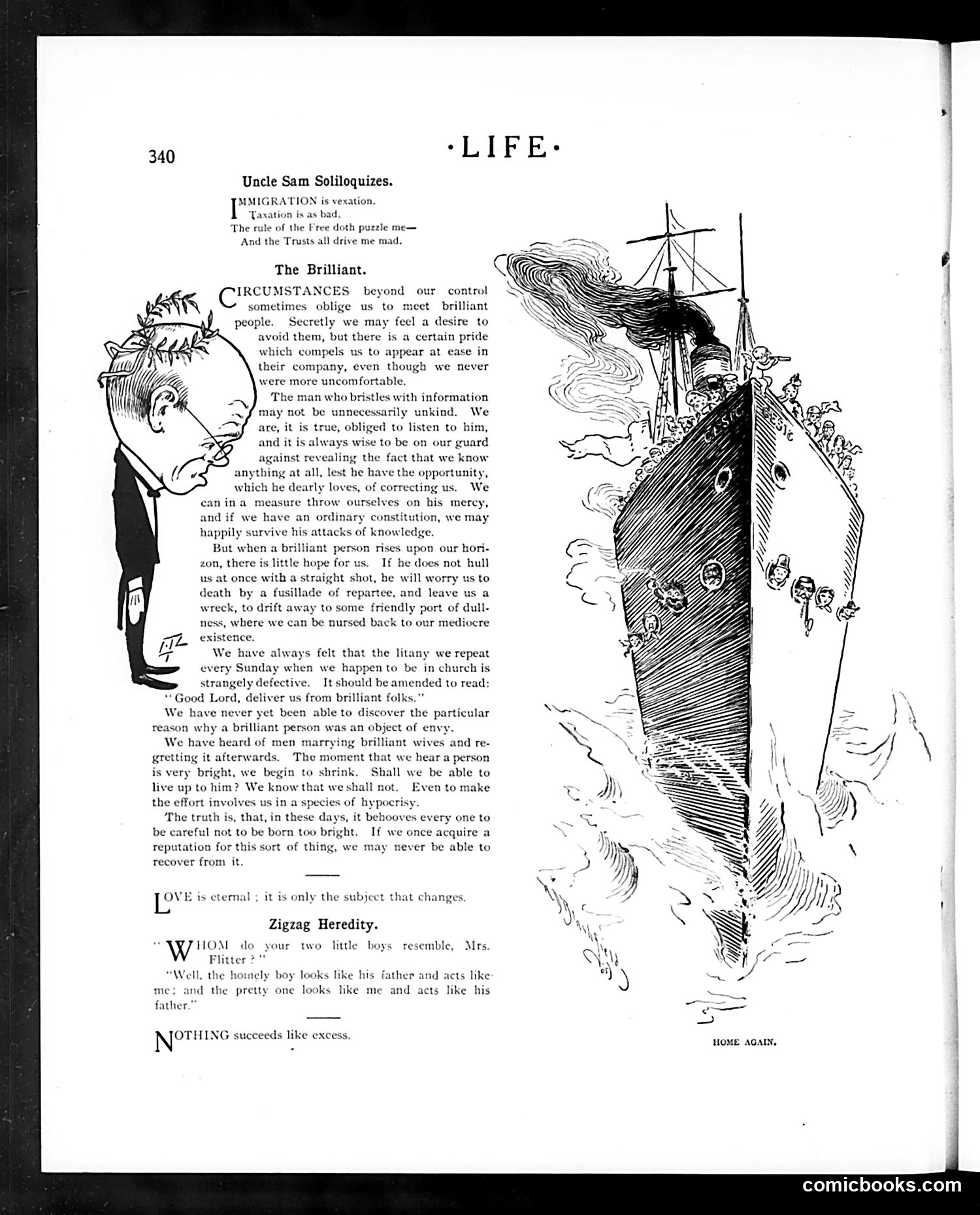
This page features a satirical essay titled "The Brilliant" with an accompanying caricature of a thin, sharp-featured man. The text warns against the social danger posed by exceptionally intelligent people who use their knowledge to embarrass or dominate others in conversation. The essay argues that while ordinary ignorant people are manageable, a "brilliant" person who "rises upon our horizon" becomes genuinely threatening—they attack relentlessly with facts and can destroy one's reputation through superior wit. The author suggests that brilliance, when weaponized socially, is worse than mere stupidity. The caricature's exaggerated features (particularly the sharp profile) visually emphasize intellectual arrogance. The satire mocks both brilliant people's condescension and society's fear of intellectual superiority in casual social settings.
📄 Transcribed text from this page (OCR, searchable)
Machine-transcribed from the original scan — historical spelling and the odd misread are preserved.
Uncle Sam Soliloquizes. I’ ‘The ru And the Trusts all drive me mad. GRATION is vexation. sation is as bad, of the Free doth puzzle me— The Brilliant. IRCUMSTANCES beyond our control sometimes oblige us to meet. brilliant people. Secretly we may feel a desire to avoid them, but there is a certain pride which compels us to appear at ease in their company, even though we never were more uncomfortable. The man who bristles with information be unnecessarily unkind. We , it is true, obliged to listen to him, s wise to be on our guard ling the fact that we know anything at all, lest he have the opportunity which he dearly loves, of correcting us. We can ina measure throw ourselves on his mercy, and if we have an ordinary constitution, we may happily surv But when a brilliant person rises upon our hori- zon, ther little hope for us. If he does not hull us at once with a straight shot, he will worry us to death by a fu Je of repartee, and leave us a wreck, to drift away to some friendly port of dull- ness, where we can be nursed back to our mediocre existence. We have always felt that the litany we repeat every Sunday when we happen to be in church is strangely defective. It should be amended to read: “Good Lord, deliver us from brilliant folks." We have never yet been able to discover the particular reason why a brilliant person was an object of envy. We have heard of men marrying brilliant wives and re- gtetting it afterwards. The moment that we hear a person is very bright, we begin to shrink. Shall we be able to live up to him? We know that we shall not. Even to make the effort involves us in a sof hypocrisy ‘The truth is, that, in these days, it behooves every one to attacks of knowledge. be careful not to be born too bright. If we once acquire a reputation for this sort of thing, we 1 never be able to recover from it. [c= is eternal ; it is only the subject that changes. Zigzag Heredity. HOM do your two little boys resemble, Mrs. Flitter 2" “Well. the ho:nely boy looks like his father and acts like 1 the pretty one looks like me and acts like his me; father.” NOtus succeeds like HOME AGAIN. comicbooks.com