
Life, 1883-08-30 · page 11 of 16
Life — August 30, 1883 — page 11: what you’re looking at
What you’re looking at
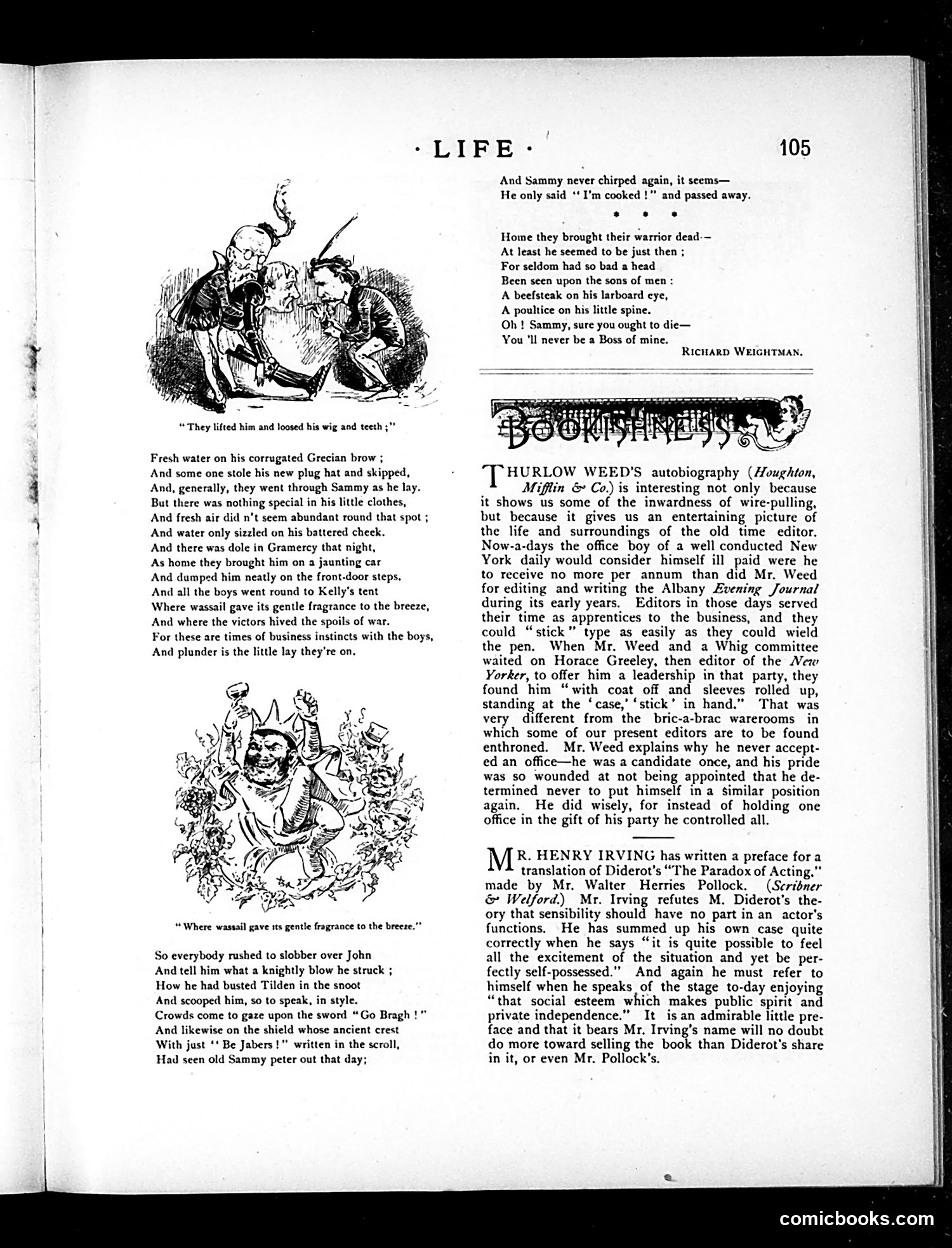
This page contains a satirical poem by Richard Weightman about a street fight in what appears to be 19th-century New York (references to "Gramercy," "Kelly's tent," and Irish characters suggest an immigrant neighborhood). The narrative describes a brawl where a character named "John" defeats "Sammy" (or "Tilden"), leaving him severely beaten—"a beefsteak on his larboard eye, / A poultice on his little spine." The poem mocks both the violence and the celebratory aftermath, where the victor's friends plunder Sammy's belongings and celebrate at a tavern. The satirical point appears to target working-class street violence as performative spectacle and petty criminality ("plunder is the little lay they're on"). The exaggerated poetic language treating a brutal mugging as heroic adventure undercuts the actual brutality. The accompanying prose discusses historical editors (Thurlow Weed, Horace Greeley), seemingly unrelated to the cartoon.
📄 Transcribed text from this page (OCR, searchable)
Machine-transcribed from the original scan — historical spelling and the odd misread are preserved.
shades « -LIFE:) 105 “ They lifted him and loosed his wig and teeth ;"” Fresh water on his corrugated Grecian brow ; And some one stole his new plug hat and skipped, And, generally, they went through Sammy as he lay. But there was nothing special in his little clothes, And fresh air did n't seem abundant round that spot ; And water only sizzled on his battered check. And there was dole in Gramercy that night, As home they brought him on a jaunting car And dumped him neatly on the front-door steps. And all the boys went round to Kelly's tent Where wassail gave its gentle fragrance to the breeze, And where the victors hived the spoils of war. For these are times of business instincts with the boys, And plunder is the little lay they're on. “ Where wassail gave its gentle frogrance to the breeze.”” So everybody rushed to slobber over John And tell him what a knightly blow he struck ; How he had busted Tilden in the snoot And scooped him, so to speak, in style. Crowds come to gaze upon the sword “Go Bragh !" And likewise on the shield whose ancient crest With just ‘‘ Be Jabers !" written in the scroll, Had seen old Sammy peter out that day; And Sammy never chirped again, it seems— He only said ‘I'm cooked !”" and passed away. Home they brought their warrior dead-— At least he seemed to be just then ; For seldom had so bad a head Been seen upon the sons of men : A beefsteak on his larboard eye, A poultice on his little spine. Oh! Sammy, sure you ought to die— You ‘ll never be a Boss of mine. RICHARD WEIGHTMAN, HURLOW WEED’S autobiography (Houghton, Mifflin & Co.) is interesting not only because it shows us some of the inwardness of wire-pulling, but because it gives us an entertaining picture of the life and surroundings of the old time editor. Now-a-days the office boy of a well conducted New York daily would consider himself ill paid were he to receive no more per annum than did Mr. Weed for editing and writing the Albany Evening Journal during its early years. Editors in those days served their time as apprentices to the business, and they could “stick” type as easily as they could wield the pen. When Mr. Weed and a Whig committee waited on Horace Greeley, then editor of the Mew Yorker, to offer him a leadership in that party, they found him “with coat off and sleeves rolled up, standing at the ‘case,’ ‘stick’ in hand.” That was very different from the bric-a-brac warerooms in which some of our present editors are to be found enthroned. Mr. Weed explains why he never accept- ed an office—he was a candidate once, and his pride was so wounded at not being appointed that he de- termined never to put himself ina similar position again. He did wisely, for instead of holding one office in the gift of his party he controlled all. R. HENRY IRVING has written a preface fora translation of Diderot's “The Paradox of Acting.” made by Mr, Walter Herries Pollock. (Scribner & Welford.) Mr. Irving refutes M. Diderot’s the- ory that sensibility should have no part in an actor's functions. He has summed up his own case quite correctly when he says “it is quite possible to feel all the excitement of the situation and yet be per- fectly self-possessed."” And again he must refer to himself when he speaks of the stage to-day enjoying “that social esteem which makes public spirit and private independence.” It is an admirable little pre- face and that it bears Mr. Irving’s name will no doubt do more toward selling the book than Diderot's share in it, or even Mr. Pollock's. comicbooks.com