
Judge, 1922-05-13 · page 25 of 36
Judge — May 13, 1922 — page 25: what you’re looking at
What you’re looking at
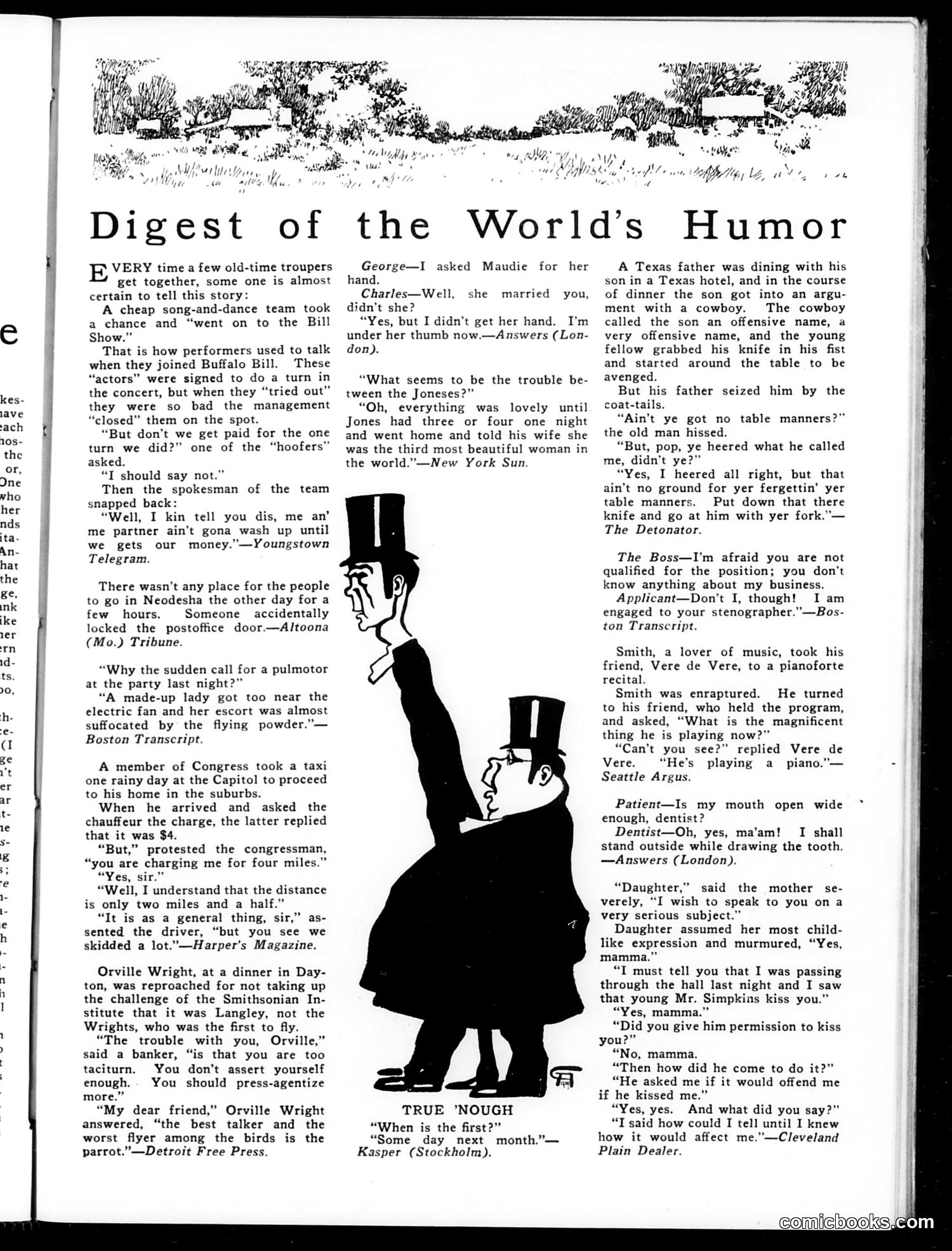
This page from the satirical magazine **Judge** contains a "Digest of the World's Humor"—a collection of brief jokes and anecdotes rather than political cartoons. The two illustrated figures appear to be generic "straight man" and "funny man" character types used to frame some jokes, not specific historical figures. The humor reflects early 20th-century American attitudes: jokes about marriage (wives controlling husbands), class differences (congressmen, bankers), and regional stereotypes (Texas frontier violence). One joke references the **Wright Brothers' aviation achievement** and their reluctance toward self-promotion—a topical reference to Orville Wright's famous modesty. The page satirizes contemporary social conventions: table manners, courtship, workplace hierarchies, and gender dynamics. The "Texas father" joke endorses using a fork rather than a knife in a dispute—darkly satirizing frontier violence while nominally praising etiquette. Most humor depends on wordplay and situational irony rather than political commentary.
📄 Transcribed text from this page (OCR, searchable)
Machine-transcribed from the original scan — historical spelling and the odd misread are preserved.
| j | ae 7 i “ae Mi flfy igs wr Sy Digest of the World’s Humor E VERY time a few old-time troupers get together, some one is almost certain to tell this story: A cheap song-and-dance team took a chance and “went on to the Bill Show.” That is how performers used to talk when they joined Buffalo Bill. These “actors” were signed to do a turn in the concert, but when they “tried out” they were so bad the management “closed” them on the spot. “But don’t we get paid for the one turn we did?” one of the “hoofers” asked. “I should say not.” Then the spokesman of the team snapped back: “Well, I kin tell you dis, me an’ me partner ain’t gona wash up until we gets our money.’—Youngstown Telegram. There wasn’t any place for the people to go in Neodesha the other day for a few hours. Someone accidentally locked the postoffice door.—Altoona (Mo.) Tribune. “Why the sudden call for a pulmotor at the party last night?” “A made-up lady got too near the electric fan and her escort was almost suffocated by the flying powder.”— Boston Transcript. A member of Congress took a taxi one rainy day at the Capitol to proceed to his home in the suburbs. When he arrived and asked the chauffeur the charge, the latter replied that it was $4. “But,” protested the congressman, “you are charging me for four miles.” “Yes, sir.” “Well, I understand that the distance is only two miles and a half.” “It is as a general thing, sir,” as- sented the driver, “but you see we skidded a lot.”’—Harper’s Magazine. Orville Wright, at a dinner in Day- ton, was reproached for not taking up the challenge of the Smithsonian In- stitute that it was Langley, not the Wrights, who was the first to fly. “The trouble with you, Orville,” said a banker, “is that you are too taciturn. You don’t assert yourself enough. You should press-agentize more.” “My dear friend,” Orville Wright answered, “the best talker and the worst flyer among the birds is the parrot.”—Detroit Free Press. George—I asked Maudie for her hand. Charles—Well, she didn’t she? “Yes, but I didn’t get her hand. I'm under her thumb now.—Answers (Lon- don). married you, “What seems to be the trouble be- tween the Joneses?” “Oh, everything was lovely until Jones had three or four one night and went home and told his wife she was the third most beautiful woman in the world.”"—New York Sun. TRUE ’NOUGH “When is the first?” “Some day next month.”— Kasper (Stockholm). A Texas father was dining with his son in a Texas hotel, and in the course of dinner the son got into an argu- ment with a cowboy. The cowboy called the son an offensive name, a very offensive name, and the young fellow grabbed his knife in his fist and started around the table to be avenged. But his father seized him by the coat-tails. “Ain't ye got no table manners?” the old man hissed. “But, pop, ye heered what he called me, didn’t ye?” “Yes, I heered all right, but that ain’t no ground for yer fergettin’ yer table manners. Put down that there knife and go at him with yer fork.’"— The Detonator. The Boss—I'm afraid you are not qualified for the position; you don’t know anything about my business. Applicant—Don't I, though! I am engaged to your stenographer.”—Bos- ton Transcript. Smith, a lover of music, took his friend, Vere de Vere, to a pianoforte recital. Smith was enraptured. He turned to his friend, who held the program, and asked, “What is the magnificent thing he is playing now?” “Can't you see?” replied Vere de Vere. “He's playing a_ piano.”— Seattle Argus. Patient—Is my mouth open wide enough, dentist? Dentist—Oh, yes, ma’am! TI shall stand outside while drawing the tooth. —Answers (London). “Daughter,” said the mother se- verely, “I wish to speak to you on a very serious subject.” Daughter assumed her most child- like expression and murmured, “Yes, mamma.” “I must tell you that I was passing through the hall last night and I saw that young Mr. Simpkins kiss you.” “Yes, mamma.” “Did you give him permission to kiss you?” “No, mamma. “Then how did he come to do it?” “He asked me if it would offend me if he kissed me.” “Yes, yes. And what did you say?” “I said how could I tell until I knew how it would affect me."—Cleveland Plain Dealer. comichooks,