
Judge, 1922-05-13 · page 24 of 36
Judge — May 13, 1922 — page 24: what you’re looking at
What you’re looking at
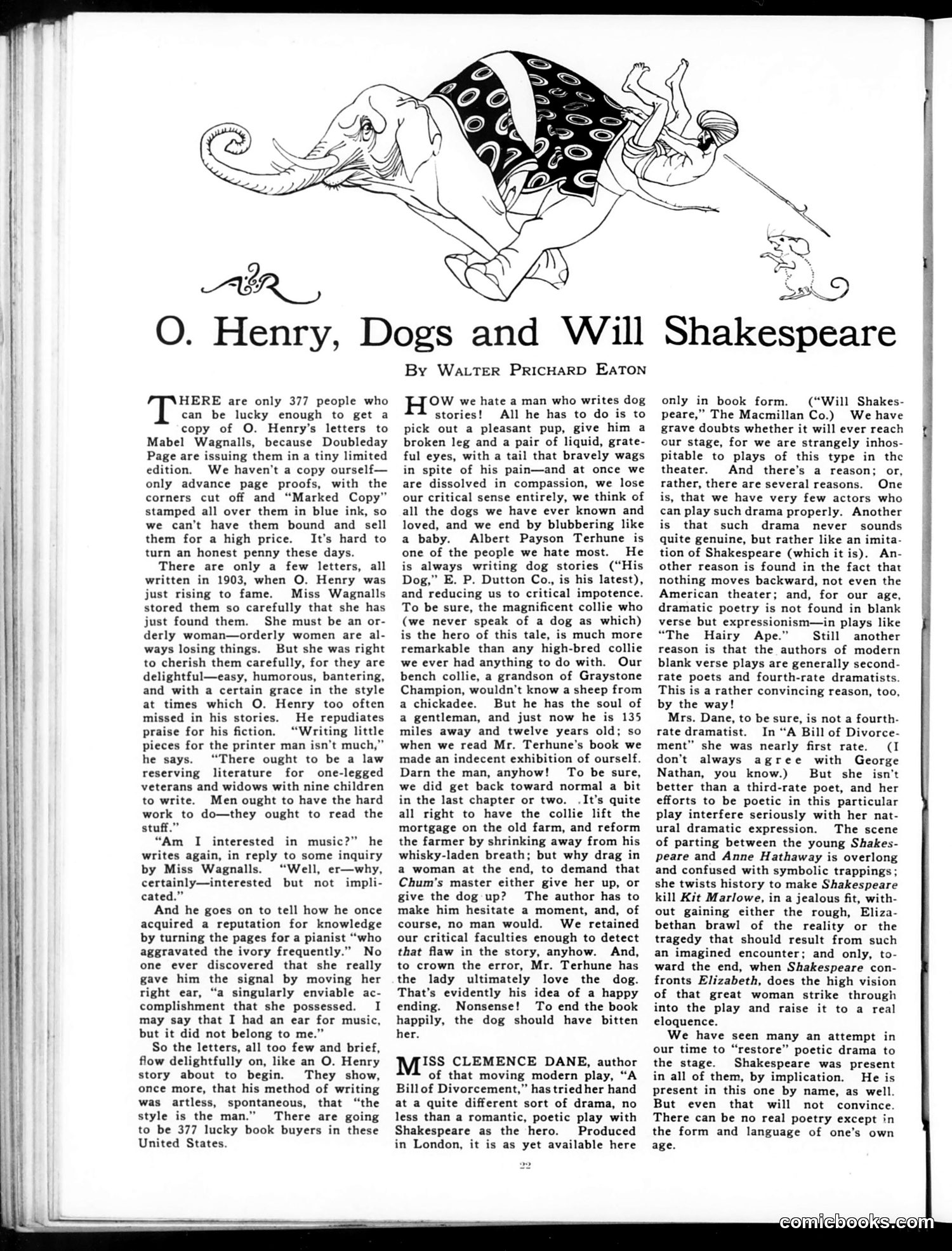
This page reviews three literary topics. The main illustration shows an elephant carrying a parasol and a small figure, likely referencing a humorous or whimsical story context. The text discusses O. Henry's recently discovered letters (377 limited copies), praising their charm and self-deprecating humor about his own writing. It then critiques author Albert Payson Terhune's dog stories, admitting the reviewer is manipulated by sentimental tales of noble collies with injured legs and "grateful eyes." The satire targets readers' predictable emotional responses to animal fiction—they lose critical judgment and "blubber like a baby." The reviewer complains that Terhune's latest book nearly had them crying, though they object to a romantic subplot involving a woman character. The piece mocks both sentimentalist literature and readers' susceptibility to it.
📄 Transcribed text from this page (OCR, searchable)
Machine-transcribed from the original scan — historical spelling and the odd misread are preserved.
O. Henry, Dogs and Will Shakespeare By Wa TER PRICHARD EATON HERE are only 377 people who can be lucky enough to get a copy of O. Henry’s letters to Mabel Wagnalls, because Doubleday Page are issuing them in a tiny limited edition. We haven't a copy ourself— only advance page proofs, with the corners cut off and “Marked Copy” stamped all over them in blue ink, so we can’t have them bound and sell them for a high price. It’s hard to turn an honest penny these days. There are only a few letters, all written in 1903, when O. Henry was just rising to fame. Miss Wagnalls stored them so carefully that she has just found them. She must be an or- derly woman—orderly women are al- ways losing things. But she was right to cherish them carefully, for they are delightful—easy, humorous, bantering, and with a certain grace in the style at times which O. Henry too often missed in his stories. He repudiates praise for his fiction. “Writing little pieces for the printer man isn’t much,” he says. “There ought to be a law reserving literature for one-legged veterans and widows with nine children to write. Men ought to have the hard work to do—they ought to read the stuff.” “Am I interested in music?” he writes again, in reply to some inquiry by Miss Wagnalls. “Well, er—why, certainly—interested but not impli- cated.” And he goes on to tell how he once acquired a reputation for knowledge by turning the pages for a pianist “who aggravated the ivory frequently.” No one ever discovered that she really gave him the signal by moving her right ear, “a singularly enviable ac- complishment that she possessed. I may say that I had an ear for music, but it did not belong to me.” So the letters, all too few and brief, flow delightfully on, like an O. Henry story about to begin. They show, once more, that his method of writi: was artless, spontaneous, that style is the man.” There are going to be 377 lucky book buyers in these United States. OW we hate a man who writes dog stories! All he has to do is to pick out a pleasant pup, give him a broken leg and a pair of liquid, grate- ful eyes, with a tail that bravely wags in spite of his pain—and at once we are dissolved in compassion, we lose our critical sense entirely, we think of all the dogs we have ever known and loved, and we end by blubbering like a baby. Albert Payson Terhune is one of the people we hate most. He is always writing dog stories (“His Dog,” E. P. Dutton Co., is his latest), and reducing us to critical impotence. To be sure, the magnificent collie who (we never speak of a dog as which) is the hero of this tale, is much more remarkable than any high-bred collie we ever had anything to do with. Our bench collie, a grandson of Graystone Champion, wouldn't know a sheep from a chickadee. But he has the soul of a gentleman, and just now he is 135 miles away and twelve years old; so when we read Mr. Terhune’s book we made an indecent exhibition of ourself. Darn the man, anyhow! To be sure, we did get back toward normal a bit in the last chapter or two. .It’s quite all right to have the collie lift the mortgage on the old farm, and reform the farmer by shrinking away from his whisky-laden breath; but why drag in a woman at the end, to demand that Chum's master either give her up, or give the dog up? The author has to make him hesitate a moment, and, of course, no man would. We retained our critical faculties enough to detect that flaw in the story, anyhow. And, to crown the error, Mr. Terhune has the lady ultimately love the dog. That's evidently his idea of a happy ending. Nonsense! To end the book happily, the dog should have bitten her. ISS CLEMENCE DANE, author of that moving modern play, “A Billof Divorcement,” has triedher hand at a quite different sort of drama, no less than a romantic, poetic play with Shakespeare as the hero. Produced in London, it is as yet available here only in book form. (“Will Shakes- peare,” The Macmillan Co.) We have grave doubts whether it will ever reach our stage, for we are strangely inhos- pitable to plays of this type in the theater. And there’s a reason; or, rather, there are several reasons. One is, that we have very few actors who can play such drama properly. Another is that such drama never sounds quite genuine, but rather like an imita- tion of Shakespeare (which it is). An- other reason is found in the fact that nothing moves backward, not even the American theater; and, for our age, dramatic poetry is not found in blank verse but expressionism—in plays like “The Hairy Ape.” Still another reason is that the authors of modern blank verse plays are generally second- rate poets and fourth-rate dramatists. This is a rather convincing reason, too, by the way! Mrs. Dane, to be sure, is not a fourth- rate dramatist. In “A Bill of Divorce- ment” she was nearly first rate. (I don’t always agree with George Nathan, you know.) But she isn’t better than a third-rate poet, and her efforts to be poetic in this particular play interfere seriously with her nat- ural dramatic expression. The scene of parting between the young Shakes- peare and Anne Hathaway is overlong and confused with symbolic trappings; she twists history to make Shakespeare kill Kit Marlowe, in a jealous fit, with- out gaining either the rough, Eliza- bethan brawl of the reality or the tragedy that should result from such an imagined encounter; and only, to- ward the end, when Shakespeare con- fronts Elizabeth, does the high vision of that great woman strike through into the play and raise it to a real eloquence. We have seen many an attempt in our time to “restore” poetic drama to the stage. Shakespeare was present in all of them, by implication. He is present in this one by name, as well. But even that will not convince. There can be no real poetry except in the form and language of one’s own age.