
Judge, 1922-05-13 · page 22 of 36
Judge — May 13, 1922 — page 22: what you’re looking at
What you’re looking at
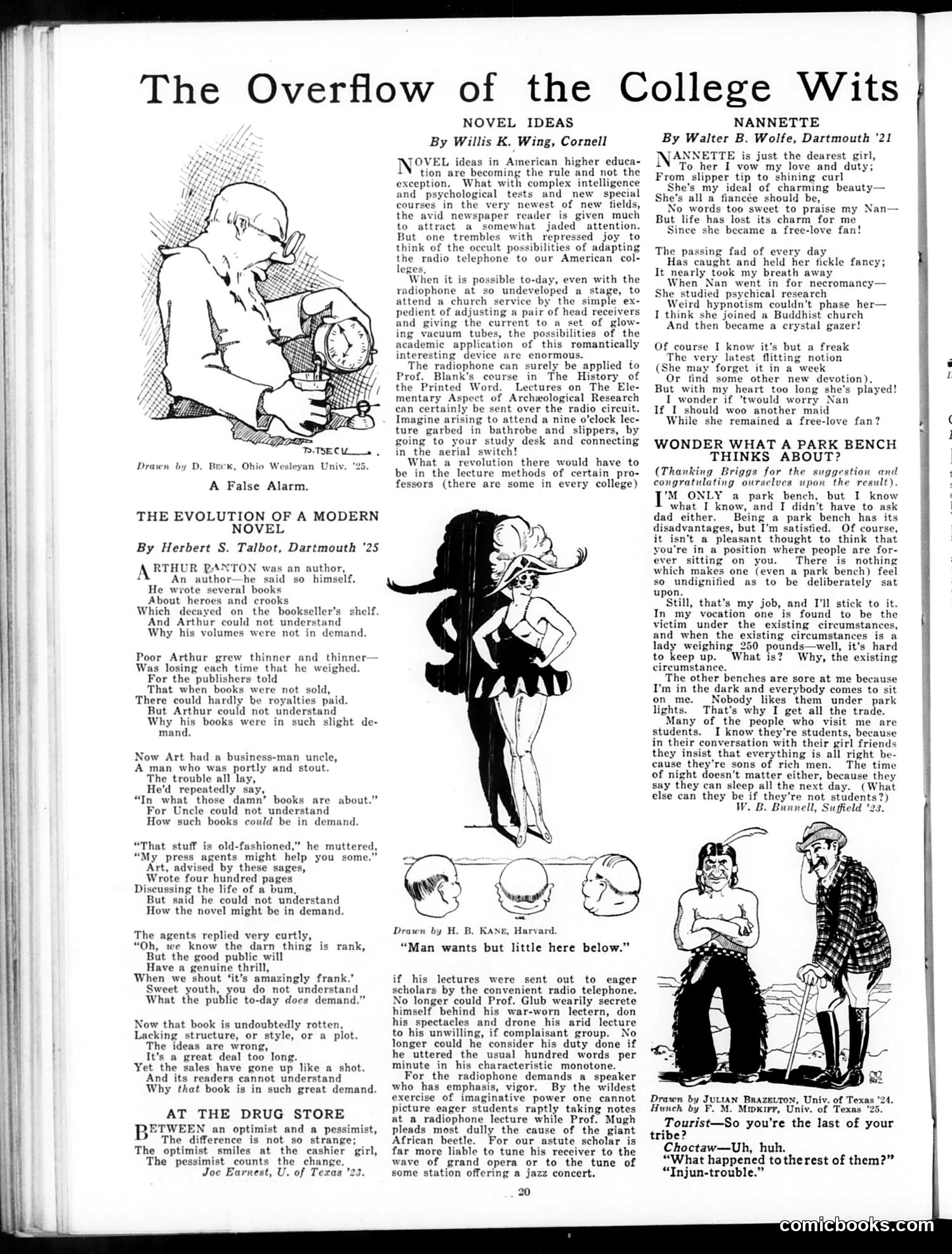
This Judge magazine page satirizes 1920s college culture through multiple pieces: **"A False Alarm"** (cartoon): Shows a student startled by a ringing telephone—a visual gag on the novelty and surprise of emerging telephone technology in dormitory life. **"The Evolution of a Modern Novel"**: Verse satire mocking how publishers and "press agents" push commercial trash over literary merit. Arthur Ranton writes a "rotten" book about "the life of a bum" lacking "structure, style, or a plot," yet it sells wildly because it's marketed as "amazingly frank." The joke: modern readers demand sensationalism, not quality—and don't understand why. **"Novel Ideas"**: Proposes applying radio technology to college lectures, sarcastically imagining students attending class in bathrobes via radio-telephone. The satire targets both academic pretension and professors' monotonous, uninspiring lectures—implying that even technological innovation can't fix dull teaching. Both pieces lampoon the gap between intellectual standards and popular demand, mocking both lowbrow commercialism and academic stuffiness.
📄 Transcribed text from this page (OCR, searchable)
Machine-transcribed from the original scan — historical spelling and the odd misread are preserved.
The Overflow of the College Wits Drawn by D. Beck, Ohio Wesleyan Univ. A False Alarm. THE EVOLUTION OF A MODERN NOVEL By Herbert S. Talbot, Dartmouth '25 ARTHUR RANTON was an author, a An author—he said so himself. He wrote several books About heroes and crooks Which decayed on the bookseller’s And Arthur could not understand Why his volumes were not in demand. shelf. Poor Arthur grew thinner and thinner— Was losing each time that he weighed. For the publishers told That when books were not sold, There could hardly be royalties paid. But Arthur could not understand Why his books were in such slight de- mand. Now Art had a business-man uncle, A man who was port ly and stout. The trouble all | He'd repeatedly “In what those damn’ books are For Uncle could not understand How such books could be in demand. about.” “That stuff is old-fashioned,” he muttere¢ “My press agents might help you som: Art, advised by these sages, Wrote four hundred pages Discussing the life of a bum. But said he could not understand How the novel might be in demand. The agents replied very curtly, “Oh, we know the darn thing is But the good public will Have a genuine thrill, When we shout ‘it’s amazingly frank.’ Sweet youth, you do not understand What the public to-day docs demand.” rank, Now that book is undoubtedly rotten, Lacking structure, or style, or a plot. The ideas are wrong, It’s a great deal too long. Yet the sales have gone up like a shot. And its readers cannot understand Why that book is in such great demand. AT THE DRUG STORE BETWEEN an optimist and a pessimist, 2 The difference is not so strange; The optimist smiles at the cashier girl, The pessimist counts the change. Joe Earnest, U. of Texas NOVEL IDEAS By Willis K. Wing, Cornell NOVEL ideas in American higher educa- tion are becoming the rule and not the What with complex intelligence tests and new special newest of new fields, the avid newspaper reader is given much to attract a somewhat jaded attention. But one trembles with repressed joy to think of the occult possibilities of adapting the radio telephone to our American col- leges, When it is po exception. and psychological courses in the very ible to-day, even with the radiophone at undeveloped a stage, to attend a church service by the simple ex- pedient of adjusting a pair of head receivers and giving the current to a set of glow- ing vacuum tubes, the possibilities of the academic application of this romantically interesting device are enormous. The radiophone can surely be applied to Prof. Blank’s course in The History of the Printed Word, Lectures on The Ele- mentary Aspect of Archeological Research can certainly be sent over the radio circuit. Imagine arising to attend a nine o'clock lec- ture garbed in bathrobe and slippers, by going to your study, desk and connecting What a be in the lecture methods of certain pro- fessors (there are some in every college) Drawn by H. B. KANe, Harvard. “Man wants but little here below.” if his lectures were sent out to eager scholars by the convenient radio telephone. No longer could Prof. Glub wearily secrete himself behind his war-worn lectern, don his spectacles and drone his arid lecture to his unwilling, if complaisant group. No longer could he consider his duty done if he uttered the usual hundred words per minute in his characteristic monotone. For the radiophone demands a speaker who has emphasis, vigor. By the wildest exercise of imaginative power one cannot picture eager students raptly taking notes at a radiophone lecture while Prof. Mugh pleads most dully the cause of the giant African beetle. For our astute scholar is far more liable to tune his receiver to the wave of grand opera or to the tune of some station offering a jazz concert. 20 NANNETTE By Walter B. Wolfe, Dartmouth '21 NANNETTE is just the dearest, girl, To her I vow my love and duty; From slipper tip to shining curl She's my ideal of charming beauty— She's all a fiancée should be, No words too sweet to praise my But life has lost its charm for me Since she became a free-love fan! The passing fad of every day Has caught and held her fickle fancy; It nearly took my breath away When Nan went in for necromancy— She studied psychical research Weird hypnotism couldn't phase her— I think she joined a Buddhist church And then ‘became a crystal gazer! Of course I know it's but a freak The very latest flitting notion (She may forget it in a week Or find some other new devotion). But with my heart too long she’s played! I wonder if "twould worry Nan If I should woo another maid While she remained a free-love fan? WONDER WHAT A PARK BENCH THINKS ABOUT? (Thanking Briggs for the suggestion and congratulating ourselves upon the result). ONLY a park bench, but I know what I know, and I didn’t have to ask dad either. Being a park bench has its disadvantages, but I'm satisfied. Of course, it isn’t_a pleasant thought to think that you're in a position where people are for- ever sitting on you. There is nothing which makes one (even a park bench) feel so undignified as to be deliberately sat upon. Still, that’s my job, and I'll stick to it. In my vocation one is found to be the victim under the existing circumstances, and when the existing circumstances is a lady weighing 250 pounds—well, it’s hard to keep up. What is? Why, the existing circumstance. The other benches are sore at me because I’m in the dark and everybody comes to on me. Nobody likes them under pa lights. That's why I get all the trade. Many of the people who visit me are students. I know they're students, because in their conversation with their girl friends they insist that everything is all right be- cause they’re sons of rich men. The time of night doesn’t matter either, because they say they can sleep all the next day. (What else can they be if they’re not students?) . B. Bunnell, Suffield '23. Drawn by JULIAN BRAZELTON, Univ. of Texas '24. Hunch by F. M. Mivxtrr, Univ. of Texas '25. Tourist—So you're the last of your tribe? Choctaw—Uh, huh. “What happened totherest of them?” “Injun-trouble.”