
Judge, 1922-05-13 · page 21 of 36
Judge — May 13, 1922 — page 21: what you’re looking at
What you’re looking at
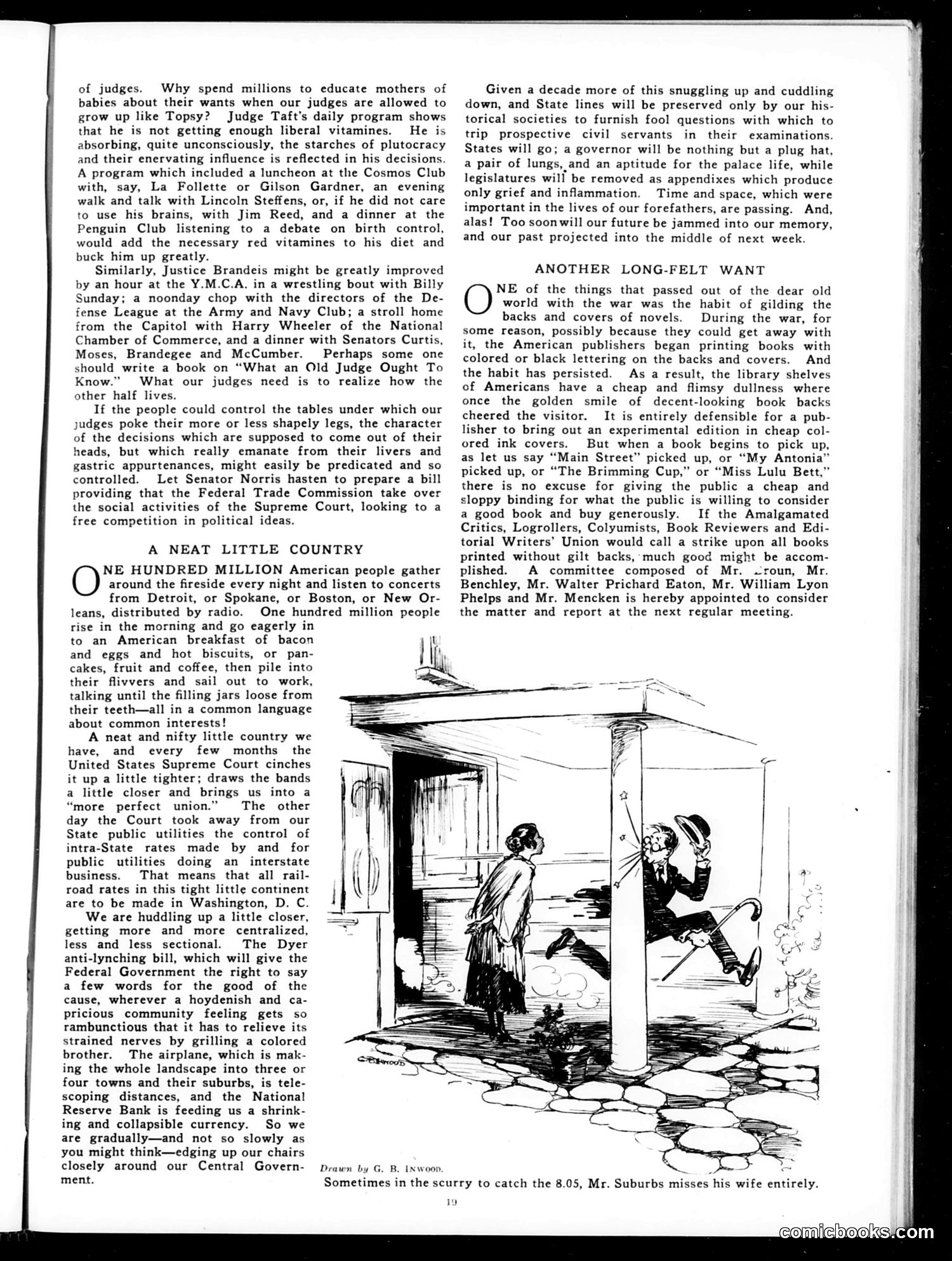
This page contains two satirical pieces critiquing American institutions circa 1920s. ## Top Section: Judges and Supreme Court The first article mocks Supreme Court justices (particularly Judge Taft, the Chief Justice) for being out of touch with ordinary Americans. The satire argues judges' decisions reflect their privileged social circles—fancy club lunches and dinners with wealthy businessmen—rather than understanding how "the other half lives." It sarcastically suggests the Federal Trade Commission should oversee judges' social activities to ensure they gain diverse perspectives. ## Bottom Section: Centralization of Power The second article satirizes increasing federal centralization. It celebrates America's unity (radio, highways, common language) while ironically warning that the Supreme Court and federal agencies are eroding state autonomy. The Dyer anti-lynching bill and the airplane are presented as examples of how Washington D.C. gains power over local communities. The small cartoon depicts a suburban commuter missing his train, captioned "Sometimes in the scurry to catch the 8:05, Mr. Suburbs misses his wife entirely"—satirizing modern commuter culture.
📄 Transcribed text from this page (OCR, searchable)
Machine-transcribed from the original scan — historical spelling and the odd misread are preserved.
of judges. Why spend millions to educate mothers of babies about their wants when our judges are allowed to grow up like Topsy? Judge Taft's daily program shows that he is not getting enough liberal vitamines. He is absorbing, quite unconsciously, the starches of plutocracy and their enervating influence is reflected in his decisions. A program which included a luncheon at the Cosmos Club with, say, La Follette or Gilson Gardner, an evening walk and talk with Lincoln Steffens, or, if he did not care to use his brains, with Jim Reed, and a dinner at the Penguin Club listening to a debate on birth control, would add the necessary red vitamines to his diet and buck him up greatly. Similarly, Justice Brandeis might be greatly improved by an hour at the Y.M.C.A. in a wrestling bout with Billy Sunday; a noonday chop with the directors of the De- fense League at the Army and Navy Club; a stroll home from the Capitol with Harry Wheeler of the National Chamber of Commerce, and a dinner with Senators Curtis, Moses, Brandegee and McCumber. Perhaps some one should write a book on “What an Old Judge Ought To Know.” What our judges need is to realize how the other half lives. If the people could control the tables under which our judges poke their more or less shapely legs, the character of the decisions which are supposed to come out of their heads, but which really emanate from their livers and gastric appurtenances, might easily be predicated and so controlled. Let Senator Norris hasten to prepare a bill providing that the Federal Trade Commission take over the social activities of the Supreme Court, looking to a free competition in political ideas. A NEAT LITTLE COUNTRY NE HUNDRED MILLION American people gather O around the fireside every night and listen to concerts from Detroit, or Spokane, or Boston, or New Or- leans, distributed by radio. One hundred million people rise in the morning and go eagerly in to an American breakfast of bacon and eggs and hot biscuits, or pan- cakes, fruit and coffee, then pile into their flivvers and sail out to work, talking until the filling jars loose from their teeth—all in a common language about common interests! A neat and nifty little country we have, and every few months the United States Supreme Court cinches it up a little tighter; draws the bands a little closer and brings us into a “more perfect union.” The other day the Court took away from our State public utilities the control of intra-State rates made by and for public utilities doing an interstate business. That means that all rail- road rates in this tight little continent are to be made in Washington, D. C. We are huddling up a little closer, getting more and more centralized, less and less sectional. The Dyer anti-lynching bill, which will give the Federal Government the right to say a few words for the good of the cause, wherever a hoydenish and ca- pricious community feeling gets so rambunctious that it has to relieve its strained nerves by grilling a colored brother. The airplane, which is mak- ing the whole landscape into three or four towns and their suburbs, is tele- scoping distances, and the National Reserve Bank is feeding us a shrink- ing and collapsible currency. So we are gradually—and not so slowly as you might think—edging up our chairs closely around our Central Govern- prawn by G. B. iNwoon. ment. Given a decade more of this snuggling up and cuddling down, and State lines will be preserved only by our his- torical societies to furnish fool questions with which to trip prospective civil servants in their examinations. States will go; a governor will be nothing but a plug hat, a pair of lungs, and an aptitude for the palace life, while legislatures will be removed as appendixes which produce only grief and inflammation. Time and space, which were important in the lives of our forefathers, are passing. And, alas! Too soonwill our future be jammed into our memory, and our past projected into the middle of next week. O world with the war was the habit of gilding the backs and covers of novels. During the war, for some reason, possibly because they could get away with it, the American publishers began printing books with colored or black lettering on the backs and covers. And the habit has persisted. As a result, the library shelves of Americans have a cheap and flimsy dullness where once the golden smile of decent-looking book backs cheered the visitor. It is entirely defensible for a pub- lisher to bring out an experimental edition in cheap col- ored ink covers. But when a book begins to pick up, as let us say “Main Street” picked up, or “My Antonia” picked up, or “The Brimming Cup,” or “Miss Lulu Bett,” there is no excuse for giving the public a cheap and sloppy binding for what the public is willing to consider a good book and buy generously. If the Amalgamated Critics, Logrollers, Colyumists, Book Reviewers and Edi- torial Writers’ Union would call a strike upon all books printed without gilt backs, much good might be accom- plished. A committee composed of Mr. ~roun, Mr. Benchley, Mr. Walter Prichard Eaton, Mr. William Lyon Phelps and Mr. Mencken is hereby appointed to consider the matter and report at the next regular meeting. ANOTHER LONG-FELT WANT NE of the things that passed out of the dear old Sometimes in the scurry to catch the 8.05, Mr. Suburbs misses his wife entirely. 19