
Judge, 1914-12-26 · page 8 of 25
Judge — December 26, 1914 — page 8: what you’re looking at
What you’re looking at
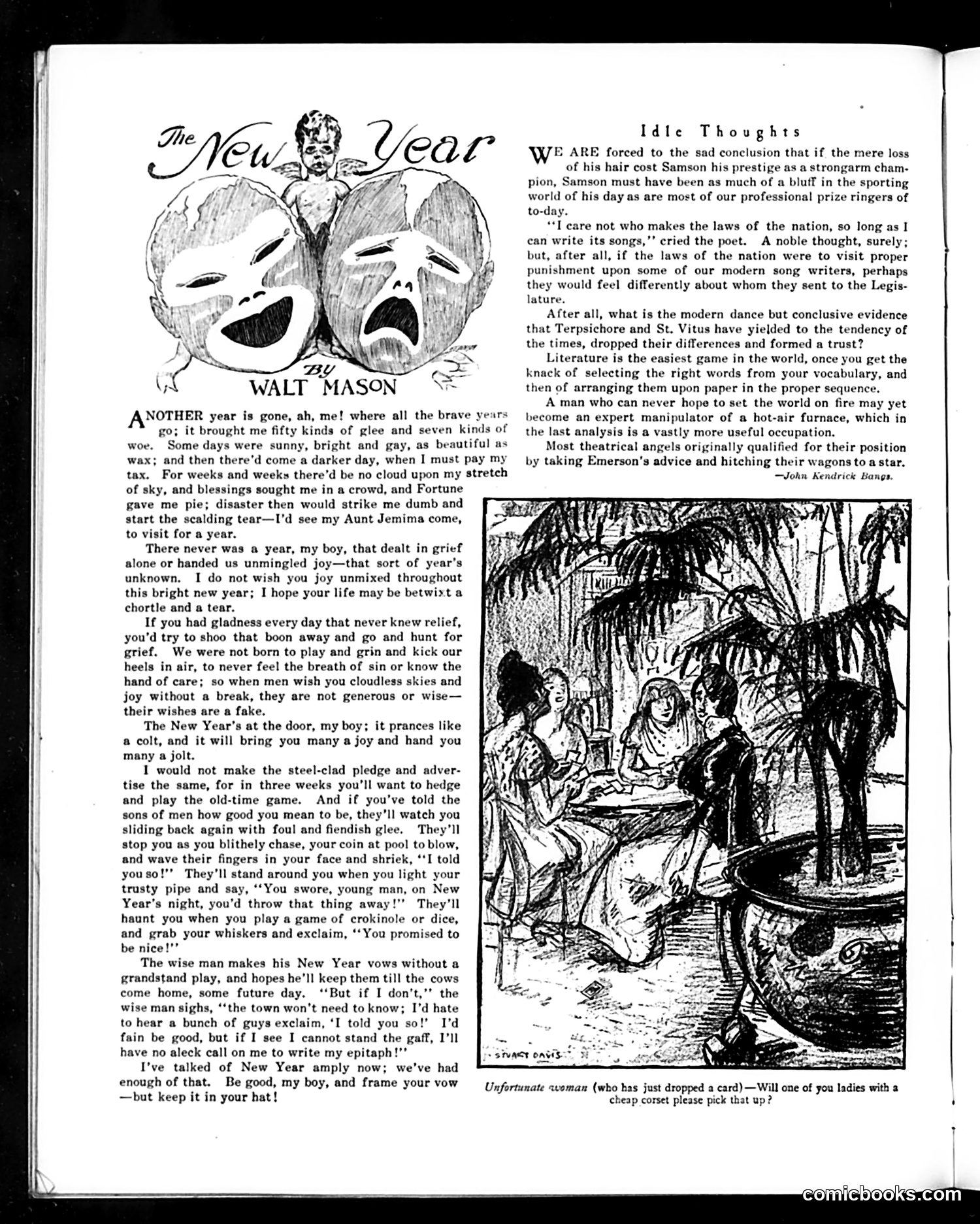
This page features Mason's sentimental New Year's essay paired with satirical "Idle Thoughts." **Main Content**: Mason's poem counsels against grand New Year's resolutions, arguing that life requires both joy and sorrow. He warns against public pledges—others will gleefully mock you when you inevitably break them ("I told you so!"). The wise approach: make private vows quietly, without fanfare. **The Illustration**: Shows people socializing indoors during winter, likely a New Year's gathering. **"Idle Thoughts"**: Sharp satirical jabs at contemporary culture—Samson's hair loss as a sporting fraud, modern songwriters deserving legal punishment, modern dance as chaotic, and theatrical investors as incompetent. These mock current entertainment and social trends with acerbic wit typical of Judge magazine's cynical humor.
📄 Transcribed text from this page (OCR, searchable)
Machine-transcribed from the original scan — historical spelling and the odd misread are preserved.
ANOTHER year is gone, ah, me! where all the brave years go; it brought me fifty kinds of glee and seven kinds of woe. Some days were sunny, bright and gay, as beautiful as wax; and then there'd come a darker day, when I must pay my tax. For weeks and weeks there'd be no cloud upon my stretch of sky, and blessings sought me in a crowd, and Fortune gave me pie; disaster then would strike me dumb and start the scalding tear—I'd see my Aunt Jemima come, to visit for a year. There never was a year, my boy, that dealt in grief alone or handed us unmingled joy—that sort of year’s unknown. I do not wish you joy unmixed throughout this bright new year; I hope your life may be betwixt a chortle and a tear. If you had gladness every day that never knew relief, you'd try to shoo that boon away and go and hunt for grief. We were not born to play and grin and kick our heels in air, to never feel the breath of sin or know the hand of care; so when men wish you cloudless skies and joy without a break, they are not generous or wise— their wishes are a fake. The New Year's at the door, my bo: it prances like a colt, and it will bring you many a joy and hand you many a jolt. I would not make the steel-clad pledge and adver- tise the same, for in three weeks you'll want to hedge and play the old-time game. And if you've told the sons of men how good you mean to be, they'll watch you sliding back again with foul and fiendish glee. They'll stop you as you blithely chase, your coin at pool to blow, and wave their fingers in your face and shriek, ‘I told youso!’’ They'll stand around you when you light your trusty pipe and say, ‘‘You swore, young man, on New Year's night, you'd throw that thing away They'll haunt you when you play a game of crokinole or dice, and grab your whiskers and exclaim, ‘‘You promised to be nice!'’ The wise man makes his New Year vows without a grandstand play, and hopes he'll keep them till the cows come home, some future day. ‘‘But if I don’t,’’ the wise man sighs, ‘‘the town won't need to know; I'd hate to hear a bunch of guys exclaim, ‘I told you so!’ I'd fain be good, but if I see I cannot stand the gaff, I'll have no aleck call on me to write my epitaph!"’ I've talked of New Year amply now; we’ve had enough of that. Be good, my boy, and frame your vow —but keep it in your hat! Idle Thoughts WE ARE forced to the sad conclusion that if the mere loss of his hair cost Samson his prestige as a strongarm cham- pion, Samson must have been as much of a bluff in the sporting world of his day as are most of our professional prize ringers of to-day. “*I care not who makes the laws of the nation, so long as I can write its songs,’’ cried the poet. A noble thought, surely; but, after all, if the laws of the nation were to visit proper punishment upon some of our modern song writers, perhaps they would feel differently about whom they sent to the Legis- lature. After all, what is the modern dance but conclusive evidence that Terpsichore and St. Vitus have yielded to the tendency of the times, dropped their differences and formed a trust? Literature is the easiest game in the world, once you get the knack of selecting the right words from your vocabulary, and then of arranging them upon paper in the proper sequence. A man who can never hope to set the world on fire may yet become an expert manipulator of a hot-air furnace, which in the last analysis is a vastly more useful occupation. Most theatrical angels originally qualified for their position by taking Emerson's advice and hitching their wagons to a star. —John Kendrick Bangs. Unfortunate woman (who has just dropped a card) —Will one of you ladies with a cheap corset please pick that up? comicbooks.com