
Judge, 1912-03-02 · page 6 of 24
Judge — March 2, 1912 — page 6: what you’re looking at
What you’re looking at
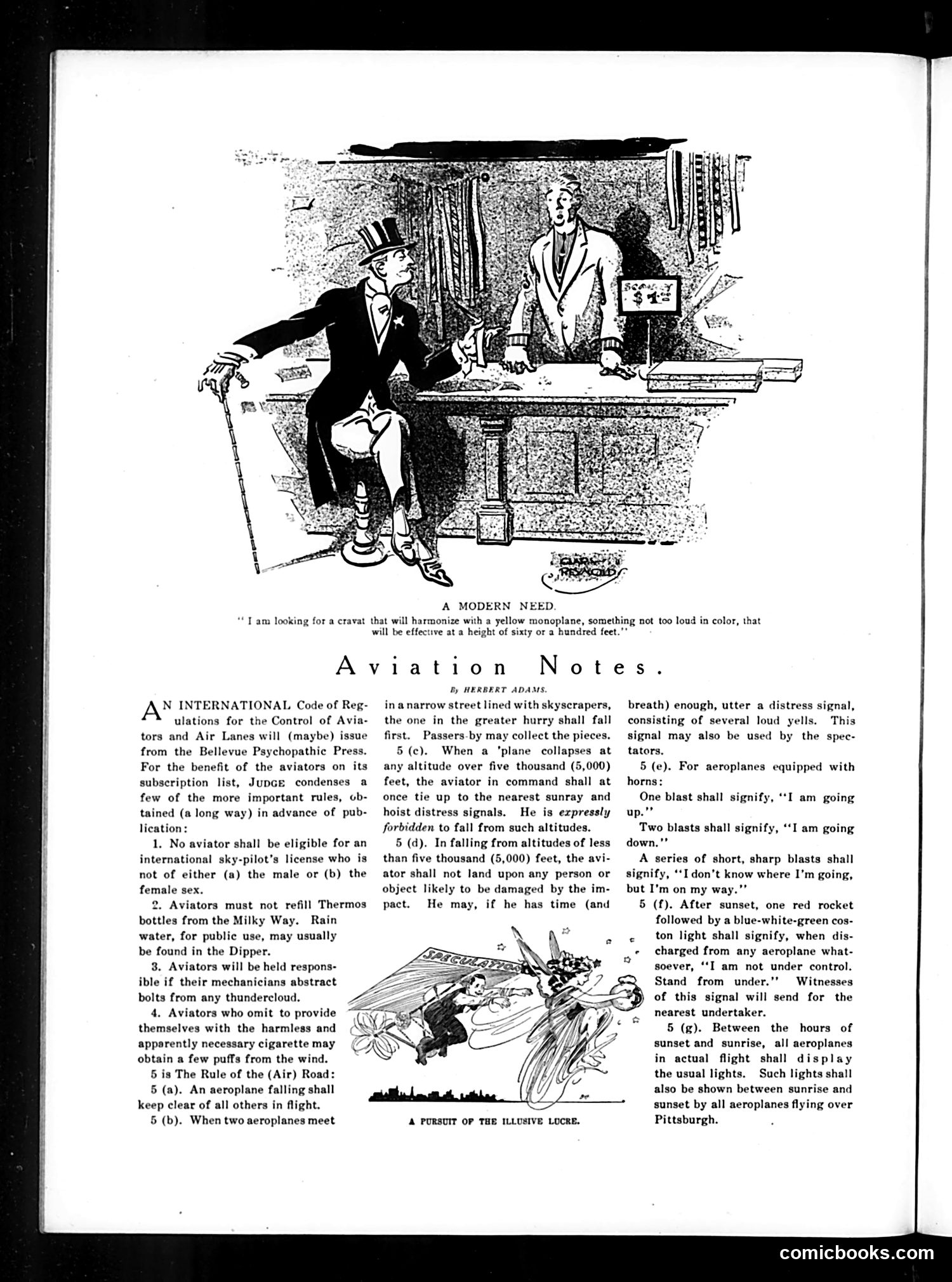
This page satirizes the then-nascent aviation industry's lack of regulation. The top cartoon shows a gentleman asking a haberdasher for a necktie matching his "yellow monoplane"—mocking how aviation had become a fashionable pursuit for wealthy dandies rather than serious aviators. The main text, presented as mock "international regulations," ridicules aviation's chaotic state through absurdist humor. Rules like "An aeroplane falling shall keep clear of all others in flight" and pilots not landing on people they'd "damage by the impact" joke about near-collisions and crashes. The regulation about Pittsburgh suggests that city was particularly polluted or hazardous to flight. Herbert Adams uses exaggeration to highlight genuine safety concerns: the lack of actual air traffic control, standardized signals, and pilot licensing. The humor underscores how dangerously unregulated early aviation was, with wealthy amateurs operating aircraft without formal rules or oversight.
📄 Transcribed text from this page (OCR, searchable)
Machine-transcribed from the original scan — historical spelling and the odd misread are preserved.
a (a aPT Eady t A MODERN NEED. “* Tam looking for a cravat that will harmonize with a yellow monoplane, something not too loud in color, that Aviation By HERBERT ADAMS. AN INTERNATIONAL Code of Reg- ulations for the Control of Avia- tors and Air Lanes will (maybe) issue from the Bellevue Psychopathic Press. For the benefit of the aviators on its subscription list, JupGe condenses a few of the more important rules, ob- tained (a long way) in advance of pub- lication: 1. No aviator shall be eligible for an international sky-pilot’s license who is not of either (a) the male or (b) the female sex. 2. Aviators must not refill Thermos bottles from the Milky Way. Rain water, for public use, may usually be found in the Dipper. 3. Aviators will be held respons- ible if their mechanicians abstract bolts from any thundercloud. 4. Aviators who omit to provide themselves with the harmless and apparently necessary cigarette may obtain a few puffs from the wind. 5 is The Rule of the (Air) Road: 5 (a). An aeroplane falling shall keep clear of all others in flight. 5 (b). When two aeroplanes meet will be effective at a height of sixty or a hundred feet.'' in a narrow street lined with skyscrapers, the one in the greater hurry shall fall first. Passers-by may collect the pieces. 5 (c). When a ‘plane collapses at any altitude over five thousand (5,000) feet, the aviator in command shall at once tie up to the nearest sunray and hoist distress signals. He is expressly forbidden to fall from such altitudes. 5 (d). In falling from altitudes of less than five thousand (5,000) feet, the avi- ator shall not land upon any person or object likely to be damaged by the im- pact. He may, if he has time (and A PURSUIT OP THE ILLUSIVE LUCRE. Notes. breath) enough, utter a distress signal, consisting of several loud yells. This signal may also be used by the spec- tators. 5 (e). For aeroplanes equipped with horns: One blast shall signify, ‘I am going up.’” Two blasts shall signify, ‘I am going down,"” A series of short, sharp blasts shall signify, ‘‘I don’t know where I’m going, but I’m on my way.’”” 5 (f). After sunset, one red rocket followed by a blue-white-green cos- ton light shall signify, when dis- charged from any aeroplane what- soever, ‘‘I am not under control. Stand from under.’’ Witnesses of this signal will send for the nearest undertaker. 5 (g). Between the hours of sunset and sunrise, all aeroplanes in actual flight shall display the usual lights. Such lights shall also be shown between sunrise and sunset by all aeroplanes flying over Pittsburgh. comicbooks.com